
Research · Minerals · Updated
Is Magnesium Oxide Really Only 4% Absorbed? What the Studies Actually Measured
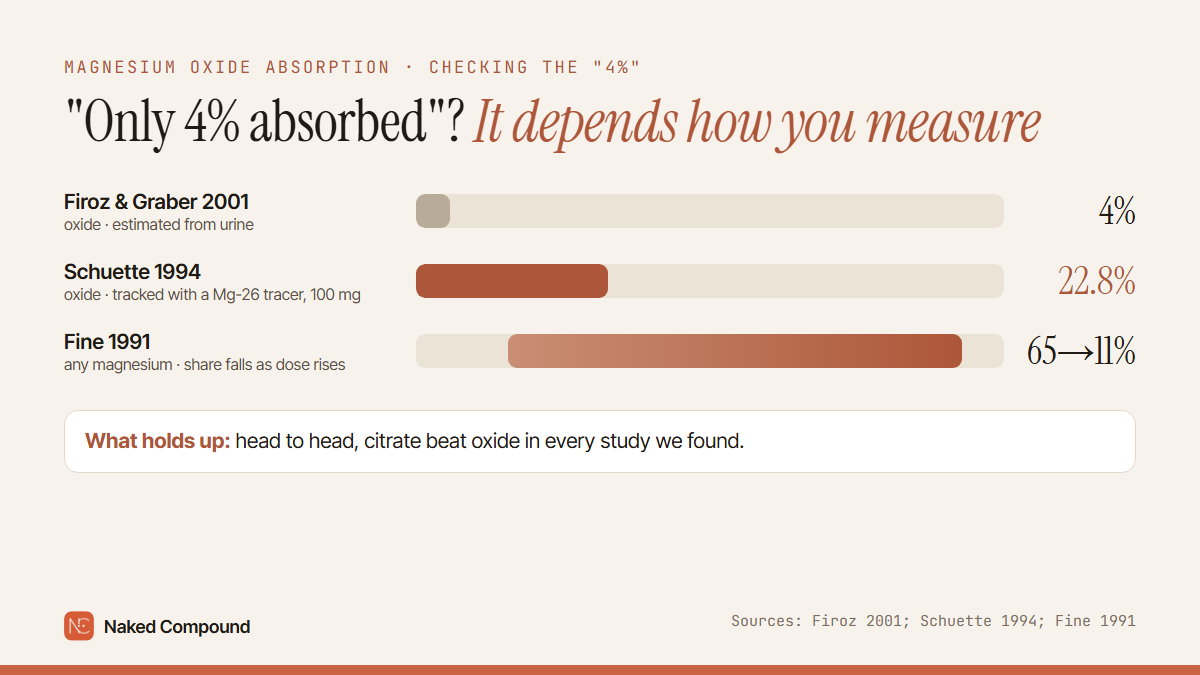
You've probably seen it on supplement pages and in Instagram reels: "your body absorbs only 4% of magnesium oxide." It's quoted like a law of nature. It isn't. The 4% comes from a single 2001 study that estimated absorption indirectly, from how much extra magnesium showed up in volunteers' urine. A study that tracked labelled magnesium directly found about 23% absorbed from oxide, and the share absorbed from any form of magnesium falls as the dose rises. What does hold up is the comparison: in every head-to-head study we found, oxide did worse than citrate. So oxide really is the weaker choice for raising your magnesium, just not by a fixed "4%".
This page looks at the evidence behind the 4% figure. Oxide's drawbacks and safety are covered in the main disadvantage of magnesium oxide; the forms side by side are in magnesium glycinate vs citrate vs oxide.
The short answer
- Not really. "4%" is one estimate from one 2001 study, worked out from urine, not measured directly.
- A direct measurement found more: about 23% of a 100 mg dose of oxide, using a magnesium tracer.
- There's no single number: the share absorbed from any magnesium falls as the dose rises, from 65% to 11% in one study.
- The comparison stands: head to head, citrate raised blood and urine magnesium more than oxide in every study we found.
- What to do: to raise low magnesium, pick citrate or glycinate; for constipation, oxide's poor absorption is the point.
Where does the "4% absorbed" figure come from?
It comes from a 2001 US study by Firoz and Graber that compared four magnesium products. Healthy volunteers took about 21 mEq of magnesium a day (roughly 255 mg) from each product, and the researchers measured how much the magnesium in their urine went up. From that rise they estimated a fractional absorption of 4% for magnesium oxide, with significantly more from magnesium chloride, lactate and aspartate. [1]
Three details rarely make it into the pages that quote it: it's one study, the absorption was estimated from urine rather than measured directly, and the volunteers were healthy people, not patients known to be low in magnesium. Each of those can affect the number.
Why can urine tests understate absorption?
Urine only shows the magnesium your body didn't keep. When you absorb magnesium, some of it goes into your blood, cells and bones, and the kidneys pass out the rest. A rise in urine magnesium tells you that absorption happened, but not exactly how much, especially if the body holds on to part of it.
Researchers know this, and some studies try to get around it. A 2019 trial first gave 14 healthy men 400 mg of magnesium a day for five days to top up their stores, so that extra magnesium would show up in urine more completely. It then compared a single 400 mg dose of citrate with oxide: citrate raised 24-hour urine magnesium and blood magnesium significantly; oxide didn't. [2] Urine studies are good for comparing forms against each other. They're weaker for putting an exact percentage on one form.
What happens when absorption is measured directly?
A study that followed labelled magnesium found about 23% absorbed from oxide. In a 1994 crossover trial, 12 patients took a 100 mg dose of magnesium oxide and of magnesium glycinate, each tagged with a stable magnesium isotope (magnesium-26) so the researchers could track exactly how much entered the blood. Absorption averaged 22.8% from oxide and 23.5% from glycinate. [3]
That's nearly six times the famous 4%, with two important caveats. The patients had had part of their small intestine removed (ileal resection), so their absorption isn't typical. And in the four patients who absorbed oxide worst, glycinate did much better: 23.5% against 11.8%. Glycinate was also better tolerated. [3]
Does the dose change how much is absorbed?
Yes, and it changes it a lot. A classic 1991 study measured net magnesium absorption in healthy people eating a standard meal with 0 to 80 mEq of added magnesium acetate (up to about 970 mg). The total amount absorbed rose with each step, but the share absorbed fell, from 65% at the lowest intake to 11% at the highest. [4]
That study used magnesium acetate, not oxide, but the lesson applies to every form: an absorption percentage means little without the dose. A small dose is absorbed far more efficiently than a big one. It's also why splitting a large dose through the day makes sense.
So is magnesium oxide poorly absorbed or not?
Compared with citrate, yes. That part of the claim holds up in every head-to-head study we found:
| Study | How it was measured | What it found for oxide |
|---|---|---|
| Lindberg 1990 [5] | Solubility in simulated stomach acid; urine rise after a dose | Barely soluble in water, 43% at peak acid; urine rise 0.006 vs 0.22 for citrate (mg per mg creatinine) |
| Firoz & Graber 2001 [1] | Urine rise over days, ~255 mg a day | Estimated 4%; chloride, lactate and aspartate significantly higher |
| Walker 2003 [6] | Urine, blood and saliva over 60 days, 300 mg a day | No different from placebo; citrate and an amino-acid chelate absorbed better |
| Werner 2019 [2] | Urine and blood after 400 mg, in topped-up volunteers | No significant rise; citrate raised both |
| Schuette 1994 [3] | Magnesium-26 tracer, 100 mg, ileal-resection patients | 22.8% absorbed, similar to glycinate overall |
The likely reason is solubility. Magnesium has to dissolve before the gut can absorb it, and oxide barely dissolves in water and only partly even in strong acid. [5] People with low stomach acid, including many on acid-reducing medicines, are likely to absorb even less of it. For context, people typically absorb about 30–40% of the magnesium in food. [7]
What does this mean when you choose a supplement?
Stop doing "4% maths", and pick the form for the job.
- Don't multiply your tablet by 4%. A 400 mg oxide tablet holds about 241 mg of magnesium. At 4% that would be 10 mg absorbed; at 23% it would be about 55 mg. The real figure depends on your dose, your gut and your magnesium status, and no label can tell you.
- To raise low magnesium, choose citrate or glycinate. They dissolve and absorb more reliably. Our magnesium comparison lists products whose labels add up.
- For constipation, oxide's poor absorption is useful: what stays in the bowel softens stools. See magnesium oxide tablets for constipation.
- Split big doses, because a smaller dose is absorbed more efficiently. [4]
क्या मैग्नीशियम ऑक्साइड सिर्फ़ 4% अवशोषित होता है? हिंदी में सार
"मैग्नीशियम ऑक्साइड सिर्फ़ 4% अवशोषित होता है" वाली बात 2001 के एक ही अध्ययन से आती है, जिसमें अवशोषण सीधे नहीं मापा गया था, बल्कि पेशाब में बढ़े मैग्नीशियम से अंदाज़ा लगाया गया था। एक दूसरे अध्ययन में, जिसमें मैग्नीशियम को सीधे ट्रैक किया गया, ऑक्साइड का लगभग 23% अवशोषित हुआ। किसी भी मैग्नीशियम में, डोज़ बढ़ने पर अवशोषित होने वाला हिस्सा घटता है। फिर भी हर तुलना वाले अध्ययन में साइट्रेट ने ऑक्साइड से बेहतर नतीजे दिए। इसलिए मैग्नीशियम की कमी पूरी करनी हो तो साइट्रेट या ग्लाइसिनेट चुनें; कब्ज़ के लिए ऑक्साइड ठीक है।
What we did
- Traced the "4%" figure to its source and read the PubMed abstract of every study cited here, checking each number against it
- Searched PubMed for studies measuring magnesium oxide absorption in people, including isotope and urine studies
- Read the top Google results for "magnesium oxide absorption rate" on 19 November 2026 and checked how they quote the figure
- Converted mEq and tablet sizes to milligrams of magnesium in code
What we didn't do
- Run an absorption study or test any product
- Read every paper in full; where we rely on an abstract, we say what it reports
- Give medical advice; if you have a gut or kidney condition, ask your doctor which form suits you
Magnesium oxide absorption: your questions
Is magnesium oxide really only 4% absorbed?
How much magnesium oxide is actually absorbed?
Is 400 mg of magnesium oxide only 16 mg absorbed?
Why is magnesium oxide poorly absorbed?
Which form of magnesium is best absorbed?
Does stomach acid affect magnesium oxide absorption?
Is magnesium oxide useless then?
- Firoz M, Graber M. Bioavailability of US commercial magnesium preparations. Magnes Res. 2001;14(4):257–262. PubMed 11794633
- Werner T, Kolisek M, Vormann J, et al. Assessment of bioavailability of Mg from Mg citrate and Mg oxide by measuring urinary excretion in Mg-saturated subjects. Magnes Res. 2019;32(3):63–71. PubMed 32162607
- Schuette SA, Lashner BA, Janghorbani M. Bioavailability of magnesium diglycinate vs magnesium oxide in patients with ileal resection. JPEN J Parenter Enteral Nutr. 1994;18(5):430–435. doi:10.1177/0148607194018005430
- Fine KD, Santa Ana CA, Porter JL, Fordtran JS. Intestinal absorption of magnesium from food and supplements. J Clin Invest. 1991;88(2):396–402. doi:10.1172/JCI115317
- Lindberg JS, Zobitz MM, Poindexter JR, Pak CY. Magnesium bioavailability from magnesium citrate and magnesium oxide. J Am Coll Nutr. 1990;9(1):48–55. doi:10.1080/07315724.1990.10720349
- Walker AF, Marakis G, Christie S, Byng M. Mg citrate found more bioavailable than other Mg preparations in a randomised, double-blind study. Magnes Res. 2003;16(3):183–191. PubMed 14596323
- National Institutes of Health, Office of Dietary Supplements. Magnesium: fact sheet for health professionals. ods.od.nih.gov