
Guide · Gut health · Updated
Best Magnesium Oxide Tablets in India for Constipation: What to Look For and What to Avoid
If you've read that magnesium oxide helps with constipation and gone looking for it on Amazon.in, you've probably hit a wall of "magnesium glycinate" bottles. You're not imagining it. Plain magnesium oxide tablets are surprisingly hard to find in India, and several "oxide" listings don't add up when you read the label. The good news: magnesium oxide genuinely works for constipation, with placebo-controlled trials behind it. Our pick is Nature Made Magnesium 250 mg, an imported plain-oxide tablet at about ₹10 a day. If you'd rather use what every chemist stocks, milk of magnesia does a similar job.
This page is about choosing magnesium for constipation in India. Why oxide is poorly absorbed is explained in the main disadvantage of magnesium oxide; magnesium for everyday top-ups is in the magnesium comparison.
The short answer
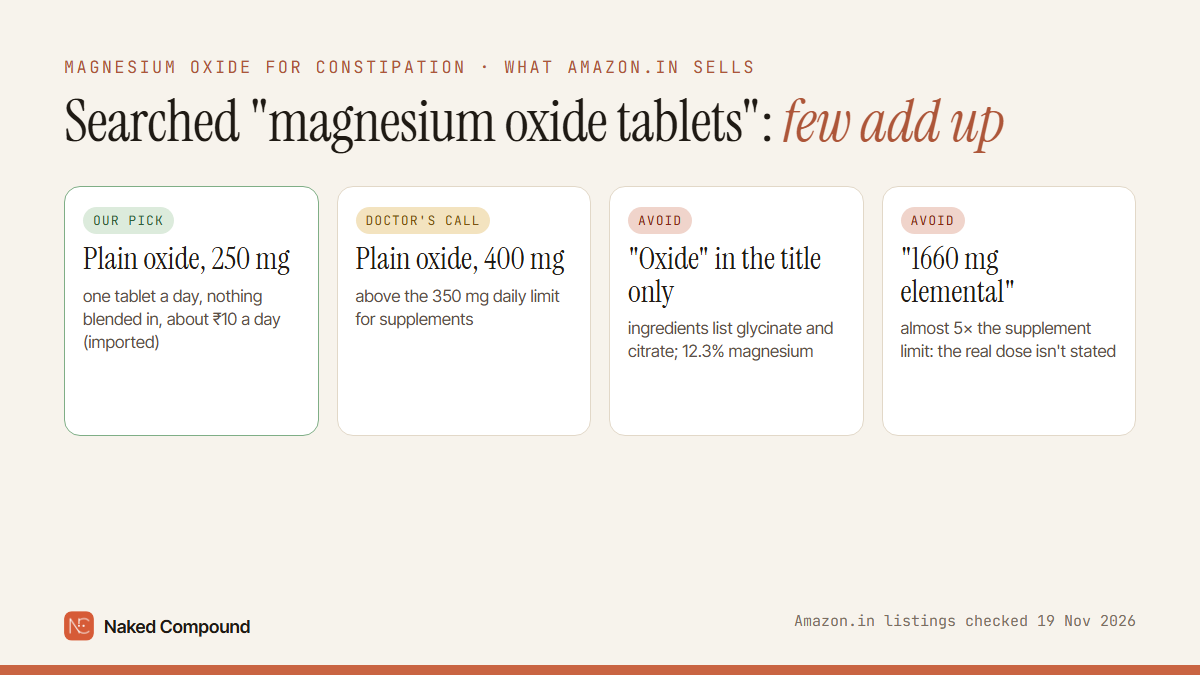
- Best plain magnesium oxide: Nature Made Magnesium 250 mg (imported, 100 tablets, ₹1,030, about ₹10 a tablet).
- Higher dose: Nature Made Magnesium 400 mg softgels, but one softgel is above the 350 mg daily limit for supplements, so use it only on medical advice.
- If oxide doesn't suit you: NOW Magnesium Citrate, which also loosens stools and states its dose clearly.
- The pharmacy option: milk of magnesia (magnesium hydroxide), a medicine sold at every chemist. Follow the pack or your doctor.
- Cheapest isn't best value: the ₹5-a-tablet blends cost about the same per day as our pick and give less magnesium you can verify.
- Avoid: "oxide" blends whose labels contradict themselves, and glycinate products sold for constipation. Glycinate is absorbed well, so it does little for your bowels.
Does magnesium oxide really work for constipation?
Yes. Magnesium oxide is one of the better-tested supplements for chronic constipation. It works for the very reason it's a poor everyday supplement: your body absorbs little of it, so most of it stays in the bowel and draws water in, softening stools. [1]
- In a placebo-controlled trial in 34 women with mild to moderate chronic constipation, 1.5 g of magnesium oxide a day for four weeks improved symptoms overall in 70.6% of women, against 25.0% on placebo. [2]
- In a trial of 90 adults, the same daily dose matched the laxative senna: 68.3% improved on oxide, 69.2% on senna and 11.7% on placebo, with no severe side effects. [3]
- The British Dietetic Association's 2025 guideline on chronic constipation lists magnesium oxide among the supplements with trial support, alongside fibre supplements, kiwifruit, prunes and mineral-rich water. [4]
One honest caveat: those trials used 1.5 g of magnesium oxide a day, which holds about 900 mg of magnesium. That's well above the 350 mg a day limit for supplements, and the trials ran under medical supervision. [5] A supplement-sized dose will have a gentler effect.
Which magnesium oxide tablets can you buy in India? Our picks
We found only two plain magnesium oxide products on Amazon.in, both imported from the US. Here's how they compare with the citrate option, at Amazon.in prices on 19 November 2026.
| Product | Form | Magnesium per dose | Price | Per day |
|---|---|---|---|---|
 Nature Made Magnesium 250 mg100 tablets · USA | Oxide | 250 mg (1 tablet) | ₹1,030 | ₹10.30 |
 Nature Made Magnesium 400 mg60 softgels · USA | Oxide | 400 mg (1 softgel) | ₹1,951 | ₹32.50 |
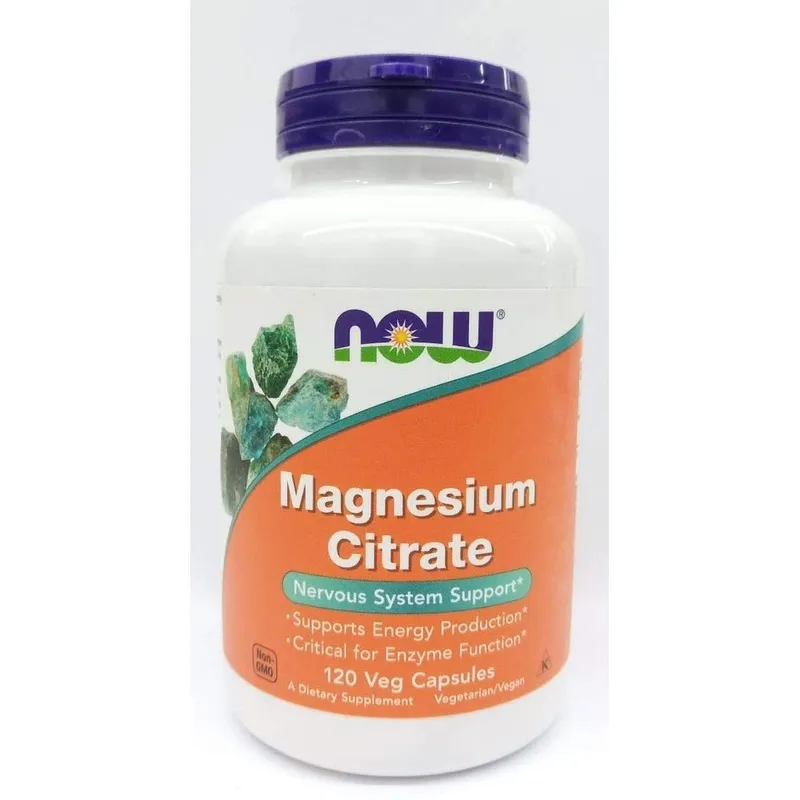 NOW Magnesium Citrate120 capsules · USA | Citrate | 267 mg (2 capsules) | ₹1,549 | ₹25.80 |
Prices from Amazon.in on 19 November 2026 (NOW from our magnesium comparison, 12 November). Per-day cost is for the dose shown. We have not lab-tested any of these products.
1. Nature Made Magnesium 250 mg: best plain magnesium oxide
This is the simplest product we found that does what the trials tested: plain magnesium oxide, one tablet, with nothing else blended in. The Amazon.in listing describes it as magnesium oxide 250 mg tablets, made in the USA, and the pack shown carries a USP mark. At ₹1,030 for 100 tablets it costs about ₹10 a day, and one tablet stays within the supplement limit.
Watch for: the listing doesn't show the full supplement facts panel, so check on the bottle that 250 mg is the amount of magnesium. A single tablet is a gentle dose; if it doesn't help after a week or two, talk to a doctor or pharmacist rather than stacking more tablets.
2. Nature Made Magnesium 400 mg: stronger, but above the limit
The same brand's "Extra Strength" softgel: the listing's ingredients name magnesium oxide, and the label says to take one a day. The catch is that 400 mg is above the 350 mg daily limit for supplemental magnesium, which is why the listing's safety note warns not to exceed one softgel a day and to check with a doctor if you have kidney disease. It also costs three times as much per day as the 250 mg tablets.
Choose it only if a doctor has suggested a higher dose for constipation.
3. NOW Magnesium Citrate: the citrate alternative
Citrate dissolves easily and also pulls water into the bowel at higher doses, so it's a reasonable choice if you want magnesium that helps both your levels and your bowels. NOW's label gives 400 mg of magnesium in three capsules; two capsules (about 267 mg) keep you under the supplement limit. The evidence for citrate in constipation is thinner than for oxide: most trials used oxide, and a 2026 review warns its findings can't be assumed to apply to other forms. [6]
What should you look for in a magnesium oxide tablet?
Read the label, not the headline. A good product makes these five things easy to check:
- "Magnesium oxide" in the ingredients, not just "magnesium" or a list of mixed salts.
- The amount of magnesium per tablet, stated as magnesium, separate from the compound weight. Oxide is 60.3% magnesium, so 250 mg of magnesium needs about 415 mg of oxide.
- A dose of 350 mg of magnesium or less a day for self-use. Anything higher is a laxative dose for a doctor to decide.
- No extra laxatives or herbs hidden in the blend, so you know what's working and what's causing side effects.
- Who made it and where: an FSSAI licence for Indian products, or the importer's details on imported ones.
Our free magnesium label checker does the maths for you: enter the compound and the magnesium amount, and it tells you whether the numbers are possible.
Which magnesium products should you avoid for constipation?
Skip anything whose label you can't make sense of. Here's what we found when we searched Amazon.in for "magnesium oxide tablets":
- "Oxide" in the title, not in the ingredients. One listing called "Chelated Magnesium Citrate Oxide" lists only magnesium glycinate and citrate in its ingredients, and its numbers (170 mg of magnesium from 1,383 mg of compound, 12.3%) are far too low for a product with much oxide in it. You can't tell what you're getting.
- Impossible "elemental" claims. Another "citrate + glycinate + oxide" complex says it delivers "1660mg of pure elemental magnesium". That would be nearly five times the 350 mg supplement limit; it's almost certainly the weight of the compound. Either way, the listing doesn't tell you the real dose.
- Glycinate sold for constipation. Magnesium glycinate is absorbed well and is gentle on the gut, which makes it good for topping up magnesium and poor as a laxative.
- Big "500 mg" numbers with no form named. Without the compound and the magnesium amount, the number is meaningless.
We haven't named these two listings, because brands change listings often; the point is the pattern. Check any product against the five label tests above.
Is the cheapest magnesium tablet the best value?
Usually not. Price per tablet is the wrong number; compare the price per day of a dose you can trust. The cheapest-looking listings we found cost about ₹5 a tablet, half the price of our pick. But you take two of them a day, so they cost about the same per day, give you less magnesium (or an amount the label won't tell you), and blend in forms that do little for constipation.
| Product | Per tablet | Per day | Magnesium a day | Per 100 mg magnesium |
|---|---|---|---|---|
| Nature Made Magnesium 250 mg (oxide) | ₹10.30 | ₹10.30 | 250 mg | ₹4.12 |
| "Citrate Oxide" blend listing | ₹5.41 | ₹10.82 | 170 mg | ₹6.36 |
| "1660 mg" triple complex listing | ₹5.41 | ₹10.82 | Not stated clearly | Can't tell |
| Nature Made Magnesium 400 mg (oxide) | ₹32.52 | ₹32.52 | 400 mg | ₹8.13 |
| NOW Magnesium Citrate | ₹12.91 | ₹25.82 | 267 mg | ₹9.68 |
Worked out from Amazon.in prices on 19 November 2026 (NOW on 12 November) and each listing's own dose: one tablet for Nature Made, two for the blends and for NOW citrate.
Three rules keep you from overpaying for a "cheap" bottle:
- Divide by the daily dose, not the tablet count. A 120-tablet bottle taken two a day lasts 60 days, not 120.
- Count only magnesium you can verify. If the label won't say how much magnesium is in a dose, you can't work out its value, so treat it as poor value.
- Match the form to the job. For constipation you're paying for magnesium that stays in the bowel. A cheap glycinate blend is good value for topping up magnesium and poor value as a laxative. The cheapest product per 100 mg in our magnesium comparison, at about ₹2.70, is a "glycinate" whose label doesn't add up.
If budget matters most and you only need occasional relief, the chemist's milk of magnesia is usually the cheapest option per bottle; follow the pack for the dose.
How should you take magnesium oxide for constipation?
Start low, take it with water, and give it a fair trial.
- Start with one 250 mg tablet a day, with a glass of water and a meal. Taking it with food can ease stomach upset.
- Give it one to two weeks. The trials measured results over four weeks. [2] [3]
- Don't double up on your own. If one tablet isn't enough, ask a doctor or pharmacist about a higher laxative dose instead of taking several tablets.
- Back it up with food: more fibre (whole grains, dal, vegetables, fruit such as kiwi and prunes), enough water, and regular movement. [4]
- Space it from medicines: keep it at least 2 hours away from antibiotics such as doxycycline or ciprofloxacin, and from osteoporosis drugs. [5]
Is milk of magnesia better than magnesium oxide tablets?
For quick, occasional relief, milk of magnesia is the more familiar choice in India; for a steady daily option, oxide tablets have the stronger trial evidence. Milk of magnesia is magnesium hydroxide in liquid form. Like oxide, it stays in the bowel and draws in water, and it's sold at every chemist as a laxative medicine, on its own or combined with liquid paraffin.
Because it's a medicine with its own dosing, follow the pack or your doctor, and don't combine it with magnesium oxide tablets. Both add to the same magnesium load, and the risks below apply to both.
Who should not take magnesium oxide?
Anyone with kidney disease should not take it without a doctor's supervision. When the kidneys can't clear magnesium, blood levels can rise too high, which can cause weakness, low blood pressure and, rarely, heart rhythm problems. [5] In a Japanese hospital study of 256 inpatients on magnesium oxide, the risk factors for high blood magnesium were weaker kidneys (blood urea nitrogen of 22 mg/dL or more, or an eGFR of 43.1 or less) and doses of 1,000 mg of oxide a day or more. [7]
- Older adults on long-term daily use should have their magnesium checked now and then. [1]
- Pregnant or breastfeeding women should ask their doctor first; the Nature Made listing says it isn't intended for them.
- People on regular medicines (antibiotics, osteoporosis drugs, diuretics, acid-reducing tablets) should check timing with a pharmacist. [5]
When should you see a doctor about constipation?
See a doctor rather than self-treating if your constipation is new and doesn't settle, or if you notice blood in your stool, unexplained weight loss, severe tummy pain, or alternating constipation and diarrhoea. These need a proper check, and no supplement should delay that. The same goes for children: don't give them magnesium for constipation without a paediatrician's advice.
कब्ज़ के लिए मैग्नीशियम ऑक्साइड: हिंदी में सार
मैग्नीशियम ऑक्साइड कब्ज़ में असरदार है; प्लेसिबो-नियंत्रित ट्रायल्स में लगभग 10 में से 7 लोगों को फ़ायदा हुआ। भारत में सादा मैग्नीशियम ऑक्साइड टैबलेट मिलना मुश्किल है; हमें Amazon.in पर सिर्फ़ आयातित Nature Made Magnesium 250 mg (लगभग ₹10 प्रति टैबलेट) सही विकल्प लगा। ग्लाइसिनेट वाले प्रोडक्ट कब्ज़ में कम मदद करते हैं, और जिन लेबल के आँकड़े आपस में मेल न खाएँ उनसे बचें। रोज़ 350 मिलीग्राम से ज़्यादा मैग्नीशियम ख़ुद से न लें। किडनी की बीमारी, गर्भावस्था या नियमित दवाइयों में डॉक्टर से पूछें, और मल में ख़ून या वज़न घटने पर तुरंत डॉक्टर को दिखाएँ।
What we did
- Searched Amazon.in for magnesium oxide tablets on 19 November 2026 and read the listing details and ingredients of each candidate
- Read the PubMed abstract of every study cited here and checked each number against it
- Worked out magnesium content and cost per day in code from the listed prices and doses
- Read the top Google India results for "magnesium for constipation"
What we didn't do
- Buy, use or lab-test these products
- See the full supplement facts panels, which the listings don't show; check them on the pack
- Give medical advice for your situation; constipation that persists needs a doctor
- Take payment from any brand for a place on this list; the buy links are affiliate links
Magnesium for constipation: your questions
Which is the best magnesium oxide tablet in India for constipation?
Which magnesium is best for constipation?
How much magnesium should I take for constipation?
How long does magnesium oxide take to work for constipation?
Is magnesium oxide safe to take daily for constipation?
Is milk of magnesia the same as magnesium oxide?
Can magnesium glycinate help with constipation?
What is the cheapest good magnesium oxide in India?
Who should not take magnesium oxide?
- Mori H, Tack J, Suzuki H. Magnesium oxide in constipation. Nutrients. 2021;13(2):421. doi:10.3390/nu13020421
- Mori S, Tomita T, Fujimura K, et al. A randomized double-blind placebo-controlled trial on the effect of magnesium oxide in patients with chronic constipation. J Neurogastroenterol Motil. 2019;25(4):563–575. doi:10.5056/jnm18194
- Morishita D, Tomita T, Mori S, et al. Senna versus magnesium oxide for the treatment of chronic constipation: a randomized, placebo-controlled trial. Am J Gastroenterol. 2021;116(1):152–161. doi:10.14309/ajg.0000000000000942
- Dimidi E, van der Schoot A, Barrett K, et al. British Dietetic Association guidelines for the dietary management of chronic constipation in adults. J Hum Nutr Diet. 2025;38(5):e70133. doi:10.1111/jhn.70133
- National Institutes of Health, Office of Dietary Supplements. Magnesium: fact sheet for health professionals. ods.od.nih.gov
- Kadhem H, Alasfoor W, Ali MS, et al. Efficacy of magnesium supplementation in functional constipation: a systematic review. Cureus. 2026. doi:10.7759/cureus.116715
- Oda S, Miyoshi T, Takechi K, Otsuka T. Risk factors analysis for hypermagnesemia with magnesium oxide [in Japanese, English abstract]. Yakugaku Zasshi. 2024;144(9):905–910. doi:10.1248/yakushi.24-00099