
Guide · Minerals · Updated
What Is the Main Disadvantage of Magnesium Oxide? Your Body Absorbs Very Little of It
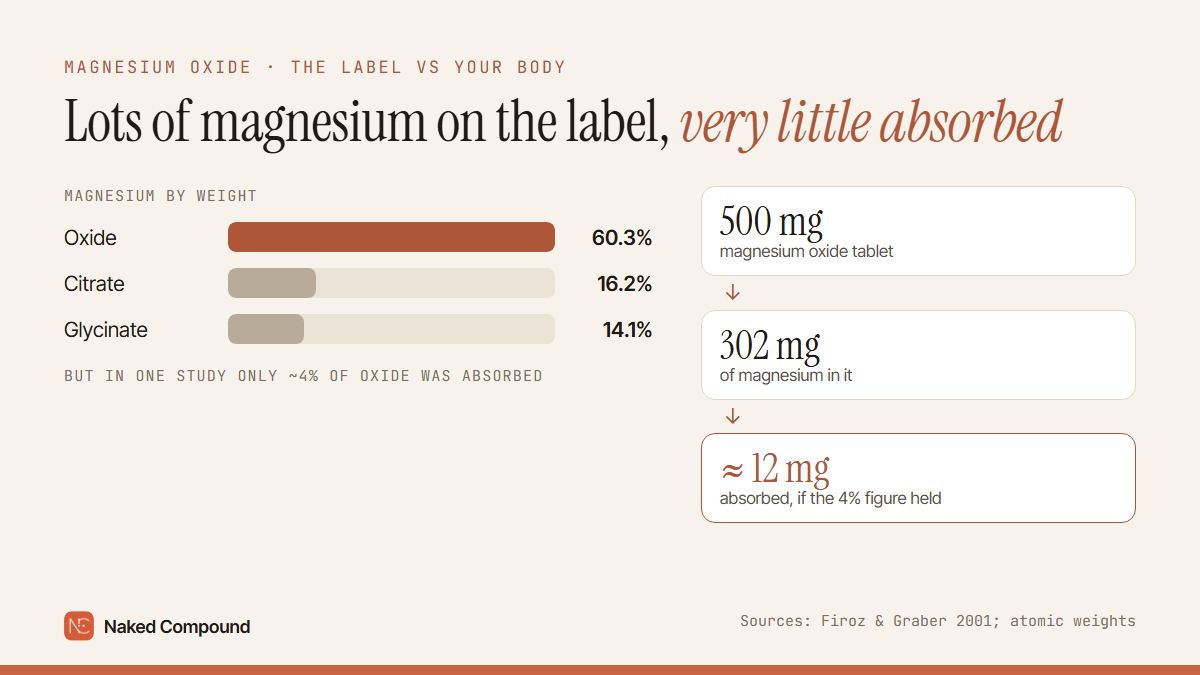
The main disadvantage of magnesium oxide is poor absorption. It dissolves badly in the gut, and in one widely quoted study only about 4% of it was taken up, far less than magnesium chloride, lactate or aspartate. Other studies found more, but oxide still trails citrate whenever the two are compared. So it's a weak way to raise low magnesium, even though the label shows a big number: oxide is 60% magnesium by weight. What isn't absorbed stays in the bowel and draws in water, which causes its other drawbacks, loose stools and cramps. That same effect makes oxide a good, cheap laxative, and it's well tested for constipation. Just don't use it at high doses if your kidneys are weak.
This page is about magnesium oxide's drawbacks and safety. A side-by-side of the three common forms is in magnesium glycinate vs citrate vs oxide; brands and prices are in the magnesium comparison; weight-loss claims are covered in magnesium glycinate vs citrate for weight loss.
The short answer
- Main disadvantage: poor absorption. In one study about 4% of the magnesium in oxide was absorbed.
- Why it misleads: oxide is 60% magnesium by weight, so a "500 mg" tablet looks strong, but little of it reaches your blood.
- Side effects: loose stools, diarrhoea and cramps, because the unabsorbed part pulls water into the bowel.
- Real risk: blood magnesium can climb too high in people with weak kidneys, especially at 1,000 mg a day or more.
- Where it's useful: constipation. In two placebo-controlled trials about 7 in 10 people improved on oxide.
Why is magnesium oxide poorly absorbed?
Magnesium oxide hardly dissolves, and magnesium has to dissolve before your gut can take it up. Three studies show the gap:
- Solubility. In lab tests that mimicked stomach acid, oxide was almost insoluble in water and only 43% dissolved even at peak acid levels. Magnesium citrate was 55% soluble in plain water. [1]
- Absorption in people. The same study gave volunteers a matched dose of each. The rise in urine magnesium, a marker of how much was absorbed, was 0.22 after citrate against 0.006 after oxide (mg per mg of creatinine, first four hours). [1]
- Fractional absorption. A comparison of US products estimated about 4% absorption from magnesium oxide, from the rise in urine magnesium, with significantly more from magnesium chloride, lactate and aspartate. [2] A study that tracked labelled magnesium directly found about 23% from a 100 mg dose, so 4% is a low-end estimate rather than a fixed rate; we look at the evidence in is magnesium oxide really only 4% absorbed?
- Over 60 days. In a randomised trial of 46 healthy adults taking 300 mg of magnesium a day, oxide did no better than placebo on blood and urine magnesium, while citrate and an amino-acid chelate did. [3]
Absorption figures vary between studies and people, and your stomach acid matters: oxide needs acid to dissolve, so people on acid-reducing medicines absorb even less.
Why does a "500 mg" oxide tablet look stronger than it is?
Because oxide carries more magnesium per gram than any other common form, the label number is big even though little is absorbed. Magnesium oxide is 60.3% magnesium by weight, against at most 16.2% for citrate and 14.1% for glycinate.
| Tablet | Magnesium in it | Absorbed if the 4% figure held |
|---|---|---|
| 250 mg magnesium oxide | 151 mg | About 6 mg |
| 400 mg magnesium oxide | 241 mg | About 10 mg |
| 500 mg magnesium oxide | 302 mg | About 12 mg |
Magnesium content worked out from atomic weights (MgO, 40.3 g/mol). The absorbed column applies the 4% estimated by Firoz and Graber [2] to illustrate the scale; a direct measurement found about 23%, and real absorption varies with the dose, the tablet and your stomach.
The same maths explains a trick we see on Indian listings. Pure magnesium glycinate can't be more than about 14% magnesium by weight, so when a "glycinate" product claims more, part of the magnesium has to come from a denser compound. One bestseller we checked claims 440 mg of magnesium from 2,000 mg of "chelated magnesium glycinate", which is 22%; at least 158 mg must come from another compound the listing doesn't name. The usual candidates are oxide or hydroxide. Our magnesium label checker runs this maths on any label, and the full product list is in our magnesium comparison.
What are the side effects of magnesium oxide?
The common side effects are loose stools, diarrhoea, stomach cramps and bloating. They come from the same poor absorption: magnesium that stays in the bowel draws water in. That's why high doses of supplemental magnesium, oxide among them, so often cause diarrhoea. [4] The effect grows with the dose, so splitting the dose or lowering it usually helps.
The serious side effect is rare in healthy people: too much magnesium in the blood, covered next.
Who should avoid magnesium oxide?
People with weak kidneys should avoid it unless a doctor is checking their blood magnesium. The kidneys clear excess magnesium; when they can't, levels can rise to dangerous highs (hypermagnesemia), which can cause weakness, low blood pressure and, in severe cases, heart rhythm problems. [4]
A Japanese hospital study of 256 inpatients on magnesium oxide identified three risk factors for high blood magnesium: blood urea nitrogen of 22 mg/dL or more, an eGFR of 43.1 mL/min or less, and taking 1,000 mg of oxide a day or more. The more risk factors a patient had, the more often levels rose; low body weight also looked like a risk. [5] A review of oxide as a laxative makes the same point: the dose, blood levels and medicines need watching, especially in older people and people with kidney disease. [6]
Older adults on long-term laxative doses, people with chronic kidney disease, and people who are very underweight should only take it with medical supervision.
Does magnesium oxide interact with medicines?
Yes. Magnesium can stop some medicines from being absorbed, and some medicines change how magnesium behaves. [4]
- Antibiotics (tetracyclines such as doxycycline, and quinolones such as ciprofloxacin): magnesium binds them in the gut. Take the antibiotic at least 2 hours before, or 4–6 hours after, magnesium.
- Osteoporosis drugs (bisphosphonates such as alendronate): keep at least 2 hours apart.
- Diuretics: some raise magnesium loss in urine, others reduce it.
- Acid-reducing medicines (proton-pump inhibitors such as omeprazole and pantoprazole): long-term use can lower magnesium, and less stomach acid means oxide dissolves even worse.
If you take any regular medicine, ask your pharmacist how to space it from magnesium.
When is magnesium oxide a good choice?
For constipation, oxide's main disadvantage turns into its use. Because it stays in the bowel and holds water there, it softens stools, and it's been tested properly:
- In a placebo-controlled trial in 34 women with mild to moderate chronic constipation, 1.5 g of oxide a day (0.5 g three times) for four weeks improved symptoms overall in 70.6%, against 25.0% on placebo. Stool frequency and form improved too. [7]
- In a trial of 90 people with chronic constipation, 1.5 g of oxide a day worked about as well as the laxative senna: overall improvement in 68.3% on oxide, 69.2% on senna and 11.7% on placebo, with no severe side effects. [8]
Note that these laxative doses contain about 900 mg of magnesium, well above the 350 mg a day upper limit for supplements, and they were used in trials under medical supervision. For constipation, use oxide on a doctor's or pharmacist's advice, not as a daily magnesium supplement. A 2026 review also cautions that the constipation evidence is mostly for oxide and can't be assumed to apply to other forms. [9]
What should you take instead?
To raise low magnesium, pick glycinate or citrate. Both dissolve far better than oxide. Glycinate is gentler on the stomach; citrate also loosens stools at higher doses. Count the elemental magnesium on the label and keep supplements to 200–350 mg of it a day. [4]
- Low magnesium, sensitive stomach: glycinate. Our best magnesium glycinate picks list the products whose label maths adds up.
- Low magnesium and constipated: citrate.
- Constipation only: oxide, at a dose your doctor or pharmacist suggests.
Food is the cheapest source: pumpkin seeds, whole grains, pulses, nuts and green leafy vegetables.
मैग्नीशियम ऑक्साइड का मुख्य नुक़सान: हिंदी में सार
मैग्नीशियम ऑक्साइड का सबसे बड़ा नुक़सान है कि शरीर इसे बहुत कम सोख पाता है; एक अध्ययन में सिर्फ़ लगभग 4% ही अवशोषित हुआ। लेबल पर "500 मिलीग्राम" बड़ा दिखता है, क्योंकि ऑक्साइड में वज़न के हिसाब से 60% मैग्नीशियम होता है, पर उसका थोड़ा ही हिस्सा ख़ून तक पहुँचता है। बाक़ी आँत में रहकर पानी खींचता है, जिससे दस्त, पेट में मरोड़ और गैस हो सकती है। किडनी कमज़ोर हो तो ख़ून में मैग्नीशियम ख़तरनाक रूप से बढ़ सकता है, इसलिए डॉक्टर की सलाह के बिना ज़्यादा मात्रा न लें। कब्ज़ के लिए यह सस्ता और असरदार है, लेकिन मैग्नीशियम की कमी पूरी करने के लिए ग्लाइसिनेट या साइट्रेट बेहतर हैं।
What we did
- Read the PubMed abstract of every study cited here and checked each number against it
- Read the top Google India results for "what is the main disadvantage of magnesium oxide" on 19 November 2026
- Worked out the magnesium percentages from atomic weights, and re-checked the label maths in our magnesium comparison
What we didn't do
- Run a trial or send any magnesium product to a lab
- Give medical advice for your situation: if you have a kidney condition or take regular medicines, ask your doctor
- Take payment from any brand; we don't sell magnesium
Magnesium oxide: your questions
What is the main disadvantage of magnesium oxide?
Is magnesium oxide bad for you?
What are the side effects of magnesium oxide?
Is magnesium oxide better than magnesium glycinate?
Does magnesium oxide work for constipation?
Can I take magnesium oxide every day?
Why do Indian magnesium tablets say 500 mg?
Should I take magnesium oxide with food?
- Lindberg JS, Zobitz MM, Poindexter JR, Pak CY. Magnesium bioavailability from magnesium citrate and magnesium oxide. J Am Coll Nutr. 1990;9(1):48–55. doi:10.1080/07315724.1990.10720349
- Firoz M, Graber M. Bioavailability of US commercial magnesium preparations. Magnes Res. 2001;14(4):257–262. PubMed 11794633
- Walker AF, Marakis G, Christie S, Byng M. Mg citrate found more bioavailable than other Mg preparations in a randomised, double-blind study. Magnes Res. 2003;16(3):183–191. PubMed 14596323
- National Institutes of Health, Office of Dietary Supplements. Magnesium: fact sheet for health professionals. ods.od.nih.gov
- Oda S, Miyoshi T, Takechi K, Otsuka T. Risk factors analysis for hypermagnesemia with magnesium oxide [in Japanese, English abstract]. Yakugaku Zasshi. 2024;144(9):905–910. doi:10.1248/yakushi.24-00099
- Mori H, Tack J, Suzuki H. Magnesium oxide in constipation. Nutrients. 2021;13(2):421. doi:10.3390/nu13020421
- Mori S, Tomita T, Fujimura K, et al. A randomized double-blind placebo-controlled trial on the effect of magnesium oxide in patients with chronic constipation. J Neurogastroenterol Motil. 2019;25(4):563–575. doi:10.5056/jnm18194
- Morishita D, Tomita T, Mori S, et al. Senna versus magnesium oxide for the treatment of chronic constipation: a randomized, placebo-controlled trial. Am J Gastroenterol. 2021;116(1):152–161. doi:10.14309/ajg.0000000000000942
- Kadhem H, Alasfoor W, Ali MS, et al. Efficacy of magnesium supplementation in functional constipation: a systematic review. Cureus. 2026. doi:10.7759/cureus.116715