
Guide · Minerals · Updated
Magnesium Glycinate vs Citrate for Weight Loss: What the Trials Show
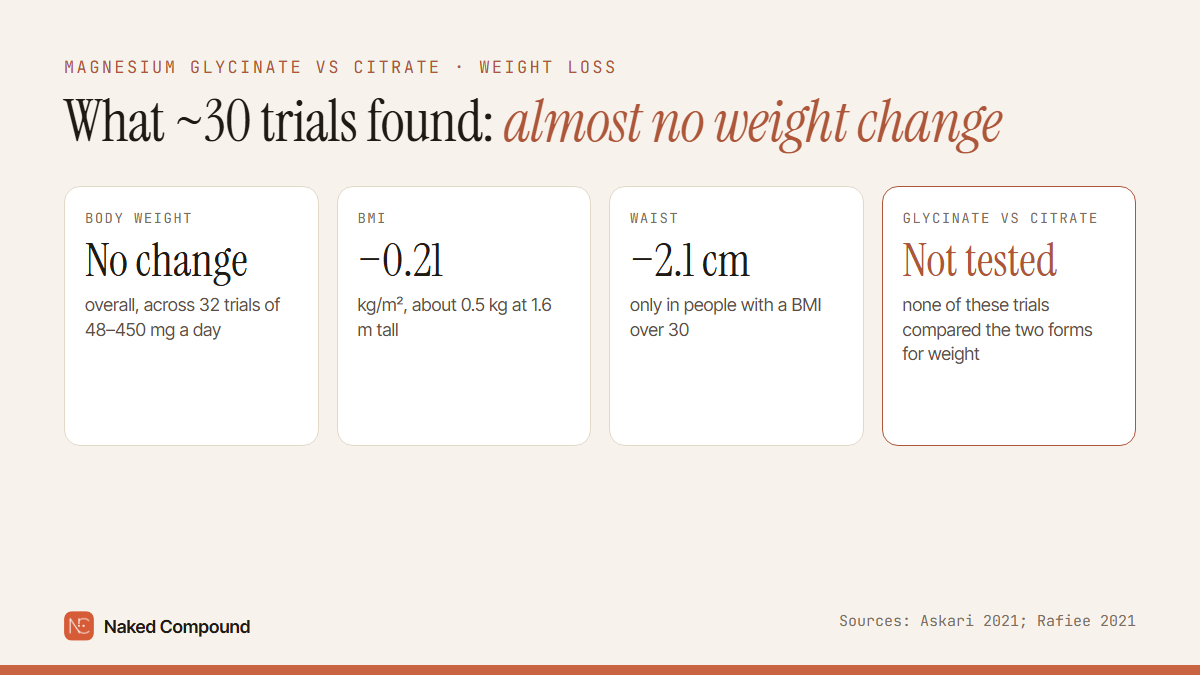
Neither magnesium glycinate nor magnesium citrate burns fat. In two meta-analyses of about 30 trials each, magnesium supplements barely changed body weight overall. Small effects showed up only in people who started low in magnesium, were insulin resistant or obese: about half a kilo of body weight, or 2 cm off the waist. If you still want one for a weight-loss plan, glycinate is the better daily choice because it's gentle on the stomach and cheaper per 100 mg in India. Citrate makes sense if constipation is the problem. Any quick drop on the scale from citrate is water and stool, not fat.
This page is about magnesium and weight loss. How the forms differ in absorption is covered in magnesium glycinate vs citrate vs oxide; dose and benefits are in the magnesium glycinate guide; brands and prices are in the magnesium comparison.
The short answer
- Fat loss: neither form causes it. Weight loss still comes from eating fewer calories than you burn.
- Who might see a small effect: people low in magnesium, with insulin resistance or prediabetes, or with obesity. The effect in trials was about 0.2 BMI points.
- Pick glycinate for a daily top-up during a diet: gentle on the stomach, about ₹6 per 100 mg of magnesium in India.
- Pick citrate only if you also want help with constipation, and expect looser stools. The kilo it may take off the scale overnight is water and stool.
- Keep supplements to 350 mg of elemental magnesium a day unless a doctor advises more, and skip them if you have kidney disease.
Does magnesium help you lose weight?
For most people, no: magnesium supplements barely move body weight. Two meta-analyses published in 2021 pooled the randomised trials, and both came to the same place.
- Askari and colleagues (32 trials, 48–450 mg a day for 6–24 weeks) found no significant change in body weight, waist, body fat percentage or waist-to-hip ratio. BMI did fall, by 0.21 kg/m², mostly in people who were magnesium deficient, insulin resistant or obese at the start. Body weight and waist did drop in those subgroups, and in women. [1]
- Rafiee and colleagues (28 trials, 2,013 people) found no change in weight, BMI, waist or body fat overall. Only people with a BMI over 30 lost waist, about 2.1 cm. Higher doses didn't do more. [2]
Put 0.21 BMI points into kilos and it's about half a kilo for someone 1.6 m tall, after weeks or months of daily tablets. That's within the normal day-to-day swing on a bathroom scale. A third meta-analysis, in people who already had type 2 diabetes, found no effect on weight, BMI or waist at all. [3]
None of these trials compared glycinate with citrate for weight. Most didn't use either form, so any page that tells you one form "burns more fat" is guessing.
Who might benefit?
People whose magnesium is low, or whose blood sugar control is slipping, are the ones the trials point to. In people with diabetes or at high risk of it, magnesium lowered fasting glucose, improved the 2-hour glucose tolerance test in the high-risk group, and improved insulin-sensitivity markers. [4] Better insulin sensitivity doesn't melt fat by itself, but it is part of why the small weight effects cluster in people with insulin resistance.
You may be in that group if you eat few whole grains, pulses, nuts and green leafy vegetables, or if you have prediabetes, PCOS or a waist that's crept up. The ICMR-NIN daily allowance is 440 mg of magnesium for men and 370 mg for women. [5] Food comes first: a handful of pumpkin seeds, a bowl of dal and some leafy greens go a long way.
If your diet already covers magnesium, a supplement is unlikely to change your weight at all.
Magnesium glycinate vs citrate: which is better for weight loss?
Glycinate is the better daily choice during a diet; citrate is the better choice only if you're also constipated. Here's how they compare on the things that matter.
| Magnesium glycinate | Magnesium citrate | |
|---|---|---|
| Effect on fat loss | None shown | None shown |
| Magnesium by weight | 14.1% at most (11.7% as the dihydrate) [6] | 16.2% (anhydrous trimagnesium citrate) [6] |
| Absorption | Good; better than oxide [7] | Good; highest blood levels in one 60-day trial [7] |
| Stomach and bowels | Gentle; loose stools uncommon | More likely to loosen stools at higher doses |
| Best for | Daily top-up, evening use, sensitive stomach | Low magnesium plus constipation |
| Cost in India per 100 mg of magnesium | About ₹6 (HK Vitals 100% Magnesium Glycinate) | About ₹9.70 (NOW Magnesium Citrate) |
Prices from our magnesium comparison, checked on Amazon.in on 12 November 2026: HK Vitals ₹789 for 120 tablets (220 mg of magnesium in two), NOW ₹1,549 for 120 capsules (400 mg in three). At 200 mg a day that works out to about ₹12 a day for glycinate and ₹19 for citrate.
On absorption, there's no clear winner. In a randomised trial of 46 healthy adults taking 300 mg a day for 60 days, both citrate and an amino-acid chelate (the family glycinate belongs to) were absorbed better than oxide, and citrate gave the highest blood levels. [7] Both are fine forms. What actually decides the choice for a dieter is your gut and your budget.
One thing to check on any glycinate label: count the elemental magnesium, not the compound weight. If a "glycinate" claims more than about 14% magnesium by weight, it's probably blended with cheaper oxide. Our magnesium label checker does that maths for you.
Does magnesium citrate make you lose weight faster?
It can make the scale drop, but not because you lost fat. Magnesium pulls water into the gut, which is why it's used for constipation. [8] A dose that loosens your stools empties the bowel and some water with it, so you may weigh less the next morning. That weight comes back as soon as you eat and drink normally.
The evidence here is thinner than many pages admit. Most constipation trials used magnesium oxide, not citrate, and a 2026 systematic review said its findings can't be assumed to apply to other forms. [8] Regular diarrhoea isn't a weight-loss method either: it costs you water and minerals, and high doses of magnesium supplements commonly cause it. [9]
Can magnesium glycinate help weight loss through better sleep?
Possibly a little, and only indirectly. Poor sleep makes a diet harder to stick to, so better sleep could help. The magnesium sleep evidence is modest:
- In a 2025 placebo-controlled trial in adults who slept badly, magnesium bisglycinate improved an insomnia score slightly more than placebo over four weeks. The effect size was small (Cohen's d = 0.2), and people with low dietary magnesium seemed to gain the most. [10]
- A meta-analysis of three small trials in 151 older adults found people fell asleep about 17 minutes faster on magnesium. The authors rated the evidence low to very low quality. [11]
No trial has shown that magnesium's effect on sleep leads to weight loss. If sleep is your problem, glycinate taken in the evening is a reasonable thing to try, alongside a regular bedtime and less screen time.
How much magnesium should you take, and when?
200–350 mg of elemental magnesium a day from a supplement is enough for most adults. The US upper limit for magnesium from supplements is 350 mg a day; food doesn't count towards it. [9] The trials in the meta-analyses used 48–450 mg a day. [1]
- Glycinate: take it in the evening if you're using it for sleep, or with any meal. You need about 1,400 mg of pure glycinate powder to get 200 mg of magnesium.
- Citrate: start at the low end, with food, and split the dose if your stools loosen.
- Don't stack both at full doses. The limit is for your total from supplements.
- Skip it or ask your doctor first if you have kidney disease, or take antibiotics such as tetracyclines or quinolones, osteoporosis drugs (bisphosphonates), diuretics or acid-reducing medicines. Magnesium can interact with these. [9]
मैग्नीशियम ग्लाइसिनेट बनाम साइट्रेट: हिंदी में सार
मैग्नीशियम ग्लाइसिनेट या साइट्रेट, कोई भी चर्बी नहीं घटाता। लगभग 30 ट्रायल्स में मैग्नीशियम से वज़न लगभग नहीं बदला; थोड़ा असर सिर्फ़ उन लोगों में दिखा जिनमें मैग्नीशियम कम था, इंसुलिन रेज़िस्टेंस था या मोटापा था। डाइट के दौरान रोज़ लेने के लिए ग्लाइसिनेट बेहतर है, क्योंकि यह पेट पर हल्का है और भारत में सस्ता पड़ता है। साइट्रेट तभी लें जब कब्ज़ भी हो; इससे अगली सुबह वज़न कम दिखे तो वह पानी और मल है, चर्बी नहीं। सप्लीमेंट से रोज़ 350 मिलीग्राम से ज़्यादा मैग्नीशियम न लें, और किडनी की बीमारी हो तो डॉक्टर से पूछें।
What we did
- Read the PubMed abstract of every study cited here and checked each number against it
- Read the top Google India results for "magnesium glycinate vs citrate for weight loss" on 19 November 2026
- Worked out the magnesium percentages from atomic weights, and the ₹ per 100 mg from the prices in our magnesium comparison
What we didn't do
- Run a trial or send any magnesium product to a lab
- Give medical advice for your situation: if you have a kidney condition or take regular medicines, ask your doctor
- Take payment from any brand; we don't sell magnesium
Magnesium and weight loss: your questions
Which is better for weight loss, magnesium glycinate or citrate?
Does magnesium glycinate help you lose belly fat?
Why did I lose weight after taking magnesium citrate?
How much magnesium should I take for weight loss?
Can I take magnesium glycinate and citrate together?
Is it OK to take magnesium glycinate every day?
Does magnesium help with weight loss in PCOS?
When should I take magnesium glycinate?
- Askari M, Mozaffari H, Jafari A, Ghanbari M, Darooghegi Mofrad M. The effects of magnesium supplementation on obesity measures in adults: a systematic review and dose-response meta-analysis of randomized controlled trials. Crit Rev Food Sci Nutr. 2021;61(17):2921–2937. doi:10.1080/10408398.2020.1790498
- Rafiee M, Ghavami A, Rashidian A, Hadi A, Askari G. The effect of magnesium supplementation on anthropometric indices: a systematic review and dose-response meta-analysis of clinical trials. Br J Nutr. 2021;125(6):644–656. doi:10.1017/S0007114520003037
- Asbaghi O, Hosseini R, Boozari B, Ghaedi E, Kashkooli S, Moradi S. The effects of magnesium supplementation on blood pressure and obesity measure among type 2 diabetes patient: a systematic review and meta-analysis of randomized controlled trials. Biol Trace Elem Res. 2021;199(2):413–424. doi:10.1007/s12011-020-02157-0
- Veronese N, Dominguez LJ, Pizzol D, Demurtas J, Smith L, Barbagallo M. Oral magnesium supplementation for treating glucose metabolism parameters in people with or at risk of diabetes: a systematic review and meta-analysis of double-blind randomized controlled trials. Nutrients. 2021;13(11):4074. doi:10.3390/nu13114074
- ICMR-National Institute of Nutrition. Nutrient Requirements for Indians: Recommended Dietary Allowances and Estimated Average Requirements. Hyderabad, 2020.
- Calculated from IUPAC standard atomic weights: magnesium bisglycinate C4H8MgN2O4, 172.4 g/mol anhydrous and 208.5 g/mol as the dihydrate; trimagnesium citrate C12H10Mg3O14, 451.1 g/mol anhydrous.
- Walker AF, Marakis G, Christie S, Byng M. Mg citrate found more bioavailable than other Mg preparations in a randomised, double-blind study. Magnes Res. 2003;16(3):183–191. PubMed 14596323
- Kadhem H, Alasfoor W, Ali MS, et al. Efficacy of magnesium supplementation in functional constipation: a systematic review. Cureus. 2026. doi:10.7759/cureus.116715
- National Institutes of Health, Office of Dietary Supplements. Magnesium: fact sheet for health professionals. ods.od.nih.gov
- Schuster J, Cycelskij I, Lopresti A, Hahn A. Magnesium bisglycinate supplementation in healthy adults reporting poor sleep: a randomized, placebo-controlled trial. Nat Sci Sleep. 2025;17:2027–2040. doi:10.2147/NSS.S524348
- Mah J, Pitre T. Oral magnesium supplementation for insomnia in older adults: a systematic review & meta-analysis. BMC Complement Med Ther. 2021;21(1):125. doi:10.1186/s12906-021-03297-z