
Ingredient · Skin & joints · Updated
Collagen Supplements: Do They Work? Dose, Marine vs Bovine
A collagen supplement probably won't change your skin the way the reels promise. In trials that no collagen company paid for, it made no measurable difference to wrinkles or elasticity. For stiff knees and brittle nails the signal is better, though still small. If you want to try it anyway, take 2.5–10 g of hydrolysed collagen a day for three months and don't overpay: marine and bovine have never been shown to work differently in people.
This page explains the ingredient. To choose a product, see our best collagen supplements in India ranking; for skin specifically, read collagen for Indian skin.
The short answer
Collagen is a reasonable experiment for stiff knees or brittle nails, and a weak bet for wrinkles. If you try it, buy unflavoured hydrolysed collagen, take 2.5–5 g a day for skin or nails (about 10 g for joints) and judge it at 12 weeks. Pick marine or bovine based on what you eat, not on absorption claims. Sunscreen will still do more for your skin than any tub.
- MixedSkin wrinkles, elasticity and hydration
- Small effectKnee osteoarthritis, mainly stiffness
- EarlyBone density · brittle nails · tendons
- No trialsHair growth
What's actually in a collagen supplement
Collagen is the protein that holds you together. It's in your skin, tendons, cartilage and bones, and it makes up about a third of the protein in your body. A supplement is collagen taken from an animal's skin, bones or scales (fish, cow, pig or chicken) and broken into short fragments called peptides. That's what "hydrolysed collagen" or "collagen peptides" means on the label.
Here's the part the ads skip. Collagen you swallow doesn't travel to your face and slot into place. Your gut digests it like any other protein, into amino acids and some very short peptides. A few of those peptides, such as prolyl-hydroxyproline, do reach the blood intact, [1] and the theory is that they nudge the cells that make collagen. Your body then decides where the building blocks go. That's why the honest question isn't "does collagen get absorbed?" (it does) but "does it change anything you can measure?"
Do collagen supplements work? Goal by goal
Before the results, one thing to keep in mind: many of the positive collagen trials were run or co-authored by people from collagen manufacturers or their research institutes. That doesn't make them wrong, but it matters, as you'll see in the skin results.
The case for collagen rests on trials like one in 69 women aged 35–55, where 2.5 g or 5 g a day improved skin elasticity against placebo after eight weeks. Moisture changes didn't reach significance. [2] A 2021 meta-analysis of 19 trials (1,125 people, 95% women) concluded that about 90 days of hydrolysed collagen improves hydration, elasticity and wrinkles. [3]
Then a 2025 meta-analysis split the evidence by who paid. Across 23 trials and 1,474 people, collagen still looked good overall. But in the trials without industry funding there was no effect on hydration, elasticity or wrinkles, and the high-quality trials found no significant effect either. The authors concluded there is currently no clinical evidence to support collagen for preventing or treating skin ageing. [4] That's the most important finding on this page.
A meta-analysis of placebo-controlled trials found collagen lowered the total WOMAC score (a standard knee osteoarthritis questionnaire) by 8 points and reduced stiffness. Pain on its own didn't improve significantly. [5] Worth a try alongside exercise and weight management, not instead of them.
Undenatured type II collagen (sold as UC-II) is a different product: 40 mg a day from chicken cartilage, meant to work through the immune system rather than as building material. In one 180-day trial of 191 people it beat both placebo and glucosamine with chondroitin on the WOMAC score; one of the authors worked for the company that makes it. [6] Don't confuse 40 mg of UC-II with 10 g of collagen peptides; they're dosed and studied separately.
In 131 post-menopausal women with low bone density, 5 g of collagen peptides a day for 12 months nudged spine and hip bone density up while the placebo group's barely changed. The changes were small, the trial was industry co-authored, and it hasn't been widely repeated. [7] It's not a substitute for calcium, vitamin D, exercise or the medicine your doctor prescribes.
In 25 people with brittle nails, 2.5 g a day for 24 weeks sped up nail growth by 12% and cut broken nails by 42%. [8] Promising, but everyone knew they were taking collagen and there was no placebo group.
Older men with low muscle mass who lifted weights for 12 weeks gained more lean mass with 15 g of collagen a day (4.2 kg) than with placebo (2.9 kg). [9] The catch: the placebo contained no protein at all, so the trial can't tell you whether collagen beats any other protein. Collagen has no tryptophan, so it isn't a complete protein, and for muscle, whey or dal-and-curd are better value. For tendons, 15 g of gelatin with vitamin C an hour before exercise doubled a blood marker of collagen production in eight men. [10] That's a lab signal, not fewer injuries.
We couldn't find a placebo-controlled trial showing that collagen grows hair. Hair is made of keratin, not collagen. If your hair is thinning, iron, thyroid and vitamin D levels are better places to start.
Marine vs bovine collagen: which is better?
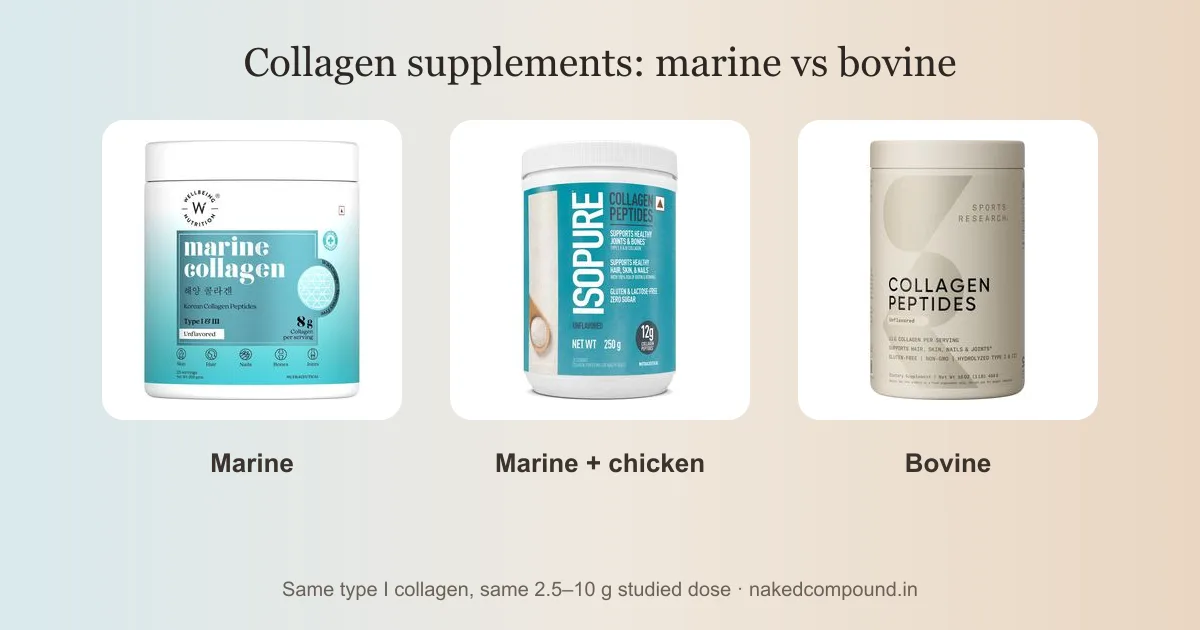
This is where marketing works hardest. You'll see marine collagen sold as "5× faster absorbing" or "bypassing the digestive system". Nothing you eat bypasses digestion, and we couldn't find a human trial comparing marine and bovine collagen on skin, joints or anything else that matters. Here's what actually differs:
| Marine | Bovine | |
|---|---|---|
| Made from | Fish skin and scales | Cow hide (sometimes bone) |
| Collagen types | Mostly type I | Type I with some type III |
| Peptide size | Set by how it's processed, not the animal. Check the label for molecular weight in daltons (Da). | |
| Evidence in people | No human trial has compared the two on skin, joints or bone. | |
| Skip it if | You're allergic to fish or shellfish | You don't eat beef |
| Cost per 10 g (our check) | ₹73–87 | ₹110 (imported) |
So the choice in India mostly comes down to diet. Many people here don't eat beef, which is why most Indian brands sell marine collagen. If fish is fine for you, marine is the easy pick. If you're allergic to fish, bovine (or chicken- or pork-derived collagen) does the same job. Don't pay extra for the source; pay attention to the dose.
How much collagen per day?
| Goal | Dose used in trials | How long |
|---|---|---|
| Skin | 2.5–5 g a day (most trials stay within 2.5–10 g) | 8–12 weeks [2] [3] |
| Brittle nails | 2.5 g a day | 24 weeks [8] |
| Bone density | 5 g a day | 12 months [7] |
| Knee osteoarthritis | Up to about 10 g of peptides, or 40 mg of UC-II | 3–6 months [5] [6] |
| Muscle, with weight training | 15 g a day | 12 weeks [9] |
Timing barely matters: take it with chai, coffee or a smoothie, whenever you'll remember. Hydrolysed collagen handles hot drinks fine. Your body does need vitamin C to build collagen, but one amla, a guava or a squeeze of lemon covers it, so you don't need to pay extra for a tub with vitamin C added.
What 10 g of collagen costs in India
Most tubs are priced per pack, not per gram of collagen, which makes them hard to compare. So we did the maths for three unflavoured tubs, one of them bovine. These aren't our recommendations, just examples of the calculation; our collagen ranking covers which products to buy.
| Tub | Source | Price · pack | Per 10 g | A month at 5 g / 10 g a day | |
|---|---|---|---|---|---|
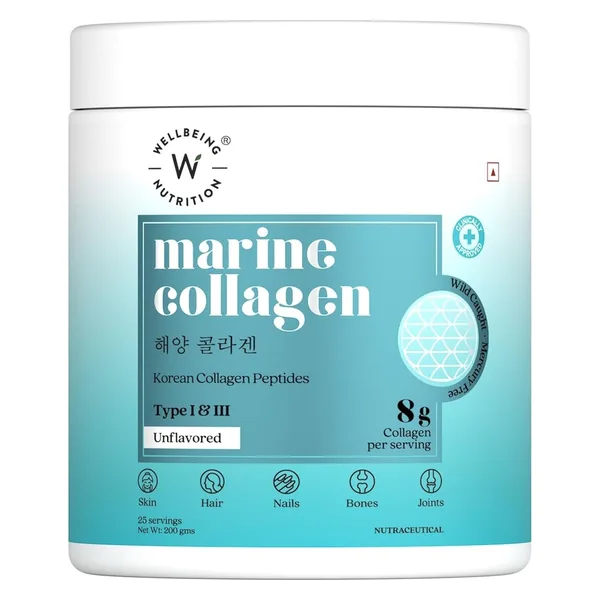 Wellbeing Nutrition Pure Korean Marine CollagenSingle ingredient: hydrolysed marine collagen peptides, unflavoured. | Marine (fish) | ₹1,745 · 200 g | ₹87 | ₹1,309 / ₹2,618 | Check price on Amazon → |
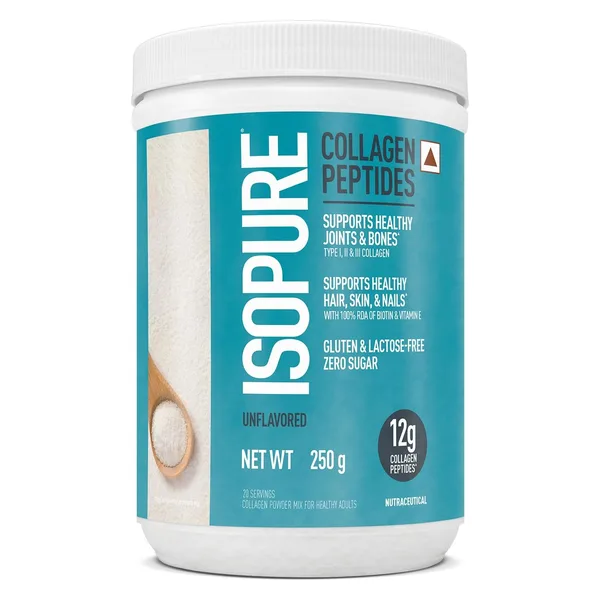 Isopure Collagen PeptidesMarine peptides plus undenatured chicken type II collagen, biotin and vitamin E. Counted as all collagen, which slightly flatters it. | Marine, plus some chicken type II | ₹1,829 · 250 g | ₹73 | ₹1,097 / ₹2,195 | Check price on Amazon → HealthKart |
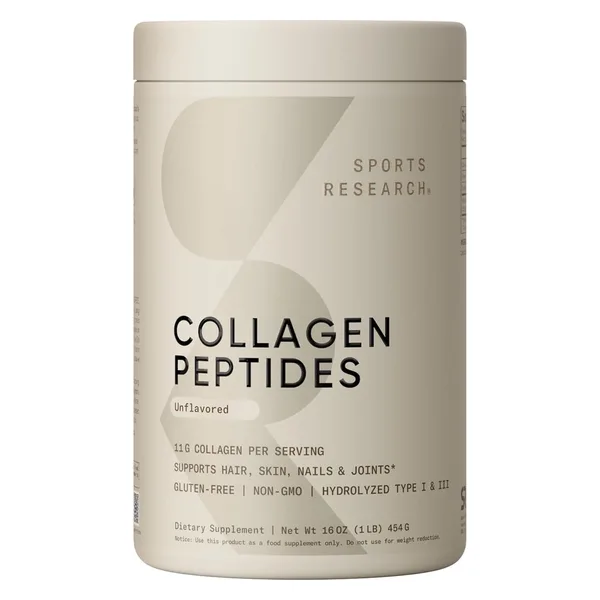 Sports Research Collagen PeptidesSingle ingredient: hydrolysed bovine collagen peptides, unflavoured. Imported. | Bovine (grass-fed cattle) | ₹4,999 · 454 g | ₹110 | ₹1,652 / ₹3,303 | Check price on Amazon → |
Prices checked on Amazon.in on 12 November 2026; they change often. The buttons are affiliate links: if you buy, we may earn a small commission at no extra cost to you. It doesn't change what we write. Per 10 g = price ÷ pack grams × 10. Flavoured powders and gummies contain sweeteners and flavourings, so a gram of powder carries less collagen; divide by the collagen grams on the label instead.
The takeaway: a month at the 10 g joint dose costs ₹2,195–3,303 with these tubs, and half that at the 5 g skin dose. Take the lower dose unless you have a reason to go higher.
How to read a collagen label in 30 seconds
- Grams of collagen per serving. Look for a number in grams. "Collagen complex" or "skin blend" without one usually means very little collagen.
- "Hydrolysed" or "peptides". That's the form used in most trials. UC-II is the exception and is dosed in milligrams.
- The source. Fish, bovine, porcine or chicken should be stated. If it isn't, ask the brand.
- Sugar. Gummies and flavoured sachets can carry several grams of sugar for a gram or two of collagen.
- Biotin. Many Indian tubs add it. High-dose biotin can make thyroid and heart lab tests come out wrong, so tell the lab you take it, or stop a few days before blood tests if your doctor agrees. [11]
- Price per 10 g. Price ÷ pack grams × 10. It cuts through every "glow" claim on the front.
Side effects and who should skip it
- Usually none. The 69-woman skin trial reported no side effects. [2] Some people feel full or bloated, especially at 10 g or more.
- Fish or shellfish allergy: avoid marine collagen; choose bovine, porcine or chicken and check the label.
- Kidney disease: 10 g of collagen is 10 g of protein. If you've been told to limit protein, count it, and ask your nephrologist.
- Pregnancy and breastfeeding: collagen hasn't been studied much here. Ask your doctor first.
- Before blood tests: if your tub has added biotin, see the label section above. [11]
For vegetarians: there's no veg collagen
Collagen only comes from animals, so a product sold as "vegan collagen" or a "collagen builder" contains none. These are usually vitamin C, a few amino acids such as glycine and proline, and plant extracts. None has been tested against real collagen. Gelatin is collagen too, and also animal-derived; agar "vegetarian gelatin" is a seaweed carbohydrate, not collagen.
A vegetarian diet already supplies what your body uses to make collagen: enough total protein (dal, paneer, curd, soy) and vitamin C (amla, guava, citrus). For skin, the things with stronger evidence are free of animal products anyway: daily sunscreen, not smoking, and sleep.
So, should you buy a collagen supplement?
If you have stiff, aching knees, a three-month trial of collagen alongside exercise is reasonable, and you'll know whether it helps. If your nails split constantly, the same goes. If you're buying it for your face because of a reel, spend the first ₹1,000 on a sunscreen you'll actually wear every day. Then, if you still want to try collagen, buy an unflavoured hydrolysed powder at 2.5–5 g a day, ignore the absorption claims, and judge it by photos in the same light after 12 weeks.
Ready to choose? Our best collagen supplements in India ranking scores the tubs on dose, form, source transparency and value. For knees, also read glucosamine and fish oil for joint pain.
What we did
- Read the abstract of every study cited here and checked each figure against it
- Noted who funded or co-authored the trials, where the papers say
- Checked prices and pack sizes of three unflavoured tubs on 12 November 2026 and did the arithmetic in code
What we didn't do
- Test any collagen product ourselves, in a lab or by taking it
- Take payment or free products from any brand
- Give medical advice: ask your doctor if you have a condition or take medicines
Collagen supplements: your questions
Do collagen supplements really work?
How much collagen should I take per day?
Is marine or bovine collagen better?
Is there a vegetarian or vegan collagen?
When is the best time to take collagen?
What happens after one month of taking collagen?
Can I mix collagen powder in hot chai or coffee?
What are the side effects of collagen supplements?
- Iwai K, Hasegawa T, Taguchi Y, et al. Identification of food-derived collagen peptides in human blood after oral ingestion of gelatin hydrolysates. J Agric Food Chem. 2005;53(16):6531–6536. doi:10.1021/jf050206p
- Proksch E, Segger D, Degwert J, et al. Oral supplementation of specific collagen peptides has beneficial effects on human skin physiology: a double-blind, placebo-controlled study. Skin Pharmacol Physiol. 2014;27(1):47–55. doi:10.1159/000351376
- de Miranda RB, Weimer P, Rossi RC. Effects of hydrolyzed collagen supplementation on skin aging: a systematic review and meta-analysis. Int J Dermatol. 2021;60(12):1449–1461. doi:10.1111/ijd.15518
- Myung SK, Park Y. Effects of collagen supplements on skin aging: a systematic review and meta-analysis of randomized controlled trials. Am J Med. 2025;138(9):1264–1277. doi:10.1016/j.amjmed.2025.04.034
- García-Coronado JM, Martínez-Olvera L, Elizondo-Omaña RE, et al. Effect of collagen supplementation on osteoarthritis symptoms: a meta-analysis of randomized placebo-controlled trials. Int Orthop. 2019;43(3):531–538. doi:10.1007/s00264-018-4211-5
- Lugo JP, Saiyed ZM, Lane NE. Efficacy and tolerability of an undenatured type II collagen supplement in modulating knee osteoarthritis symptoms: a multicenter randomized, double-blind, placebo-controlled study. Nutr J. 2016;15:14. doi:10.1186/s12937-016-0130-8
- König D, Oesser S, Scharla S, et al. Specific collagen peptides improve bone mineral density and bone markers in postmenopausal women: a randomized controlled study. Nutrients. 2018;10(1):97. doi:10.3390/nu10010097
- Hexsel D, Zague V, Schunck M, et al. Oral supplementation with specific bioactive collagen peptides improves nail growth and reduces symptoms of brittle nails. J Cosmet Dermatol. 2017;16(4):520–526. doi:10.1111/jocd.12393
- Zdzieblik D, Oesser S, Baumstark MW, et al. Collagen peptide supplementation in combination with resistance training improves body composition and increases muscle strength in elderly sarcopenic men: a randomised controlled trial. Br J Nutr. 2015;114(8):1237–1245. doi:10.1017/S0007114515002810
- Shaw G, Lee-Barthel A, Ross ML, et al. Vitamin C-enriched gelatin supplementation before intermittent activity augments collagen synthesis. Am J Clin Nutr. 2017;105(1):136–143. doi:10.3945/ajcn.116.138594
- US Food and Drug Administration. UPDATE: The FDA warns that biotin may interfere with lab tests: FDA safety communication. fda.gov