Why "SPF 50" on Indian Sunscreens Often Doesn't Mean SPF 50
Three things stand between the number on the tube and the protection on your face: how the product was tested, how much you put on, and what happens to it by lunchtime. Here's the evidence on each, and how to check a sunscreen before you buy it.
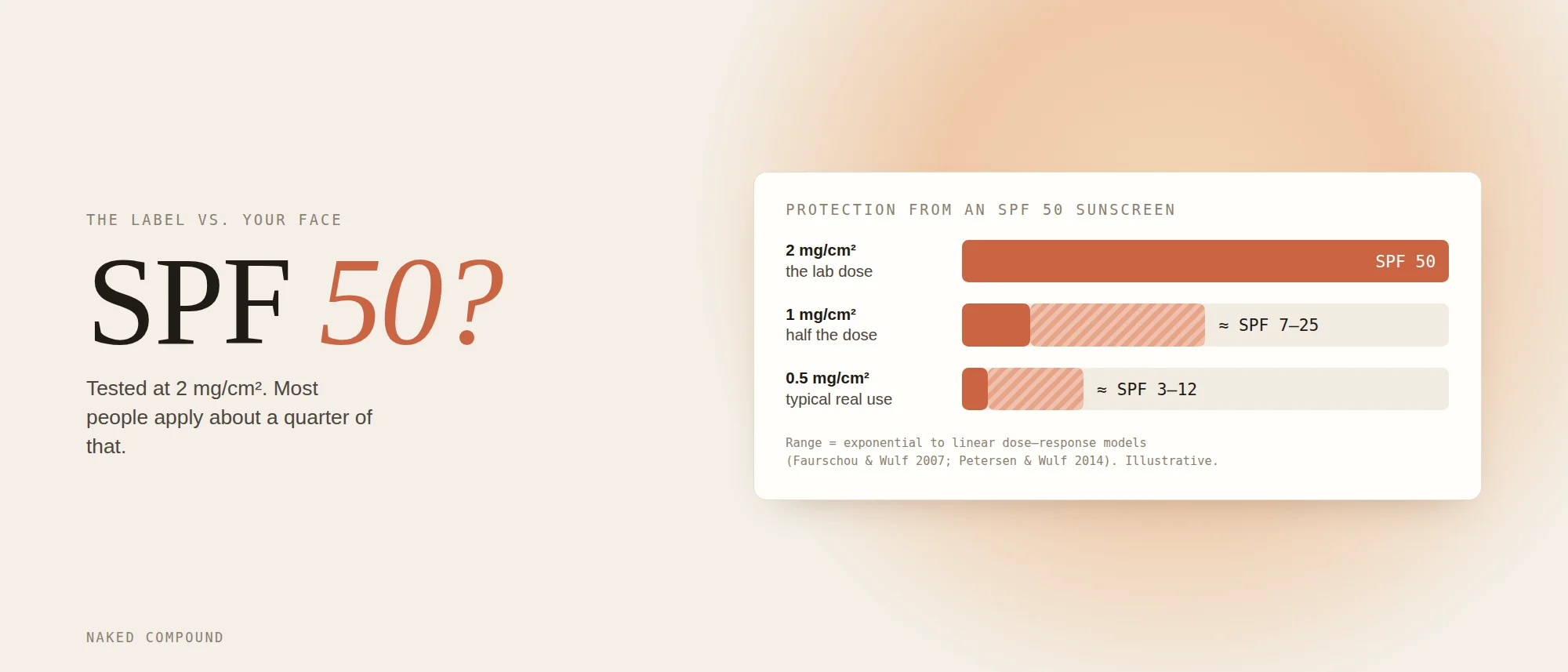
The same SPF 50 sunscreen at three application amounts. Ranges span the exponential and linear dose–response models; illustrative, not a test of any product.
"SPF 50" is a lab result measured with 2 mg of sunscreen per cm² of skin, and on many Indian sunscreens it hasn't been reliably verified. In an independent October 2025 test of ten popular Indian SPF 50+ sunscreens, six fell short of their claim and five measured below half of it. Even a sunscreen that truly is SPF 50 gives far less in real life, because most people apply about a quarter of the tested amount. Until India's new in-vivo testing standard is visibly enforced, choose sunscreens that publish an ISO 24444 test report, apply two finger-lengths to the face and neck, and reapply every two hours outdoors.
- What SPF 50 means
- Blocks ~98% of UVB at 2 mg/cm²
- Real-world dose
- ~0.5 mg/cm², a quarter of the lab dose
- Gold-standard test
- In-vivo, ISO 24444 (India: IS 17494)
- UVA check
- PA++++ or a tested broad-spectrum claim
- How much
- Two finger-lengths for face and neck
- How often
- Every 2 hours outdoors, and after sweating
Researched by the Naked Compound Research Team · Last updated · Based on published studies, standards and reported test results; we haven't lab-tested any sunscreen.
Sunscreen is one of the fastest-growing skincare categories in India, and almost every tube on the shelf now says SPF 50 or higher. The number looks like a guarantee. It isn't. It's the result of one specific test, done one specific way, and it only holds if you use the product the way the test did.
In 2025 two things made the gap visible. An Indian creator paid for lab tests of ten bestselling sunscreens and published results showing most fell far short. And an Australian consumer group found 16 of 20 sunscreens it tested didn't meet their claims. Neither proves any one tube in your bag is weak, but together they show why a label alone isn't enough.
"SPF isn't a property of the bottle. It's a property of the bottle used exactly as tested — and almost nobody does."— Naked Compound Research Team
What SPF 50 actually measures.
SPF is a ratio of sunburn doses. In the international in-vivo method, ISO 24444, sunscreen is spread on volunteers' backs at 2 mg/cm², exposed to a UV lamp, and compared with unprotected skin. If protected skin takes 50 times as much UV to redden, the product is SPF 50. [1]
Higher numbers add less than they seem. Applied as tested, SPF 15 filters about 93% of UVB, SPF 30 about 97% and SPF 50 about 98% (the share blocked is 1 − 1/SPF). The jump from 30 to 50 halves the UVB that gets through, but only if you apply the full dose.
SPF is mostly about UVB. Sunburn is driven by UVB. Tanning, pigmentation and much of photo-ageing are driven strongly by UVA, which SPF barely reflects. That's what the PA rating (PA+ to PA++++) or a tested broad-spectrum claim is for; see our Skin Care edit on reading SPF and PA together.
Some tubes don't test at their label.
In October 2025, Noida-based creator Nitin Joshi published results from sending ten popular Indian sunscreens, all labelled SPF 50 or higher, to two Government of India-accredited labs: MS Clinical Research in Bengaluru and the Centre for Cruelty-Free Testing in Meerut. He reported paying for the tests himself. [5][6]
| Brand | Claimed SPF | Measured SPF (in-vitro) | Share of claim |
|---|---|---|---|
| Renee | 70+ | 12.81 | 18% |
| WishCare | 50+ | 12.94 | 26% |
| Dot & Key | 50+ | 14.98 | 30% |
| Lotus | 50+ | 16.89 | 34% |
| Deconstruct | 55+ | 17.82 | 32% |
| Foxtale | 55+ | 36.9 | 67% |
| Lakmé | 50+ | 52.96 | 106% |
| Minimalist | 50+ | 78.54 | 157% |
| The Derma Co | 50+ | 79.72 | 159% |
| Aqualogica | 50+ | 146.08 | 292% |
Results as reported in press coverage of the test, October 2025. [5][6] Exact product variants weren't listed in the coverage we could verify. "Share of claim" is our arithmetic against the headline number.
Read these numbers with real caution. The test was in-vitro, not on people, and the coverage says it followed ISO 24443 and COLIPA 2011 protocols, which were designed mainly to measure UVA protection. A Mumbai dermatologist publicly questioned both the method and its independence, pointing out that the four brands that did well belong to two companies: Lakmé and Minimalist to Hindustan Unilever, The Derma Co and Aqualogica to Honasa Consumer. [6][11][12] An in-vitro reading of SPF 146 for a product labelled 50+ is itself a sign of how much these tests can swing.
But the swing is exactly the problem. Even with the gold-standard in-vivo method, SPF results for the same sunscreen can differ enormously between labs. One study that sent products to several contract labs found results ranging from SPF 62.4 down to 5.5 for a single product. [4] In Australia, which has one of the strictest sunscreen regimes in the world, the consumer group CHOICE found 16 of 20 sunscreens didn't meet their claims in 2025; one labelled SPF 50+ tested at SPF 4, was re-tested at a second lab at SPF 5, and was withdrawn by its brand. [7]
That a specific brand is unsafe
- One in-vitro test, one sample per product, variants undisclosed.
- The method was disputed and the funding and sponsorship were questioned.
That "SPF 50" on a label isn't proof
- Until 2025 India had no standard method brands had to use to support an SPF claim.
- A published in-vivo report, with the lab named, is worth more than the number on the front.
You're probably applying a quarter of it.
This is the bigger problem, and it applies to every sunscreen, including honestly labelled ones. Studies of how people actually apply sunscreen find amounts of roughly 0.39 to 1.0 mg/cm², usually about 0.5 mg/cm², against the 2 mg/cm² used in testing. [2]
Protection falls faster than the amount. In a trial on volunteers, halving the dose to 1 mg/cm² brought SPF down to roughly its square root, and a quarter dose to roughly its fourth root. [3] A study in Korean volunteers also found SPF fell steeply, and non-linearly, as less was applied. [8] Some formulas behave closer to a straight line, where half the amount gives about half the SPF. [4] Either way, the result is far below the label:
| Amount applied | SPF 30 label | SPF 50 label |
|---|---|---|
| 2 mg/cm² (lab dose) | 30 | 50 |
| 1 mg/cm² (half) | ≈ 5–15 | ≈ 7–25 |
| 0.5 mg/cm² (typical) | ≈ 2–7.5 | ≈ 3–12.5 |
Lower figure: exponential model (square root and fourth root). [3] Higher figure: linear model. Real products fall somewhere in this range; the table is illustrative, not a measurement of any product.
The fix is the amount, not a higher number. Squeeze two strips of sunscreen along the full length of your index and middle fingers for the face and neck; that approximates the tested dose. [9][10] If a sunscreen feels too heavy or greasy to use in that quantity, it's the wrong sunscreen for you, whatever its SPF. That's the real reason gel and fluid textures do well in Indian humidity: people actually apply enough of them.
Sweat, touch and time wear it away.
SPF is measured shortly after application on still, dry skin. In a hot Indian afternoon, sweat, wiping your face, masks and helmets all remove sunscreen. No sunscreen is sweat-proof, and dermatologists advise reapplying about every two hours outdoors, and after swimming or sweating heavily. [9] A morning layer on a 9 a.m. commute is largely gone by the time you step out for lunch.
Reapplying over makeup is where most routines break down. A sunscreen stick or a spray can help, but sprays in particular are hard to apply thickly enough, so treat them as a top-up, not your main layer.
India's new sunscreen standards.
Sunscreens in India are regulated as cosmetics under the Drugs and Cosmetics Act and the Cosmetics Rules, 2020, which set the permitted UV filters and limits. Until recently, though, brands could choose how to test an SPF claim: in-vivo on volunteers, in-vitro on plates, or by calculation. [13]
- IS 17494:2025 — the Bureau of Indian Standards' method for in-vivo SPF testing, adopting ISO 24444. [13]
- Broad-spectrum criteria — reported to require a UVA protection factor of at least one-third of the SPF and a critical wavelength of 370 nm. [14]
- IS 19685:2026 — a specification for leave-on sunscreen cosmetic products, published in March 2026, covering ingredients, efficacy, safety and labelling. [15]
Industry and brand sources cite 10 January 2026 as the date from which SPF claims had to be backed by in-vivo testing. [13] We couldn't find public data on how that's being enforced on shelves, and a label doesn't tell you which method stands behind its number, which is why the checklist below matters.
Six checks before you buy.
- Look for an in-vivo test report. The best brands publish, or send on request, an ISO 24444 (or IS 17494) SPF report with the lab named. "Dermatologically tested" is not an SPF test.
- Check UVA, not just SPF. Look for PA+++ or PA++++, or a broad-spectrum claim backed by a UVA test (ISO 24442 in-vivo or ISO 24443 in-vitro).
- Be wary of very high numbers. SPF 70, 90 or 100 adds almost nothing over SPF 50 in UVB blocked. The EU caps labels at "SPF 50+", which needs a measured result of at least 60. [16]
- Check the CDSCO licence and manufacturing details. A genuine product lists the manufacturer or importer and a licence number. Buy from the brand or an authorised seller.
- Pick a texture you'll use generously. Two finger-lengths every morning is the real test. A light gel you apply fully beats a thick cream you skimp on.
- Plan the reapplication. If you're outdoors for hours, keep a stick, or a second tube, where you'll actually use it.
Four sunscreens worth starting with.
We haven't tested these ourselves. They're chosen on what's publicly known: brands that held up in the 2025 independent test (with the caveats above) and a European sunscreen made under EU rules, where SPF must be measured in-vivo. The three Indian picks belong to the two companies whose ownership was questioned during the test controversy; we're flagging that so you can weigh it yourself.
The Derma Co 1% Hyaluronic Sunscreen Aqua Gel
A light gel that declares both SPF and PA on the pack, with a finish that suits oily skin and humid weather, so it's easy to apply the full two finger-lengths. The brand measured 79.72 against a 50+ claim in the 2025 in-vitro test; the exact variant tested wasn't disclosed.
Why it's here: texture you'll apply generously; UVA declared. Watch for: Honasa-owned, see above.
Minimalist SPF 50 PA++++ Sunscreen with Multi-Vitamins
A light, fragrance-free daily sunscreen with four named UV filters (Uvinul T 150, avobenzone, octocrylene and titanium dioxide). Minimalist says its SPF was confirmed by an independent in-vivo test to ISO 24444:2019, which is exactly the kind of claim to look for. The brand also measured 78.54 against a 50+ claim in the 2025 in-vitro test; the exact variant tested wasn't disclosed. [17]
Why it's here: states an in-vivo ISO 24444 test; declared filters and UVA rating. Watch for: HUL-owned, see above.
Lakmé Sun Expert SPF 50 PA+++ Ultra Matte Gel Sunscreen
A widely available, low-cost matte gel made for hot, humid weather. Lakmé was the one brand in the 2025 test whose result sat close to its claim (52.96 against 50+), which is more believable than a result three times the label. The exact variant tested wasn't disclosed.
Why it's here: result close to claim; cheap enough to apply generously. Watch for: PA+++ rather than PA++++, so slightly less UVA protection; contains plant extracts; HUL-owned.
La Roche-Posay Anthelios UVMune 400 Invisible Fluid SPF 50+
A thin fluid made for the European market, where an SPF 50+ label requires an in-vivo result of at least 60 and a UVA factor of at least a third of the SPF. It costs several times more than the Indian picks, but it's the easiest way to buy a sunscreen whose claim was tested under strict, long-standing rules.
Why it's here: EU testing and labelling rules; strong UVA filters. Watch for: price; buy from the brand or an authorised seller.
Didn't make the list: sunscreens labelled above SPF 50 (70+, 90, 100), which add almost nothing, and any product whose SPF claim in the 2025 test came in below half its label, until the brand publishes an in-vivo report.
Frequently asked questions about SPF 50 sunscreens in India
Is SPF 50 on Indian sunscreens real?
How much sunscreen should I apply to my face to get SPF 50?
What is the difference between in-vivo and in-vitro SPF testing?
Is SPF 30 enough in India?
What are the new BIS rules for sunscreen in India?
Does SPF protect against tanning and pigmentation?
- International Organization for Standardization. ISO 24444:2019 — Cosmetics — Sun protection test methods — In vivo determination of the sun protection factor (SPF). iso.org
- Petersen B, Wulf HC. Application of sunscreen — theory and reality. Photodermatol Photoimmunol Photomed. 2014;30(2–3):96–101. PubMed 24313722
- Faurschou A, Wulf HC. The relation between sun protection factor and amount of sunscreen applied in vivo. Br J Dermatol. 2007;156(4):716–719. PubMed 17493070
- Trullàs C, Granger C, Lim HW, Krutmann J, Masson P. Linear and exponential sunscreen behaviours as an explanation for observed discrepancies in sun protection factor testing. Photodermatol Photoimmunol Photomed. 2020;36(5):351–356. PubMed 31376288
- Storyboard18. Noida influencer's investigation flags misleading SPF claims by popular Indian sunscreens. October 2025. storyboard18.com
- Business Standard. Influencer's sunscreen test sparks debate over SPF claims, marketing ethics. 21 October 2025. business-standard.com
- CHOICE. We tested the SPF claims of 20 sunscreens. 16 failed. June 2025; and ABC News, Choice defends sunscreen testing after criticism from Ultra Violette, 17 June 2025. choice.com.au; abc.net.au
- Kim SM, et al. The relation between the amount of sunscreen applied and the sun protection factor in Asian skin. J Am Acad Dermatol. 2010;62(2):218–222. PubMed 19962787
- American Academy of Dermatology. Sunscreen FAQs. aad.org
- Taylor S, Diffey B. Simple dosage guide for suncreams will help users. BMJ. 2002;324(7352):1526. PMC1123459
- Unilever. HUL to acquire premium beauty brand Minimalist. 22 January 2025. unilever.com
- Honasa Consumer Ltd. Know our brands. honasa.in
- The Nod Mag. Why your favourite sunscreen may not survive 2026 (BIS IS 17494 and in-vivo testing). thenodmag.com
- Financial Express, via Skinobs. BIS notifies sunscreen testing standards. news.skinobs.com
- Enviliance ASIA. India establishes national standard for sunscreen cosmetic products (IS 19685:2026). enviliance.com
- European Commission. Recommendation 2006/647/EC on the efficacy of sunscreen products and the claims made relating thereto. eur-lex.europa.eu
- Minimalist. Multi-Vitamin SPF 50 PA++++ — product page (UV filters, ISO 24444 in-vivo test claim). beminimalist.co