Post-acne marks have two distinct mechanisms. Most actives only target one. Matching your ingredient to your mark type is what determines whether anything works at all.
Red/pink marks (PIE) — Post-Inflammatory Erythema — are vascular, not melanin-based. They typically resolve in 3–6 months with SPF alone. Tranexamic acid and alpha arbutin are not primarily designed for these. Brown/tan marks (PIH) — Post-Inflammatory Hyperpigmentation — are melanin-based and respond to tyrosinase inhibition and melanin-pathway interference. This is what tranexamic acid and alpha arbutin treat. At consistent therapeutic doses, clinical studies show visible PIH improvement starting at 8 weeks and near-complete fading in 16–20 weeks — but only when SPF50+ is applied every morning without exception.
The rest of this article is the mechanism, the evidence, and the protocol.
PIE vs PIH — the distinction that determines your treatment
Most people use "post-acne marks" as a catch-all for anything left behind after a breakout clears. The problem is that this category contains two biologically distinct phenomena that respond to completely different interventions — and confusing them is why so many targeted serums seem to "not work."
Post-Inflammatory Erythema (PIE) is the red or pink discolouration that typically follows a papule or pustule. It is a vascular injury response: inflamed acne damages the small capillaries beneath the skin surface, and those damaged vessels remain dilated after the inflammation resolves. The redness is from blood visible through thinned, damaged skin — not from melanin. It has no direct melanin component. PIE typically fades on its own in 3–6 months if the area receives no further UV exposure and no new inflammation. SPF is the primary treatment. Niacinamide (which reduces erythema via prostaglandin modulation) and azelaic acid can accelerate resolution.
Post-Inflammatory Hyperpigmentation (PIH) is the brown or tan discolouration that forms after inflammation triggers excess melanin production. During active acne inflammation, keratinocytes and fibroblasts release inflammatory mediators — primarily prostaglandins and leukotrienes — that stimulate melanocytes to produce and distribute more melanin into the surrounding skin. That excess melanin then persists in the epidermis (and sometimes the upper dermis) long after the acne itself has healed, creating the dark mark that can last months to years without intervention.
Look at your marks in natural light. Red or pink marks that temporarily disappear when you press a finger against them (blanching) are almost certainly PIE — vascular. Brown, tan, or grey-brown marks that do not blanch are PIH — melanin-based. Many people have both simultaneously: older marks that have already transitioned from pink to brown are PIH, while more recent marks from the last few months are still PIE. Tranexamic acid and alpha arbutin target PIH. If your marks are primarily pink-red and recent, SPF plus time is your primary tool.
PIH disproportionately affects people with higher Fitzpatrick skin types (III–VI) — that is, South Asian, East Asian, Southeast Asian, Middle Eastern, and African skin tones — because higher baseline melanin activity means more melanin is available to be stimulated by inflammation. In an Indian context, this is not a minor caveat: the majority of Indian adults fall into Fitzpatrick types IV–V, which means PIH is both more likely to form and takes longer to resolve than in lighter skin tones. This is a reason for both more consistent SPF use and more patience with the timeline, not for abandoning evidence-backed actives.
The timeline problem: why 2-week promises are meaningless
Before getting to the ingredients, it is worth understanding why the timelines in most product marketing are disconnected from the biology of what's actually happening in your skin.
Melanin is produced in melanocytes in the basal layer of the epidermis and then transferred to keratinocytes, where it accumulates as visible pigmentation. The epidermis turns over roughly every 28–40 days — meaning that even if you completely stopped all new melanin production on day one, you would need at least one full epidermal turnover cycle before any pigmentation reduction became visible on the surface. That alone rules out any meaningful visible change in two weeks from a mechanism that works on melanin synthesis.
In practice, PIH involves multiple epidermal and sometimes dermal layers. Clinical melanin inhibition studies measure outcomes at 8 weeks as the minimum meaningful timepoint, with most efficacy studies running 12–20 weeks. "Results in 2 weeks" is a marketing number, not a clinical one. What may happen in 2 weeks is that your skin texture or overall tone improves slightly — but PIH reduction measured by spectrometry or visual grading scales consistently shows the meaningful change window starting at weeks 8–10.
Tranexamic acid: mechanism, evidence, and what the Minimalist formula contains
Tranexamic acid is a synthetic lysine derivative originally developed as an antifibrinolytic drug for controlling surgical bleeding. Its application to hyperpigmentation came from an accidental clinical observation in the 1970s when Japanese patients receiving oral tranexamic acid for urticaria reported unexpected lightening of melasma. That observation took decades to be systematically investigated, but the mechanism is now well understood.
Tranexamic acid inhibits plasminogen activator in keratinocytes — blocking the conversion of plasminogen to plasmin. Plasmin, in turn, activates arachidonic acid and increases prostaglandin synthesis, which stimulates melanocyte activity. By blocking this cascade at the plasminogen stage, tranexamic acid reduces the inflammatory stimulus to melanocytes that creates PIH in the first place. It also appears to directly reduce the uptake of melanosomes (melanin-containing packages) from melanocytes into keratinocytes, which reduces the surface accumulation of pigment independently of the synthesis pathway.
This dual mechanism — reducing melanin synthesis stimulation AND reducing melanin transfer — is what makes tranexamic acid particularly useful for PIH caused by acne inflammation specifically, rather than UV-induced pigmentation alone.
What the evidence says
The clinical evidence for topical tranexamic acid in hyperpigmentation is primarily built on melasma trials — a condition that shares the same melanin-overproduction mechanism as PIH. A 2019 randomised controlled trial by Ebrahimi and Naeini comparing 3% topical tranexamic acid against 3% hydroquinone found equivalent efficacy at 12 weeks on melanin index, with a significantly better side-effect profile for tranexamic acid (no ochronosis risk, no contact dermatitis in the tranexamic arm).1 A 2020 systematic review by Taraz et al. across 6 studies found consistent evidence for topical tranexamic acid efficacy in reducing MASI (Melasma Area and Severity Index) scores, with 3–5% the effective concentration range.2
Importantly for an Indian context, several of the better-designed studies used predominantly South Asian and East Asian cohorts — Fitzpatrick types IV–V — which maps closely to the population most affected by PIH in India. The 8–12 week timeframe for visible improvement appears consistent across these studies.
Formulation note: what the Minimalist Tranexamic 03% adds beyond the active
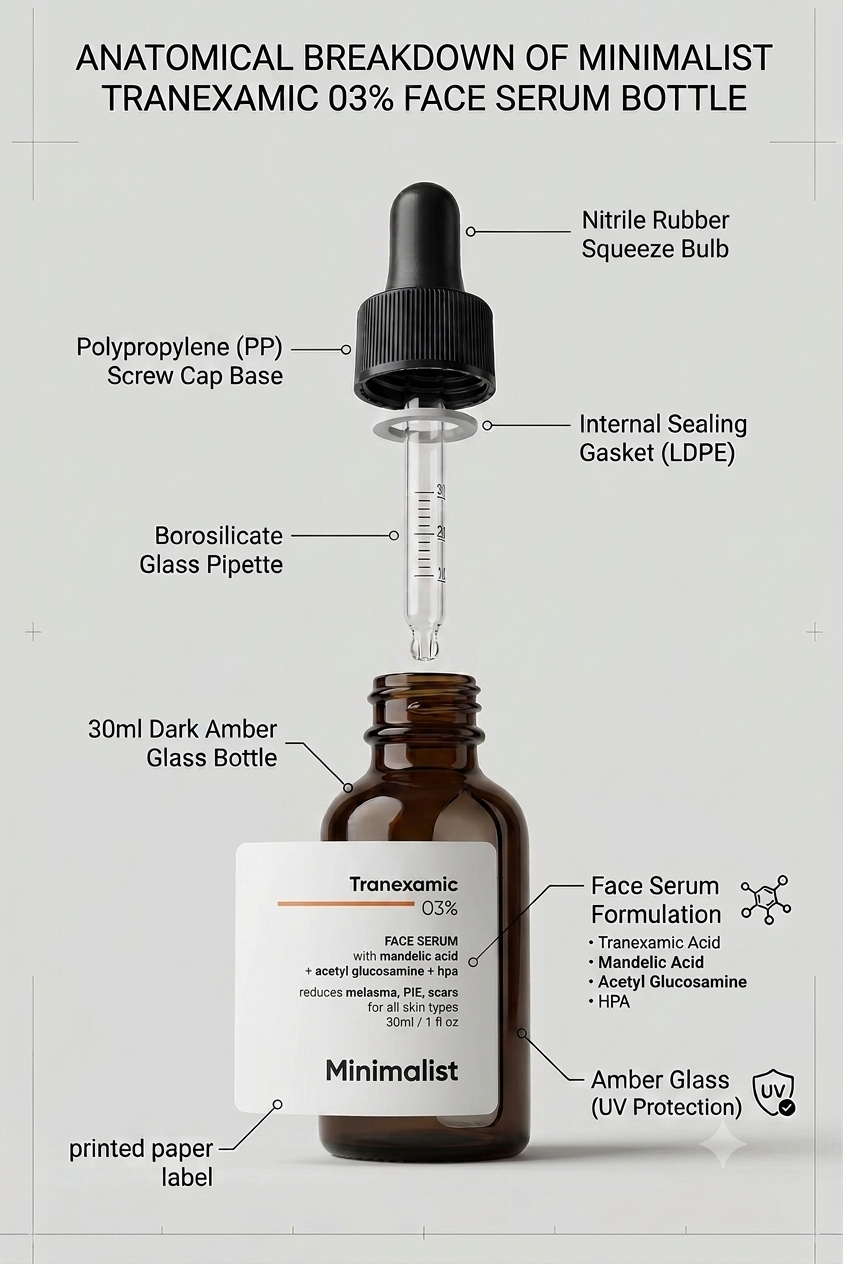
The Minimalist Tranexamic 03% formulation combines tranexamic acid with three supporting actives. Mandelic acid (an AHA) provides gentle chemical exfoliation — accelerating the epidermal turnover that makes all topical actives more effective by removing the melanin-loaded surface cells faster. Acetyl glucosamine is an N-acetyl sugar that inhibits the glycosylation of tyrosinase (the enzyme that produces melanin), adding a third pathway of melanin reduction complementary to tranexamic acid's mechanism. HPA (Hydroxyphenyl Propamidobenzoic Acid) functions as an adjunct UV filter within the formulation, providing additional photo-protection at the skin surface.
Because the Minimalist Tranexamic 03% contains mandelic acid (an AHA), it is an exfoliating active and should not be used in the same routine as other strong AHAs (glycolic, lactic) or physical scrubs. If you are also using a vitamin C serum, separate them to AM/PM to avoid irritation. As with all AHAs, photosensitivity increases — making the SPF requirement even more non-negotiable while using this product.
Alpha arbutin: mechanism, evidence, and what the Minimalist formula contains
Alpha arbutin is a glucosylated derivative of hydroquinone — essentially hydroquinone attached to a glucose molecule. That structural modification is the key to why it behaves differently from hydroquinone itself. The glucose moiety makes alpha arbutin more chemically stable (hydroquinone oxidises quickly and causes irritation at higher concentrations), and it allows the molecule to be absorbed into skin cells where it slowly releases its active hydroquinone component directly at the site of tyrosinase activity rather than acting systemically.
The mechanism is competitive tyrosinase inhibition. Tyrosinase is the rate-limiting enzyme in melanogenesis — the pathway that converts tyrosine to melanin. Alpha arbutin binds to the active site of tyrosinase, blocking L-DOPA from binding, and thereby reducing the conversion rate to melanin. This is a direct, targeted block on the primary melanin synthesis enzyme. Where tranexamic acid works upstream of tyrosinase (reducing the inflammatory stimuli that activate melanocytes), alpha arbutin works at the enzymatic level of the synthesis process itself. This is why combining them is additive rather than redundant.
What the evidence says
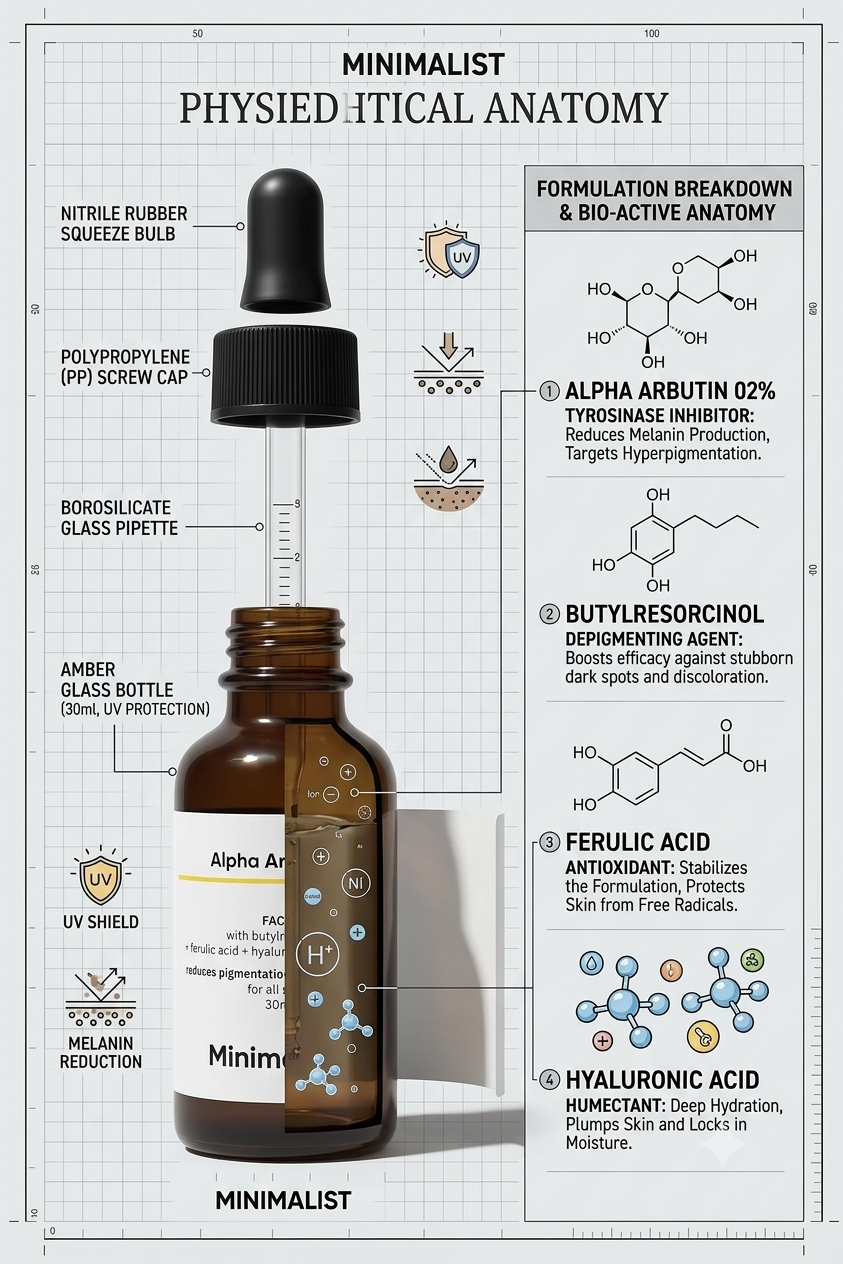
Alpha arbutin's evidence base in human clinical studies is smaller than tranexamic acid's, though its in vitro tyrosinase inhibition activity is well established and consistently replicated. A 2013 study by Draelos et al. comparing 1% alpha arbutin against vehicle control found significant melanin index reduction at 12 weeks in a mixed-race cohort.3 A comparative study by Sugimoto et al. found alpha arbutin's stability advantage over hydroquinone in formulation is substantial — hydroquinone degrades to benzoquinone under UV exposure, becoming both less effective and more irritating, while alpha arbutin maintains stability in the amber glass packaging used by most serious formulations.4
The 2% concentration used by Minimalist sits at the upper end of well-tolerated topical doses. Unlike hydroquinone (which carries a 3-month maximum use recommendation due to ochronosis risk at higher concentrations), alpha arbutin is generally considered safe for extended use at cosmetic concentrations — an important practical advantage for a PIH treatment that may need to be applied for 16–20+ weeks.
What the additional actives in the Minimalist formulation contribute
Butylresorcinol is a resorcinol derivative and a second tyrosinase inhibitor — studies show it suppresses both tyrosinase and peroxidase activity, with particular efficacy against stubborn epidermal dark spots that alpha arbutin alone addresses less completely. Adding it to alpha arbutin provides broader tyrosinase pathway coverage. Ferulic acid is a potent antioxidant that does two things: it stabilises other actives in the formulation (particularly relevant since many depigmenting agents are oxidation-sensitive), and it independently reduces free radical damage to melanocytes that can trigger or worsen PIH. Hyaluronic acid at the concentrations used in serums is a humectant — it draws water into the stratum corneum, maintaining the skin barrier integrity that makes all other actives more effective and reduces the irritation that might otherwise limit compliance over 16+ weeks.
Using tranexamic acid and alpha arbutin together
These two ingredients target the melanin production cascade at different points — tranexamic acid upstream (inflammatory stimulation of melanocytes) and alpha arbutin at the enzymatic synthesis step (tyrosinase inhibition). They are complementary in mechanism and additive in effect, not redundant. Using both is a legitimate strategy for addressing PIH from multiple angles.
Morning: Cleanse → Alpha Arbutin 02% serum → moisturiser → SPF50+ (non-negotiable). Evening: Cleanse → Tranexamic 03% serum (contains mandelic acid AHA) → moisturiser. The AHA in the tranexamic serum works better in the PM when photosensitivity is not an issue. The alpha arbutin serum in the AM sits well under SPF without any interaction issues. Do not apply both in the same routine step — they can be used AM/PM rather than layered simultaneously.
| Ingredient | Mechanism | When to use | Evidence tier | Timeline to effect |
|---|---|---|---|---|
| Tranexamic Acid 3% | Blocks plasmin → reduces prostaglandin-driven melanocyte stimulation; reduces melanosome transfer to keratinocytes | PM (contains mandelic AHA) | Strong — multiple RCTs for melasma | Visible at 8–12 weeks |
| Alpha Arbutin 2% | Competitive tyrosinase inhibitor — blocks melanin synthesis at the enzymatic step | AM (stable, suits SPF layering) | Moderate — in vitro + clinical | Visible at 8–16 weeks |
| Butylresorcinol | Dual tyrosinase + peroxidase inhibitor; enhanced efficacy on stubborn spots | PM (in alpha arbutin formula) | Moderate — fewer standalone RCTs | Supporting role, 8–16 weeks |
| Mandelic Acid (AHA) | Chemical exfoliation — accelerates epidermal turnover, removes melanin-loaded surface cells | PM only | Strong — well-established AHA | Accelerates all other actives; visible within 4–6 weeks |
| Ferulic Acid | Antioxidant — stabilises formulation, reduces oxidative stress–triggered melanocyte activity | AM or PM (both fine) | Supporting — primarily formulation role | Protective/supporting role |
| SPF 50+ | Blocks UV-induced prostaglandin release — prevents active stimulation of melanocytes that undoes all active ingredient work | AM — every day, indoors or outdoors | Essential — strongest single factor | Without this, no active ingredient fully works |
What slows PIH treatment down — and what actually helps
Even with the right actives at the right concentrations applied consistently, PIH can take longer than the clinical average. The variables that affect speed are real, and understanding them is the difference between abandoning a protocol that was working and adjusting correctly.
UV exposure stimulates melanocyte activity directly and actively reverses the pigmentation reduction you've achieved with actives. Clinical studies consistently show that SPF-wearing cohorts fade PIH faster than active-ingredient-only cohorts who skip sun protection. SPF50+ PA+++ minimum, applied every morning regardless of whether you're going outside. Indoor UV through windows is real and sufficient to stimulate melanocytes.
If you have ongoing breakouts, treating existing PIH while creating new PIH is a treadmill. Addressing the root cause of acne — with a retinoid, benzoyl peroxide, or salicylic acid targeting active spots — is the upstream intervention that makes hyperpigmentation treatment tractable. Tranexamic acid and alpha arbutin fade existing marks; they do not prevent new ones.
Higher baseline melanocyte activity in darker skin tones means more melanin to clear and a slower relative response to the same treatment. The 8–12 week benchmark is derived primarily from Fitzpatrick type II–IV populations. For Fitzpatrick V–VI — common in South India, East Africa, and among many Indian diaspora communities — the 12–20 week range is more realistic for visible clearing. This doesn't mean the ingredients don't work; it means patience and consistency are even more important.
Melanin deposited in the dermis (deeper layer) is much harder to reach with topical actives than epidermal PIH. Dermal PIH tends to appear grey-brown rather than tan-brown, and does not respond significantly within 20 weeks of topical treatment. If your marks have a grey or blue-grey tint and have been present for over a year, consult a dermatologist for options including Q-switched laser or chemical peels rather than continuing to cycle through topical products.
In high Fitzpatrick skin types, irritation from active ingredients — AHAs, retinoids, vitamin C at high concentrations — can itself trigger PIH through the same inflammatory mechanism as acne. If your skin is reacting to a product (stinging beyond a mild initial tingle, visible redness, persistent flaking), reduce frequency before assuming the product isn't working. Mandelic acid is a gentler AHA than glycolic specifically because it penetrates more slowly — but even it can cause irritation in sensitive or compromised barrier skin.
Post-inflammatory hyperpigmentation is more prevalent and persistent in the Indian population than in clinical literature dominated by Western cohorts, for two reasons. First, Fitzpatrick types IV–V predominate in India, creating higher baseline melanin activity. Second, year-round UV Index levels across most of India — routinely UVI 7–11 even in winter months across peninsular and central India — mean that unprotected skin encounters a continuous melanocyte-stimulating signal that significantly slows PIH resolution.
A PPD (Persistent Pigment Darkening) rated SPF50+ with PA++++ protection is strongly preferred over SPF50/PA++ products for outdoor use in Indian conditions. The PA rating, which measures UVA protection — the UV wavelength most responsible for PIH — is more relevant to hyperpigmentation treatment outcomes than the SPF number alone.
The protocol: what to do, in what order, for how long
The evidence supports a clear protocol. The variables are your Fitzpatrick type, the depth of your PIH, and how consistently you apply it — not which brand's version of these ingredients you use.
AM: Gentle cleanser → Alpha Arbutin 02% (1–2 drops, affected areas) → lightweight moisturiser → SPF50+ PA++++ (apply generously; this is the most important step). PM: Double cleanse if wearing SPF/makeup → Tranexamic 03% serum (1–2 drops, affected areas) → moisturiser. No retinoid in the same routine — if you're using a retinoid for active acne, use it on alternate evenings to the tranexamic serum. Do not expect visible results for 6–8 weeks. Do not switch products before 12 weeks — the biology does not operate on a faster timeline, regardless of what the packaging suggests.
Do not pick active spots — this is how new PIH is created faster than any serum can fade old marks. Do not use multiple AHAs simultaneously — the Minimalist Tranexamic 03% contains mandelic acid; adding glycolic toner or vitamin C over this in the same routine risks over-exfoliation and barrier damage, which worsens PIH in darker skin. Do not apply to actively inflamed (red, swollen) spots — wait until the spot has resolved to begin targeted PIH treatment on that area. Do not expect tranexamic acid or alpha arbutin to treat PIE (the red marks) — these are different biology and need different treatment.
"The strongest predictor of PIH treatment outcome is not the active ingredient — it is SPF compliance. In studies where SPF was mandatory in both arms, the improvement gap between active and vehicle arms narrowed significantly versus studies where sun protection was uncontrolled."
— Summary observation, Taraz et al. 2020 systematic review, Tranexamic Acid in Melasma2References
Disclosures. This article is educational and does not constitute medical or dermatological advice. Product images are provided for formulation reference. Naked Compound participates in the Amazon.in affiliate programme — some links may earn a commission. Minimalist was not consulted in the preparation of this article and did not review its content. For persistent or severe post-acne hyperpigmentation, consult a qualified dermatologist. Full conflicts policy →