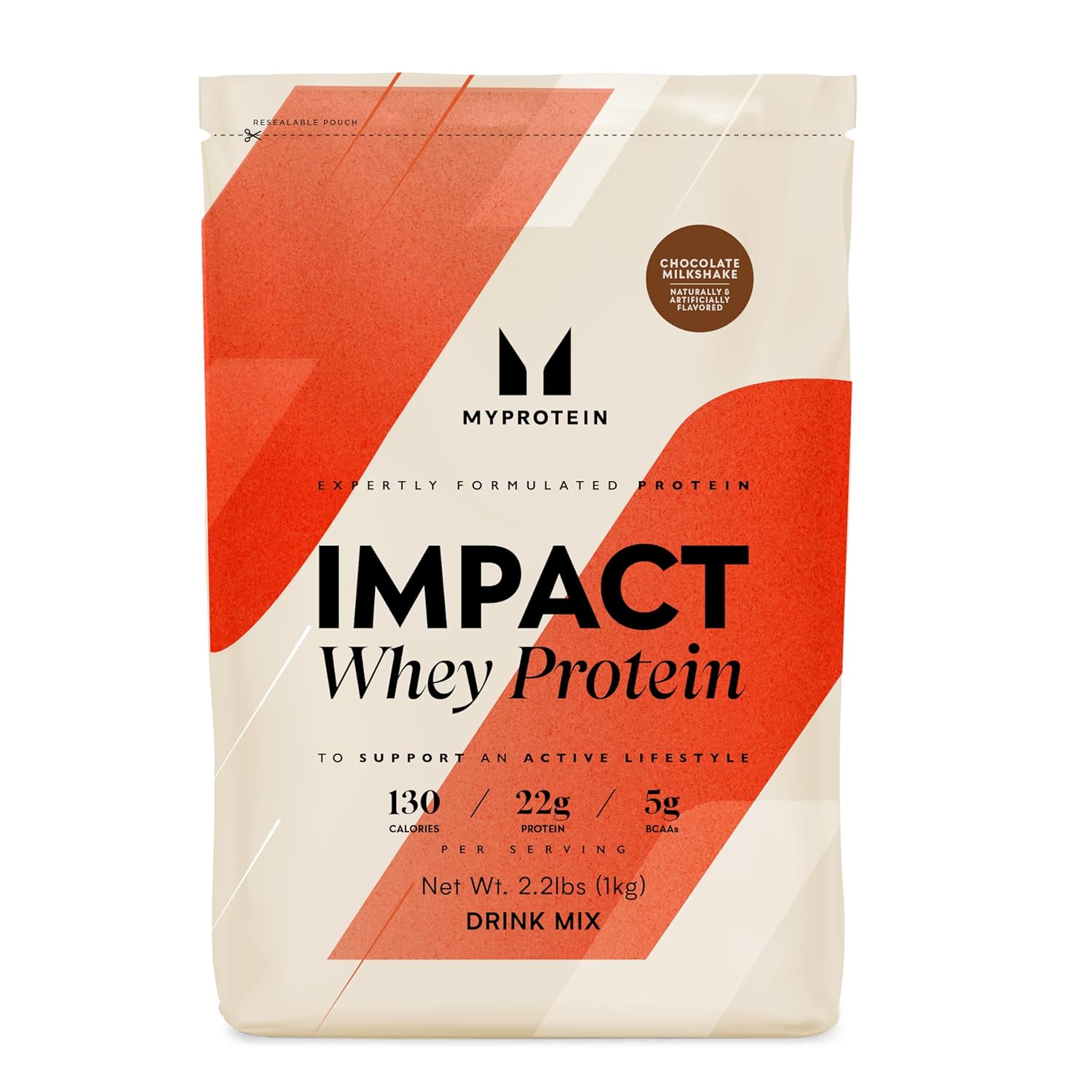
The bottom line
Add the counterfeit problem, the undisclosed India manufacturing, and the sucralose + soy lecithin combination that a significant slice of Indian buyers would rather avoid, and you get a product that's solidly decent when you get the real thing at a fair price — but requires more verification effort than any supplement at this price point should.
Two lab tests, three years apart — both tell a different part of the same story
This review features two publicly available independent laboratory reports on Myprotein Impact Whey Isolate. Read them both. Neither alone gives you the full picture.
Key findings
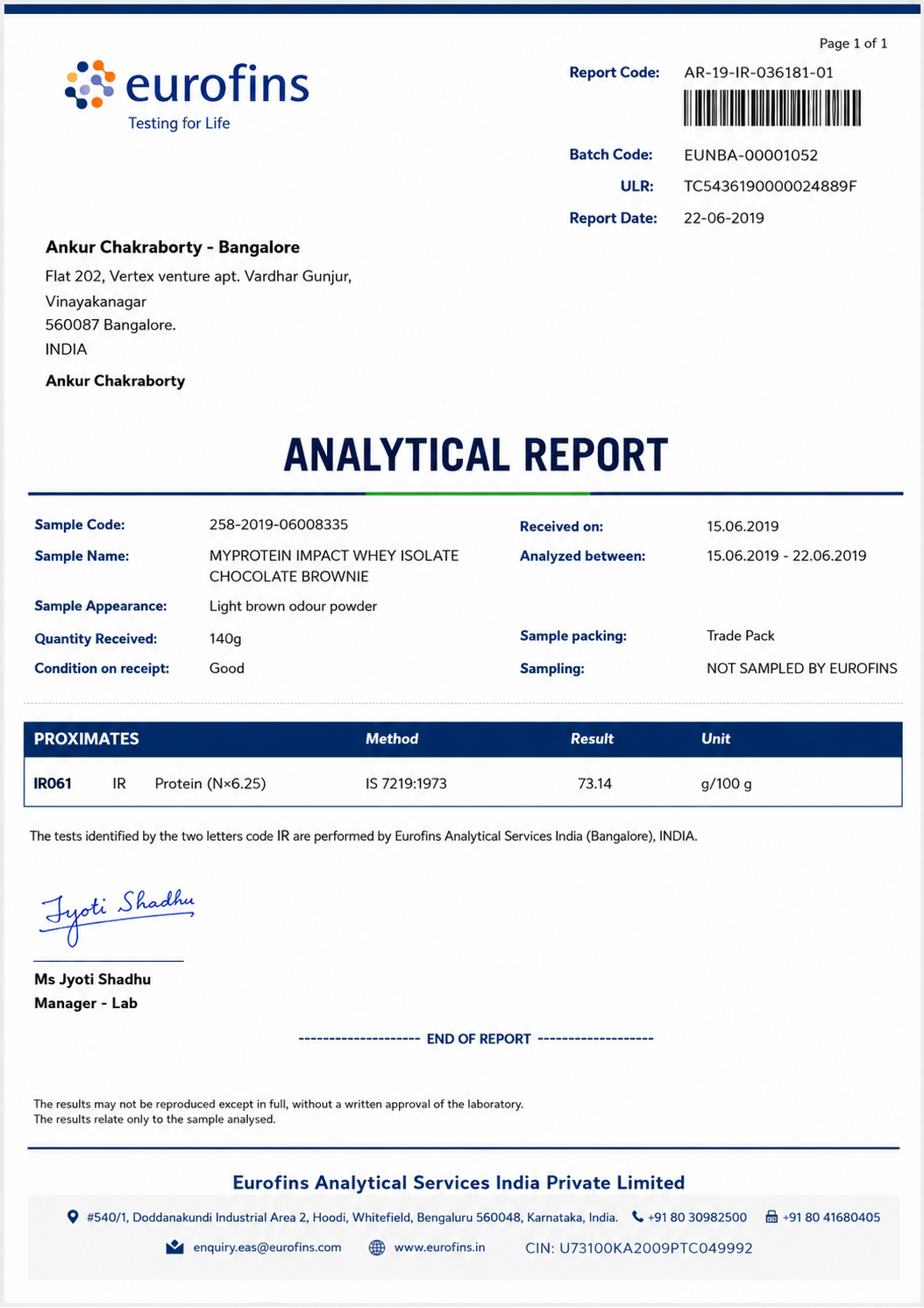
The 73.14g/100g result is the number most people gloss over. At face value it looks alarming — the brand says over 90%, the lab says 73.14%. There's a real explanation for the gap, but the explanation doesn't make the 90%+ headline any more honest for flavoured variants.
Why chocolate flavours will always test lower than the 90%+ claim
Myprotein discloses that their Chocolate Smooth formulation contains approximately 90% WPI and 8% cocoa powder by weight (plus emulsifiers and sweetener making up the remaining ~2%). When you buy a 25g scoop of Chocolate Brownie, roughly 2g of it is cocoa powder with zero protein content. That alone drops the theoretical maximum protein-by-weight from 90% down to around 83–85% before any measurement variability. The 2019 Eurofins result of 73.14g/100g sits even lower, suggesting either a higher-than-average cocoa inclusion in that specific batch, some batch variation, or both. What it does not show is amino spiking — the N×6.25 method tests total nitrogen, and 73.14% still reflects a genuine protein reading, just from a flavour-heavy batch. The brand's error is applying the 90%+ headline to all variants regardless of flavour content.
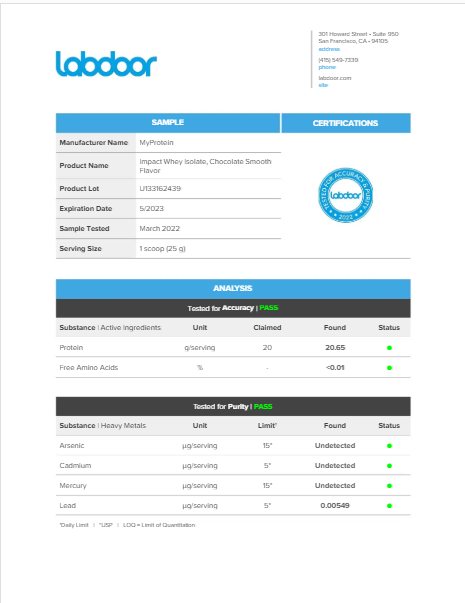
Key findings — Accuracy
Key findings — Heavy metals
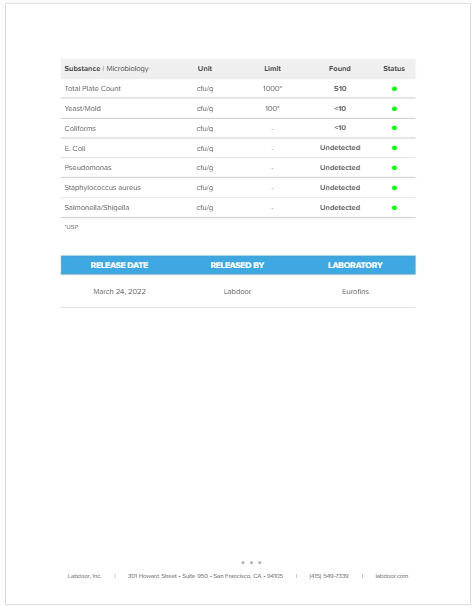
Key findings — Microbiology
How to read both reports together
The Labdoor 2022 test confirms the per-serving label claim is accurate, the amino acid profile is clean (no glycine, taurine, or creatine spiking), heavy metals are non-issues, and the microbiology is fine. The 2019 Eurofins test shows that the protein-by-weight figure for chocolate variants sits materially below the 90%+ headline. These findings don't contradict each other — they measure different things. Labdoor asks "does the serving contain what the label says?" The answer is yes. The Eurofins test asks "what percentage of this powder is protein?" The answer, for Chocolate Brownie, was 73.14%. Both results can be true simultaneously. The brand's responsibility is to stop claiming 90%+ for flavoured variants where 8% of the formulation by weight is cocoa powder.
What's actually in each scoop — and what varies by flavour more than most buyers realise
| Ingredient | Unflavoured | Chocolate Smooth | Chocolate Brownie | Assessment |
|---|---|---|---|---|
| Whey Protein Isolate (WPI) | ~95–96% | ~90% | ~90% | Genuine WPI — not concentrate. Per-serving protein label is accurate per Labdoor 2022. |
| Cocoa Powder | None | ~8% | Higher cocoa inclusion (Brownie profile) | The 8% cocoa directly displaces protein mass — this is why the 90%+ headline fails for chocolate variants by weight |
| Emulsifier | Soy Lecithin | Soy Lecithin + Sunflower Lecithin | Soy Lecithin | Soy allergen present in all variants. Relevant for soy-sensitive individuals. Sunflower lecithin in some versions is preferable. |
| Sweetener | None | Sucralose | Sucralose | Sucralose at standard doses has a good safety record in adults. Some buyers prefer stevia or no sweetener. No option here for flavoured variants. |
| Fat per serving | <0.25g | ~0.25–0.5g | ~0.5g | Appropriately low for a genuine WPI — consistent with proper microfiltration |
| Carbs per serving | <0.5g | <1g | <1g | Ultra-low carb profile — suitable for keto, cutting, calorie-controlled eating |
| Protein per serving label claim | ~22–25g | 20–21g (India label) | 20–21g (India label) | Labdoor 2022 confirms per-serving accuracy on Chocolate Smooth |
| Protein by weight (g/100g) | >90% (reasonable for unflavoured WPI-90) | 82.6g/100g (Labdoor 2022) | 73.14g/100g (Eurofins India 2019) | Both chocolate variants below the brand's "90%+ protein" headline. The flavour inclusion is not incidental — it meaningfully changes protein density. |
A point that doesn't get enough attention: the India-market label says 20g protein per 25g scoop for flavoured variants. The brand's global website, and most Indian retailer listings, lead with "over 90% protein." Those two numbers don't add up. 20g from 25g is 80%, not 90%. That's not deceptive in the clinical sense — 20g per serving is honest and the Labdoor test confirms it. But the 90%+ headline, applied to a chocolate variant with 20g protein from a 25g scoop, is a marketing claim that doesn't survive basic arithmetic.
Myprotein Impact Whey Isolate is manufactured in Paonta Sahib, Himachal Pradesh — not Manchester
The Myprotein brand was founded in the UK and built its reputation on UK-manufactured products. The India-market version of Impact Whey Isolate is manufactured by Zeon Lifesciences Ltd and Tirupati Wellness Pvt. Ltd., both operating out of Paonta Sahib, District Sirmour, Himachal Pradesh. The importer of record is Uniglobal Distributors Pvt. Ltd. This information appears on the physical product packaging in small text. It does not appear on Myprotein's India marketing pages, the global website, or most Indian retailer listings.
Is India-manufactured the same quality as UK-manufactured?
Myprotein does not publicly disclose whether the same quality standards, raw material suppliers, or process specifications apply to their Indian contract manufacturers as to their UK plant in Manchester. The Labdoor 2022 test — which passed for accuracy, purity, and microbiology — was conducted on a product from lot U133162439, which is an India-manufactured batch. So the available evidence suggests the India manufacturing is capable of producing a product that passes third-party testing. What's not available: ongoing per-batch verification, the raw material supplier for the WPI used in India, or any Informed Sport certification specifically covering the India-manufactured batches. Contract manufacturing quality can vary between batches in ways a single Labdoor test won't capture.
The counterfeit problem is real, documented, and not going away
Myprotein is one of the most counterfeited supplement brands in India. The combination of strong brand recognition, a consumer base that trusts the name without verifying the seller, and Amazon's third-party seller marketplace has created a situation where fake Myprotein products circulate at scale. The fakes range from low-protein knockoffs to outright non-whey fillers in legitimate-looking packaging.
The Indian Consumer Protection Authority and multiple consumer forums have documented complaints about substandard Myprotein products purchased through Amazon third-party sellers. Several fitness communities and YouTube reviewers have independently tested Amazon-sourced Myprotein products and found significant protein content discrepancies — some consistent with outright counterfeiting, others consistent with the kind of batch variation the 2019 Eurofins test captured.
How to reduce counterfeit risk when buying Myprotein in India
Purchase only from: (1) Myprotein's own India website (myprotein.co.in), (2) HealthKart's Myprotein-verified listings, or (3) Amazon listings where Sold by: Uniglobal Distributors Pvt. Ltd. and Fulfilled by Amazon are both confirmed. Never buy Myprotein from any third-party Amazon seller whose name is not Uniglobal. The price premium you pay buying from authorised channels over grey-market third-party sellers is not a discretionary saving — it's the cost of getting a product that matches the Labdoor test results. A product that costs ₹200 less from a random third-party seller and provides 30% less protein per serving costs you significantly more per gram of actual protein.
Why whey isolate outperforms concentrate for the specific users this product targets
Whey protein isolate's practical advantages over concentrate come down to two things that matter for the Indian market specifically: lactose content and protein density per calorie.
Standard whey protein concentrate contains 3–5g lactose per serving. Genuine WPI after microfiltration contains trace lactose, typically under 0.5g. Given that India has one of the highest lactose intolerance prevalence rates globally — roughly 70–80% of adults have some degree of lactase insufficiency — this distinction is not academic. Millions of Indian gym-goers experience bloating, cramps, and gas from WPC that disappears when they switch to a genuine isolate. The Myprotein Impact Whey Isolate, when authentic, delivers this benefit.
The protein-per-calorie argument is simpler. At roughly 21g protein and under 100 kcal per serving, this product lets someone in a caloric deficit hit their protein target without burning much of their energy budget on the supplement itself. That's a real advantage over concentrate for cutting phases, which is where a significant portion of the Indian gym community operates much of the year.
Leucine content and mTORC1 activation
At 21g protein per serving from a high-quality WPI source, leucine delivery is approximately 2.1–2.3g — below the 2.5g mTORC1 activation threshold that research identifies as optimal for acute muscle protein synthesis in most adults. RCT This means one scoop of the India-variant Myprotein Impact Whey Isolate (at 20g protein) technically sits at the lower boundary of the post-exercise dosing range. For adults over 60 or those with known anabolic resistance, a 1.5-scoop serve is a more reliable option. This is a dose consideration, not a quality concern — the protein is real and clean per Labdoor 2022.
What the published data says — and where Myprotein's own testing stands up
Labdoor Grade A — what it actually covers and what it doesn't
Myprotein Impact Whey Isolate has historically held a Labdoor Grade A rating. The 2022 test published its detailed findings: per-serving protein accuracy (pass), amino acid profile (no spiking), heavy metal screen (all below limits), and microbiology (all clean). This is good independent verification — Labdoor purchases products blind and tests without brand involvement.
What Labdoor doesn't do: provide per-batch ongoing verification. A test from March 2022 covers one lot. The 2019 Eurofins test covered a different lot, and the protein-by-weight result was materially different. This doesn't mean the Labdoor result is wrong — it means quality can vary between batches in ways a single test won't capture, particularly when the product is manufactured by contract manufacturers rather than in a proprietary controlled facility.
The protein per serving vs. protein per 100g distinction
The Labdoor test found 20.65g protein per 25g serving. That's label-accurate and represents a pass. Expressed per 100g, it's 82.6g. Neither the brand nor Labdoor is hiding this — it follows directly from the maths. The problem is that Myprotein's marketing consistently uses "over 90% protein" as the headline across all their materials, including for flavoured variants where cocoa powder occupies 8% of the formulation. At no point does the brand marketing say "90%+ for unflavoured; expect 80–83% for chocolate variants." That's the label honesty gap this review is scoring against.
Amino spiking — the clean result that matters most for the India market
The Labdoor 2022 test found free amino acids at less than 0.01% — well below the threshold that indicates nitrogen spiking. This is the most practically important finding for Indian buyers, because amino spiking with cheap nitrogen sources like glycine and taurine is documented in the Indian supplement market. Myprotein, at least in the 2022 Labdoor batch, is clean on this metric. RCT-equivalent — independent blind-purchase test
Flavour variety, price point, and who this product actually makes sense for
The honest India-specific case for Myprotein Impact Whey Isolate is this: it offers one of the widest flavour ranges of any WPI available on the Indian market, at a mid-tier import price point (₹4,500–5,000/kg from authorised sellers), with a per-serving protein label that independent testing has confirmed is accurate. For buyers who have tried domestic WPI options and found them bland or single-flavour, the Myprotein range genuinely solves a real problem. Not every buyer wants unflavoured powder added to curd or lassi.
Where it doesn't make sense: buyers who want the best protein-per-rupee outcome. Nakpro Platinum at ₹1.46/g protein, with Trustified QR authentication, puts a Trustified-verified certified product in your hand at roughly a quarter of the cost per gram. The flavour range is narrower, but the protein economics are not close.
| Product | Protein / serving | India price | ₹ / g protein | Independent test | Soy lecithin? |
|---|---|---|---|---|---|
| Myprotein Impact WPI (this) | 20–21g (flavoured) | ~₹4,500/1kg | ₹4.5–5.0 | Labdoor 2022 (one batch) | Yes — all variants |
| Nakpro Platinum Isolate | 31g | ₹1,449/32 sv | ₹1.46 | Trustified QR auth | No — sunflower |
| AS-IT-IS Whey Isolate | 25g | ₹2,499/1kg | ₹3.33 | Labdoor certified | No |
| Transparent Labs WPI | 28g | ~₹7,500/30sv | ₹12–15 | IC + IP + Labdoor 98/100 | No — sunflower |
| ON Gold Standard 100% Whey | 24g (WPI+WPC blend) | ₹3,599/908g | ₹5.0 | Labdoor Grade A | Yes |
Myprotein Impact Whey Isolate against three honest alternatives
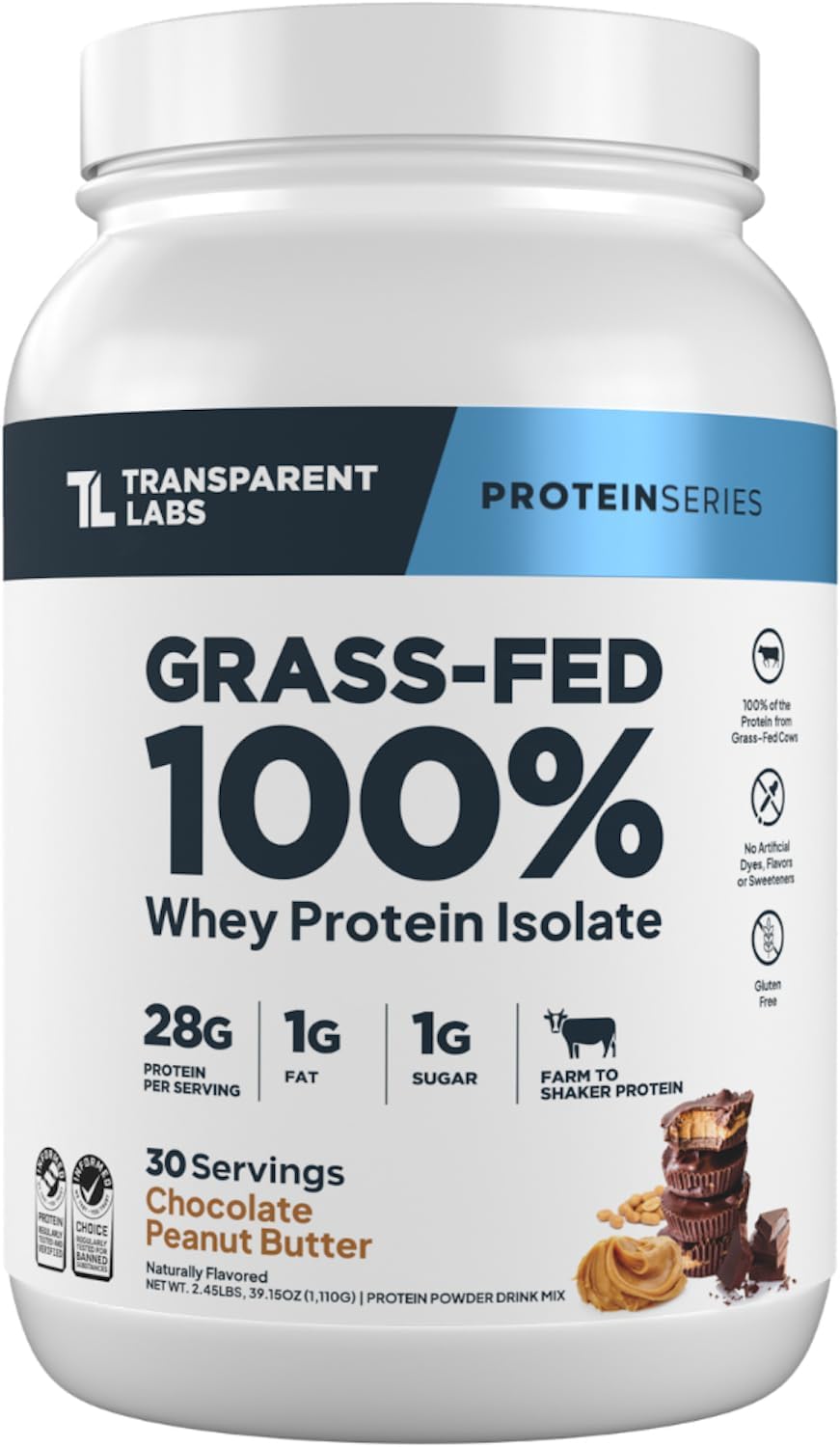

Full category: Best Whey Protein in India 2026 → | Whey Protein Isolate — ingredient deep-dive → | Transparent Labs WPI — 8.6/10 →
Buy / consider alternatives
Buy if
- You want a wide flavour selection in a genuine WPI — Myprotein's flavour range is legitimately one of the best available in India, and the base product is real isolate
- You buy exclusively from authorised sellers: myprotein.co.in, HealthKart Myprotein listings, or Amazon sold by Uniglobal Distributors with FBA fulfilment
- You are lactose-sensitive and want WPI with near-zero lactose, and domestic plain isolates have not worked for flavour preference
- You are on a caloric deficit and need a low-carb, low-fat protein source with a palatable chocolate flavour
- You want a product with at least one solid independent test on record — the 2022 Labdoor result gives more confidence than most Indian domestic brands without any third-party verification
Consider an alternative if
- You want the best protein-per-rupee outcome — Nakpro Platinum delivers more protein per serving at less than a third of the cost per gram
- Soy allergy or soy sensitivity is a concern — soy lecithin is present in every Myprotein Impact Whey Isolate flavoured variant
- You want per-batch independent verification — Labdoor's 2022 result covers one lot; Transparent Labs publishes lot-searchable COAs for every batch
- You are a competitive athlete requiring Informed Sport certification for WADA compliance — the standard Impact Whey Isolate line is not Informed Sport certified
- You are buying from any Amazon third-party seller who is not Uniglobal — counterfeit risk makes that purchase unreliable regardless of price
- The "90%+ protein" claim bothers you when the chocolate variants independently test at 73–82g/100g. This isn't deception in a legal sense, but it's not honest either.
Three changes that would make this an 8.5+ product in the India market
Stop applying the "90%+ protein" headline to chocolate variants
This is the simplest fix and the one with the most direct impact on trust. The unflavoured Impact Whey Isolate can legitimately claim over 90% protein by weight. Any chocolate variant, by the brand's own formulation disclosure (approximately 8% cocoa powder), cannot. The 2019 Eurofins test at 73.14g/100g and the 2022 Labdoor test at 82.6g/100g both confirm this. A product page that says "over 90% protein (unflavoured); approximately 80–83% for chocolate variants" would be accurate. The current approach — using 90%+ universally — is the kind of marketing claim that gets picked apart by consumers who can do basic maths, and rightly so.
Disclose India manufacturing prominently across all India-market channels
The manufacturer details are on the physical product label. They are not on myprotein.co.in product pages. They are not in Amazon listing descriptions. Most Indian buyers purchasing Myprotein products assume they're buying a UK-manufactured product — the brand's heritage and marketing actively encourage this assumption without directly stating it. Disclosing "Manufactured in India by Zeon Lifesciences / Tirupati Wellness, Paonta Sahib, HP" on the product pages would be an honest disclosure that the brand is currently making only at the physical label level. For a brand that built its reputation on transparency and science, this omission is inconsistent with the identity.
Publish per-batch COAs for India-manufactured lots on the India website
Transparent Labs does this. The infrastructure exists. A lot-number-searchable COA portal for India-manufactured batches — covering protein assay, amino acid profile, heavy metals, and microbiological results — would directly address the counterfeit problem by giving buyers a way to verify the specific unit they received. It would also differentiate Myprotein from the dozens of Indian supplement brands that cannot do this because they lack the quality documentation. At Myprotein's scale and resources, this is an editorial and website decision, not a cost barrier. Given that the 2022 Labdoor results are clean, publishing the data publicly should carry no risk. The hesitation to do so is harder to explain than the investment required to make it happen.
References & citations
- Eurofins Analytical Services India Private Limited (2019). Analytical Report AR-19-IR-036181-01. Sample: Myprotein Impact Whey Isolate Chocolate Brownie. Batch EUNBA-00001052. Protein (N×6.25, IS 7219:1973): 73.14g/100g. Report date: 22-06-2019. Consumer-commissioned; Bengaluru facility.
- Labdoor Inc. (2022). Myprotein Impact Whey Isolate Chocolate Smooth — Accuracy and Purity Report. Product Lot U133162439. Tested March 2022, released March 24, 2022. Laboratory: Eurofins. Protein found: 20.65g vs. 20g claimed (PASS). Free amino acids: <0.01% (no spiking). All heavy metals below USP limits. All microbiology results clean. labdoor.com.
- Witard OC et al. (2014). Myofibrillar muscle protein synthesis rates in response to small and large bolus doses of dairy protein. Am J Clin Nutr, 99(1):86–95. RCT — leucine threshold context for 20g vs. 25g+ protein doses.
- Moore DR et al. (2009). Ingested protein dose response of muscle and albumin protein synthesis. Am J Clin Nutr, 89(1):161–8. RCT
- Nunes EA et al. (2022). Systematic review and meta-analysis of protein intake to support muscle mass and function. J Cachexia Sarcopenia Muscle, 13(2):795–810.
- Myprotein.com (2026). Impact Whey Isolate product page — ingredient disclosure. "Whey Protein Isolate (Milk) (90%), Fat Reduced Cocoa Powder (8%), Natural Flavouring, Sweetener (Sucralose)."
- Amazon.in (2026). Myprotein Impact Whey Isolate product listing. Manufacturer: Zeon Lifesciences Ltd / Tirupati Wellness Pvt. Ltd., Paonta Sahib, HP. Importer: Uniglobal Distributors Pvt. Ltd.
Lab report note. The Eurofins 2019 report was commissioned by a consumer and is publicly circulated in the Indian supplement community. The Labdoor 2022 report is publicly available at labdoor.com. Both are reproduced here for editorial transparency and reader access — they are presented in full without editing. The Naked Compound analysis of their findings represents our independent editorial interpretation.
Not medical advice. Whey protein is safe for healthy adults at standard supplementation doses. Soy-allergic individuals should avoid all flavoured variants of this product due to soy lecithin content.
Frequently asked questions
Is Myprotein Impact Whey Isolate actually 90% protein?
The 90%+ protein figure applies to the unflavoured variant. Flavoured versions are a different story — a 2019 Eurofins India test on Chocolate Brownie returned 73.14g protein per 100g, and a 2022 Labdoor test on Chocolate Smooth returned 82.6g/100g (or 20.65g per 25g scoop). Both are well below the 90%+ headline that Myprotein uses across all product marketing. The gap exists because cocoa powder constitutes roughly 8% of the chocolate formulation by weight, directly displacing protein mass. Myprotein's 90%+ claim is technically defensible for the unflavoured product — applying it universally to flavoured variants is where the label strains credibility.
Is Myprotein Impact Whey Isolate made in India or the UK?
The India-market version of Myprotein Impact Whey Isolate is manufactured locally by Zeon Lifesciences Ltd and Tirupati Wellness Pvt. Ltd., both based in Paonta Sahib, Himachal Pradesh. The importer of record is Uniglobal Distributors Pvt. Ltd. This is not disclosed prominently on Myprotein's India marketing, which leads many buyers to assume they're getting a UK-manufactured product. The manufacturing quality at Indian contract facilities may or may not match the UK plant — Myprotein does not publicly disclose whether the same quality standards apply to both.
Does Myprotein Impact Whey Isolate have Labdoor certification?
Myprotein Impact Whey Isolate has historically received a Grade A rating from Labdoor. A March 2022 Labdoor test (Chocolate Smooth flavour, 25g serving) found 20.65g protein versus the 20g label claim, no free amino acid spiking, all heavy metals below detection limits, and clean microbiological results. The test was conducted at Eurofins laboratories. However, Labdoor tests one or a few batches at a time — it does not provide ongoing per-batch certification. The 2019 Eurofins India test, conducted independently by a consumer, found 73.14g protein per 100g on Chocolate Brownie, significantly below the 90%+ claimed.
How does Myprotein Impact Whey Isolate compare to Nakpro and Transparent Labs in India?
On verified protein per gram cost, Myprotein Impact Whey Isolate at approximately ₹4–5/g protein sits between Nakpro Platinum (₹1.46/g) and Transparent Labs (₹12–15/g). On third-party certification, Transparent Labs holds Informed Choice + Informed Protein + Labdoor 98/100 with public per-batch COAs — Myprotein has only historical Labdoor testing without per-batch public COAs. On protein purity per 100g in flavoured variants, the 2019 India test at 73.14g/100g is concerning and has not been publicly addressed by the brand. For buyers who train regularly and want verified protein at the lowest honest cost, Nakpro Platinum is the rational domestic choice. Myprotein's main advantage is flavour variety and brand recognition.