The bottom line
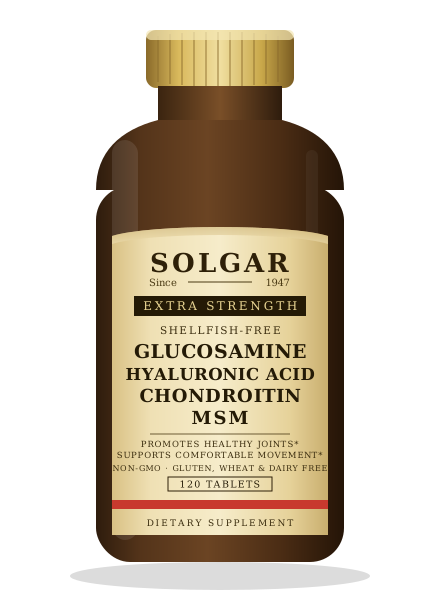
Two things keep the score in the mid-6s. First, the glucosamine is hydrochloride form, not sulfate — and almost all of the positive osteoarthritis evidence was built on pharmaceutical-grade glucosamine sulfate, not HCl. Second, this whole category — glucosamine plus chondroitin plus MSM — is a genuinely contested treatment that OARSI, the American College of Rheumatology and the UK's NICE all conditionally recommend against for most patients. Add an India import price near ₹4,800 for a 40-day supply, and the maths only works for people who need exactly what this bottle offers: a clean, shellfish-free option they'll actually take for three months to see if it helps them personally.
What Solgar gets right
The stand-out is the shellfish-free glucosamine from corn fermentation — a real answer for shellfish-allergic buyers who are otherwise locked out of this category. Glucosamine (1500mg), chondroitin sulfate (1200mg) and MSM (1500mg) all sit at their standard studied amounts. The tablet is remarkably clean: non-GMO, no gluten, wheat, dairy, soy, yeast, sugar, artificial colours, flavours or preservatives, with only vegetable cellulose, vegetable stearic acid, silica, vegetable magnesium stearate and vegetable glycerin as excipients. Solgar's Gold Standard manufacturing and 75+ years of brand history are behind it.
What each ingredient is supposed to do — and why the glucosamine salt form is the whole story
Cartilage is a living tissue with almost no blood supply. It is built from chondrocytes embedded in a matrix of type II collagen and proteoglycans — long, brush-like molecules whose bristles are glycosaminoglycans (GAGs) such as chondroitin sulfate and hyaluronic acid. The logic behind every glucosamine-chondroitin-MSM formula is simple: feed the body the raw materials of cartilage and hope some of it ends up being used to slow cartilage breakdown or dampen joint inflammation. Whether that logic survives contact with clinical trials is the real question of this review — but first, the four ingredients.
Glucosamine — the substrate argument
Glucosamine is an amino sugar and the natural precursor the body uses to build the GAG chains in cartilage. The supplement rationale is that supplying extra glucosamine gives chondrocytes more substrate for matrix synthesis, and some in vitro work suggests glucosamine can also modestly down-regulate inflammatory signalling (NF-κB, IL-1β-driven cartilage catabolism). In vitro / mechanistic The mechanistic story is plausible; the clinical story depends heavily — as we'll see — on which chemical form of glucosamine you use and how you dose it.
Chondroitin sulfate — the matrix bristle
Chondroitin sulfate is itself one of the GAGs in cartilage. Orally, it is a large molecule and its absorption is partial and debated, but ingested chondroitin does raise plasma GAG levels and may reduce cartilage-degrading enzyme activity (aggrecanases, MMPs). Mechanistic Solgar supplies 1200mg per serving from a standalone chondroitin source, plus a further ~48mg carried inside the BioCell Collagen II — a total near 1248mg, comfortably within the studied 800–1200mg range.
MSM — the sulfur donor
Methylsulfonylmethane (MSM) is an organosulfur compound. Sulfur is a structural requirement for GAG and collagen cross-linking, and MSM has documented antioxidant and anti-inflammatory activity, plausibly by scavenging reactive oxygen species and blunting NF-κB signalling. In vitro / mechanistic The osteoarthritis RCTs that show a signal for MSM generally used 3000–6000mg/day. Solgar's 1500mg sits at the bottom of the studied range — enough to be honest about including, not enough to expect the effect sizes seen in the higher-dose trials.
Hyaluronic acid (and BioCell Collagen II) — the small print
Hyaluronic acid is the GAG that gives synovial fluid its viscosity and cartilage its shock absorption. Injected HA is an established osteoarthritis therapy; oral HA is a far weaker proposition, and the trials that show anything used roughly 80–200mg/day. Solgar delivers 30mg of HA, carried inside 300mg of BioCell Collagen II (a chicken-cartilage extract that also brings a little collagen type II and chondroitin). BioCell's own supportive RCT used 2000mg/day — nearly seven times what's in a Solgar serving. Both the HA and the BioCell here are best understood as label garnish: real ingredients, present in amounts too small to expect their studied effects.
The part that actually decides this product: HCl vs sulfate
Here is the single most important fact about Solgar's formula, and it is hidden in one word on the label — "hydrochloride." All oral glucosamine reaches the body as a salt: either glucosamine sulfate or glucosamine hydrochloride (HCl). HCl actually contains slightly more glucosamine per milligram (it is not diluted by a sulfate/salt-stabiliser). On paper, HCl looks like the efficient choice. In the clinic, it is the opposite.
The positive osteoarthritis trials — the ones that put glucosamine on the map — almost all used a single, specific preparation: patented crystalline glucosamine sulfate, 1500mg taken once daily, manufactured by Rottapharm. When reviewers separate the trials by preparation, a striking pattern appears: the sulfate-form, once-daily, industry-standard studies tend to show benefit; the hydrochloride-form studies tend not to. Solgar uses hydrochloride.
Why "1500mg glucosamine" is not the same claim as it looks
Solgar's 1500mg of glucosamine hydrochloride matches the studied amount — but not the studied form. Three explanations compete for why sulfate outperformed HCl in trials: (1) the sulfate moiety itself may matter for cartilage synthesis; (2) the winning trials dosed 1500mg once daily, producing a higher plasma peak than split dosing; and (3) the sulfate trials were run by a single manufacturer, raising the possibility of sponsorship bias. Whichever is true, the practical takeaway is the same: HCl-form glucosamine carries the weaker end of the evidence. If glucosamine is the reason you're buying this, the sulfate form has the better paper trail.
To be fair to Solgar: the reason they use HCl is almost certainly the shellfish-free story. Shellfish-free glucosamine is produced by corn fermentation, and the fermentation route yields the hydrochloride salt cleanly. In other words, the very feature that makes this product valuable — no shellfish — is bound up with the form that has the weaker evidence. That trade-off sits at the heart of this review.
What's in a 3-tablet serving — mapped to clinical evidence thresholds
| Component | Per 3 tablets (daily serving) | Clinically studied dose | Assessment |
|---|---|---|---|
| Glucosamine Hydrochloride | 1500 mg | 1500 mg/day (as sulfate, once daily) RCT | Right amount, wrong salt — HCl carries the weaker evidence vs pharmaceutical glucosamine sulfate |
| Chondroitin Sulfate | 1200 mg (+~48 mg from BioCell) | 800–1200 mg/day RCT | On target — full studied dose |
| MSM (methylsulfonylmethane) | 1500 mg | 3000–6000 mg/day in most positive OA trials RCT | Bottom of the studied range — present but under-dosed for the trial effect sizes |
| BioCell Collagen II | 300 mg | 2000 mg/day (Schauss 2012) RCT | ~15% of the studied dose — effectively decorative |
| Hyaluronic Acid (from BioCell) | 30 mg | 80–200 mg/day for oral HA trials Observational / small RCT | Well below studied oral dose — label garnish |
| Hydrolyzed Collagen Type II (from BioCell) | 180 mg | Data thin at this dose; UC-II trials use 40 mg undenatured (a different molecule) | Minor contribution; not comparable to undenatured UC-II protocols |
| Glucosamine source | Shellfish-free — corn fermentation | Genuine differentiator — safe for shellfish allergy | |
| Other ingredients | Vegetable cellulose, microcrystalline cellulose, vegetable stearic acid, silica, vegetable magnesium stearate, vegetable glycerin | Clean excipient list — no synthetic dyes, no titanium dioxide, no PEG | |
| Free-from claims | Non-GMO; no gluten, wheat, dairy, soy, yeast, sugar, artificial flavour, sweetener, preservative or colour | Industry-leading label cleanliness | |
| Vegetarian? | No — chondroitin and BioCell Collagen II are animal-derived | Shellfish-free ≠ vegetarian. Not for vegetarians or vegans. | |
Dose adequacy — Solgar's serving as a share of each ingredient's clinically studied dose
Dose calibration: take all three tablets together, with food
Each tablet is one-third of the serving. Because the pharmaceutical glucosamine-sulfate evidence is specifically tied to a single high-peak once-daily dose, the closest you can get with this HCl product is to take all three tablets at once — not one at each meal. Take them with your largest meal to reduce the mild GI upset some people get from glucosamine. A 120-tablet bottle is exactly 40 days at three tablets a day, so budget for a fresh bottle roughly every six weeks if you commit to a proper trial.
The evidence-grade gap: HCl form, a contested category, and an import premium
The category itself is on shaky ground
Before we even get to Solgar's specific choices, the honest framing is this: glucosamine and chondroitin are among the most-studied supplements in the world, and the weight of that evidence is unconvincing for most people. Three of the most influential guideline bodies — OARSI (2019), the American College of Rheumatology (2019) and the UK's NICE — all issue conditional recommendations against glucosamine and chondroitin for knee and hip osteoarthritis. Their reasoning is consistent: where benefits appear, they are small, inconsistent across trials, and shrink further in the largest, best-blinded, industry-independent studies. This isn't fringe scepticism; it's the mainstream reading of the literature.
That does not make the product useless. A meaningful minority of individuals report genuine relief, the safety profile is excellent, and osteoarthritis pain is variable enough that an 8–12 week self-trial is a reasonable, low-risk thing to do. But you should buy this understanding that you are testing a hypothesis on yourself, not filling a prescription with settled efficacy behind it.
Solgar picked the weaker form of a contested ingredient
Within that already-contested category, Solgar's glucosamine is hydrochloride — the form associated with the flatter trial results. The GAIT trial (Clegg et al., 2006; n=1583), the largest US study, used glucosamine HCl plus chondroitin and found no statistically significant benefit over placebo for the overall cohort on its primary endpoint. The trials that did show benefit used crystalline glucosamine sulfate dosed once daily. So the buyer of this bottle is, in a sense, getting the less-supported version of an already-doubtful intervention. The shellfish-free benefit is what has to justify that.
If you specifically want the best-evidence glucosamine
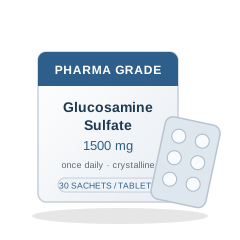
Ask for pharmaceutical-grade crystalline glucosamine sulfate, 1500mg once daily (sold internationally as Dona or Viartril-S, and available in India as glucosamine sulfate tablets). That is the exact preparation and dose behind the positive European trials. The catch: it is almost always shellfish-derived, so it is off-limits if a shellfish allergy is the reason you're reading this review. This is the fork in the road — best evidence (sulfate, shellfish) versus shellfish-free safety (HCl, weaker evidence). Solgar sits firmly on the shellfish-free side.
The India import problem
Solgar is a US brand, now owned by Nestlé Health Science, and this product reaches India as an import: sea or air freight, customs, a registered importer's warehouse, then Amazon fulfilment or a pharmacy shelf. The landed price is roughly ₹4,800 for 120 tablets — a 40-day supply — which works out near ₹120 a day. For an intervention that guideline bodies are lukewarm on, at a dose form tied to the weaker evidence, that is a lot to ask unless the shellfish-free feature is doing real work for you. Tablets are far more shelf-stable than fish-oil softgels, so the import journey doesn't threaten potency the way it does for omega-3 — but it does inflate the price.
Buying an import in India — the checks that matter
Insist on a bottle carrying the Indian importer's FSSAI sticker with a legible importer name and licence number; its absence signals grey-market stock. Check that the expiry is at least 18 months out and the tamper-evident seal is intact. Prefer listings that are Fulfilled by Amazon or sold by an authorised Solgar distributor over anonymous third-party sellers. Tablets tolerate heat far better than oils, but store the closed bottle in a cool, dry cupboard away from bathroom humidity all the same.
What the clinical literature actually shows for these four ingredients
Glucosamine — a tale of two salt forms
The positive case rests on the sulfate preparation. Reginster et al. (2001; n=212) and Pavelka et al. (2002; n=202) reported that crystalline glucosamine sulfate, 1500mg once daily for up to three years, slowed joint-space narrowing and improved symptoms versus placebo in knee osteoarthritis. RCT The negative case rests largely on the hydrochloride form: the NIH-funded GAIT trial (Clegg et al., 2006; n=1583) used glucosamine HCl and found no significant benefit over placebo overall, with only a non-significant signal in a subgroup with moderate-to-severe pain. RCT Cochrane's review (Towheed et al., 2005) crystallised the pattern: pooled benefit shrinks toward null once non-sulfate, non-Rottapharm preparations are included. Solgar is the HCl form.
Chondroitin — modest, and better in combination
The MOVES trial (Hochberg et al., 2016; n=606) found glucosamine plus chondroitin comparable to celecoxib for knee OA pain over six months — an encouraging combination result, though the absence of a placebo arm limits it. RCT A large Cochrane review (Singh et al., 2015) concluded chondroitin produces a small, probably clinically marginal improvement in pain, with better-quality trials showing smaller effects. Solgar's ~1200mg chondroitin is a full studied dose — the strongest-dosed part of this formula on paper.
MSM — a real but small signal, under-dosed here
A systematic review by Brien et al. (2008) and subsequent RCTs (Kim et al., 2006, 3g/day; Debbi et al., 2011, 3.4g/day) found MSM produced modest reductions in pain and stiffness in knee OA versus placebo, without major safety concerns. RCT The effect sizes were small and the trials mostly used 3000–6000mg/day. Solgar's 1500mg is half the lower boundary of that range — enough to list honestly, not enough to expect the trial effect.
Oral hyaluronic acid and BioCell Collagen II — thin at these doses
Small trials of oral HA (Oe et al., 2016; Tashiro et al., 2012) at 80–200mg/day suggest possible symptom benefit in knee OA, but the evidence base is small and industry-linked. Small RCT / observational BioCell Collagen II has one supportive RCT (Schauss et al., 2012) at 2000mg/day for joint comfort. RCT Solgar delivers 30mg HA and 300mg BioCell — roughly a fifth to a seventh of those studied amounts. Treat both as marketing ingredients rather than active doses.
The honest synthesis
If you strip away the two garnish ingredients, this is a glucosamine-HCl-plus-chondroitin-plus-low-MSM product. The best-case reading of the literature is that a combination like this offers a small, uncertain symptom benefit for some people with knee osteoarthritis, comparable in size to what a modest NSAID dose provides but far slower to appear. The worst-case reading — held by several guideline committees — is that most of the apparent benefit is placebo and publication bias. Both readings agree on two things: it is very safe, and it is worth a defined 8–12 week trial only if you can judge your own response honestly at the end of it.
Solgar Gold Standard manufacturing — clean, but no public per-batch COA
| Parameter | Standard applied | Status | Notes |
|---|---|---|---|
| Active ingredient potency | Label claim ±QA tolerance | Verified internally — not posted per batch | Solgar Gold Standard QA; consumer cannot see lot-level results |
| Glucosamine source purity | Shellfish-free (corn fermentation) | Confirmed shellfish-free | The core reason to choose this product — verified non-shellfish origin |
| Heavy metals (Pb, Cd, As, Hg) | USP / GMP limits | Passes per Solgar QA | Not publicly posted per Indian batch |
| Non-GMO | Non-GMO sourcing | Verified | Relevant given the corn-fermentation glucosamine origin |
| Allergen control | Free-from programme | No gluten, wheat, dairy, soy, yeast, shellfish | Strong allergen profile; note it still contains animal-derived chondroitin/collagen |
| Excipient cleanliness | Best practice | Vegetable-based; no synthetic dyes or TiO₂ | Cleaner than most mass-market joint tablets |
| Third-party public certification (USP/NSF) | Publicly searchable results | Not enrolled | No independent, consumer-searchable batch verification |
| Per-batch COA publicly accessible | Best practice | On request only | Must contact Solgar with a lot number — not a realistic workflow for Indian buyers |
As with Solgar's other imports, the gap here is transparency rather than quality. Nestlé Health Science's resources and Solgar's Gold Standard programme mean genuine controls exist, and the label is unusually clean. But none of it is verifiable at the batch level by a consumer buying through Amazon India. For a ₹4,800 supplement, publicly searchable batch COAs — or USP/NSF enrolment — should be the standard, and they are absent.
Who this is actually for in India, and the honest INR value comparison
Who genuinely benefits — and who shouldn't bother
The clearest case for this specific product is a person with a shellfish allergy — or a strong aversion to shellfish-derived ingredients — who wants to trial glucosamine for knee or hip osteoarthritis and has been warned off ordinary crab/shrimp-shell glucosamine. For them, Solgar is one of the few clean, well-made, shellfish-free options on the Indian shelf, and the premium buys something real.
It is a weaker choice for: vegetarians and vegans (the chondroitin and BioCell Collagen II are animal-derived — this is shellfish-free, not plant-based); budget-conscious buyers who can take ordinary glucosamine (a domestic combination formula or pharmaceutical glucosamine sulfate delivers equal-or-better evidence for far less); and anyone hoping for a decisive fix, since the category's efficacy is genuinely uncertain. For inflammatory joint disease such as rheumatoid arthritis or ankylosing spondylitis, this is not a treatment — those require physician-directed DMARD therapy, and a glucosamine formula is at best an adjunct to discuss with a rheumatologist.
INR pricing comparison — Solgar vs the Indian joint-supplement shelf
| Product | Key actives / daily serving | Glucosamine form | Pack price (India, approx.) | ≈ ₹ / day | Shellfish-free? |
|---|---|---|---|---|---|
| Solgar Glucosamine HA Chondroitin MSM (this product) | Glu 1500 + Chon 1200 + MSM 1500 + HA 30 | HCl | ~₹4,800 / 120 tab | ~₹120 | Yes |
| Pharmaceutical glucosamine sulfate (Dona / Viartril-S type) | Glucosamine sulfate 1500 (once daily) | Sulfate (best evidence) | ~₹1,200–1,800 / month | ~₹40–60 | No (shellfish-derived) |
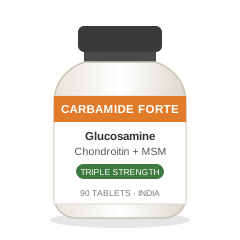
| Carbamide Forte Glucosamine Chondroitin MSM | Glu + Chon + MSM combination | Typically HCl | ~₹700 / 90 tab | ~₹23 | Varies |
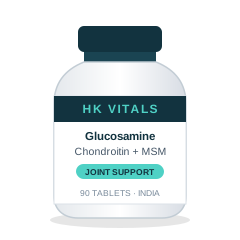
| HealthKart HK Vitals Glucosamine | Glu + Chon + MSM combination | HCl / sulfate (varies) | ~₹650 / 90 tab | ~₹22 | Varies |
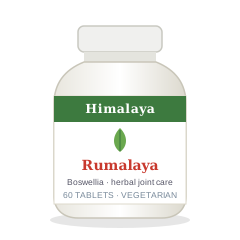
| Himalaya Rumalaya (herbal alternative) | Boswellia + other joint herbs | n/a — different mechanism | ~₹250 / 60 tab | ~₹8 | Yes (herbal) |
Prices are indicative Indian retail as of mid-2026 and move with import duty, seller and pack size — treat them as ballpark, not quotes.
The table tells the whole story. If your only requirement is "glucosamine for my knees," a pharmaceutical-grade glucosamine sulfate gives you the best-evidence form at roughly half Solgar's daily cost, and a domestic combination gives you a similar HCl-based formula at a fifth of the cost. Solgar wins on exactly one axis: it is genuinely shellfish-free and impeccably clean. If that axis matters to you, the premium is defensible. If it doesn't, it is very hard to justify paying ₹120 a day here.
Solgar against the alternatives that matter for Indian buyers

Full category context: Best joint-support supplements India 2026 → | Glucosamine — full ingredient entry → | Solgar VM-75 Multivitamin — 8.2/10 →
Buy / consider alternatives
Buy if
- You have a shellfish allergy (or avoid shellfish) and want to trial glucosamine safely — this is the product's whole reason to exist, and it does it well
- You want the cleanest possible label — non-GMO, no gluten/wheat/dairy/soy, no synthetic dyes, vegetable-based fillers
- You value Solgar's brand provenance and Gold Standard manufacturing and are willing to pay the import premium for it
- You'll commit to a proper 8–12 week trial, taking all three tablets together with a meal, and judge your own response honestly at the end
- You want glucosamine, chondroitin and MSM in one bottle rather than juggling separate products
Consider an alternative if
- You can take ordinary glucosamine — a pharmaceutical-grade glucosamine sulfate at 1500mg once daily has the stronger evidence at lower cost
- You are vegetarian or vegan — this contains animal-derived chondroitin and BioCell Collagen II; shellfish-free is not the same as plant-based
- Budget matters — domestic combinations deliver a comparable HCl formula at roughly a fifth of the daily cost
- You are hoping for a decisive result — OARSI, ACR and NICE all lean against this category; manage your expectations accordingly
- You need the hyaluronic acid or collagen to do real work — at 30mg HA and 300mg BioCell, they are present but under-dosed
How to run a fair trial of this product
Take all three tablets together, once daily, with your largest meal — this best approximates the high-peak dosing behind the positive glucosamine evidence and reduces stomach upset. Give it a full 8–12 weeks; joint-supplement effects, if they appear at all, are slow. Track a simple weekly score (0–10) for your worst-affected joint before you start and throughout, so you can tell a real change from a good week. If there's no meaningful improvement by week 12, stop — you are a non-responder, and continuing at ₹120/day isn't justified. If you're on any medication, note that glucosamine can mildly potentiate warfarin; check with your doctor first.
Three changes that would lift this from niche pick to category leader
Offer a shellfish-free glucosamine sulfate version
The single biggest limitation is baked into the chemistry: the shellfish-free route yields glucosamine hydrochloride, the form tied to weaker trial results. But fermentation-derived glucosamine can be converted to a stabilised sulfate salt — some manufacturers already do this. A shellfish-free glucosamine sulfate at 1500mg once daily would give allergy-sensitive buyers the best-evidence form for the first time, and would be a genuine world-first selling point rather than a compromise. That product would score in the 8s.
Right-size the hyaluronic acid and BioCell, or drop them from the name
Putting "Hyaluronic Acid" in the product name while delivering 30mg — a fraction of any studied oral dose — is the one place the label oversells. Either raise the HA and BioCell Collagen II toward their studied amounts (which would justify the billing), or move them to a supporting line and let the glucosamine-chondroitin-MSM core carry the name. As it stands, two of the four headline ingredients are present in amounts that can't do what the name implies.
Publish per-batch COAs or enrol in USP/NSF
Solgar has the manufacturing resources of Nestlé Health Science behind it. For a ₹4,800 import, Indian buyers should be able to look up the potency and heavy-metal results for the exact lot in their hand — searchable by lot number — instead of being asked to make an international phone call. Publicly posted batch COAs, or enrolment in a third-party certification scheme, would turn Solgar's real (but invisible) quality into a verifiable advantage.
References & citations
- Clegg DO et al. (2006). GAIT: Glucosamine, chondroitin sulfate, and the two in combination for painful knee osteoarthritis. N Engl J Med, 354(8):795–808. RCT
- Reginster JY et al. (2001). Long-term effects of glucosamine sulphate on osteoarthritis progression. Lancet, 357(9252):251–256. RCT
- Pavelka K et al. (2002). Glucosamine sulfate use and delay of progression of knee osteoarthritis. Arch Intern Med, 162(18):2113–2123. RCT
- Herrero-Beaumont G et al. (2007). Glucosamine sulfate in the treatment of knee osteoarthritis symptoms (GUIDE). Arthritis Rheum, 56(2):555–567. RCT
- Towheed TE et al. (2005). Glucosamine therapy for treating osteoarthritis. Cochrane Database Syst Rev, (2):CD002946.
- Hochberg MC et al. (2016). MOVES: Combined chondroitin + glucosamine vs celecoxib in knee osteoarthritis. Ann Rheum Dis, 75(1):37–44. RCT
- Singh JA et al. (2015). Chondroitin for osteoarthritis. Cochrane Database Syst Rev, (1):CD005614.
- Brien S et al. (2008). Systematic review of MSM in the treatment of osteoarthritis. Osteoarthritis Cartilage, 16(11):1277–1288.
- Kim LS et al. (2006). Efficacy of methylsulfonylmethane (MSM) in osteoarthritis pain of the knee. Osteoarthritis Cartilage, 14(3):286–294. RCT
- Schauss AG et al. (2012). Effect of BioCell Collagen on joint discomfort. J Agric Food Chem, 60(16):4096–4101. RCT
- Bannuru RR et al. (2019). OARSI guidelines for the non-surgical management of knee, hip, and polyarticular osteoarthritis. Osteoarthritis Cartilage, 27(11):1578–1589.
- Kolasinski SL et al. (2020). 2019 American College of Rheumatology guideline for the management of osteoarthritis of the hand, hip, and knee. Arthritis Care Res, 72(2):149–162.
Not medical advice. Glucosamine may mildly potentiate anticoagulants such as warfarin and can affect blood-sugar readings in some people. If you are pregnant, breastfeeding, diabetic, on blood thinners, or managing an inflammatory joint disease, consult a physician before starting. Osteoarthritis that is worsening, or joint pain with swelling, redness, fever or locking, needs medical assessment — not a supplement. Nothing here constitutes a clinical recommendation.