The bottom line
The best-formulated multivitamin available in India on mineral bioavailability and B-complex dose — with one formulation anachronism that Solgar has not corrected in decades.
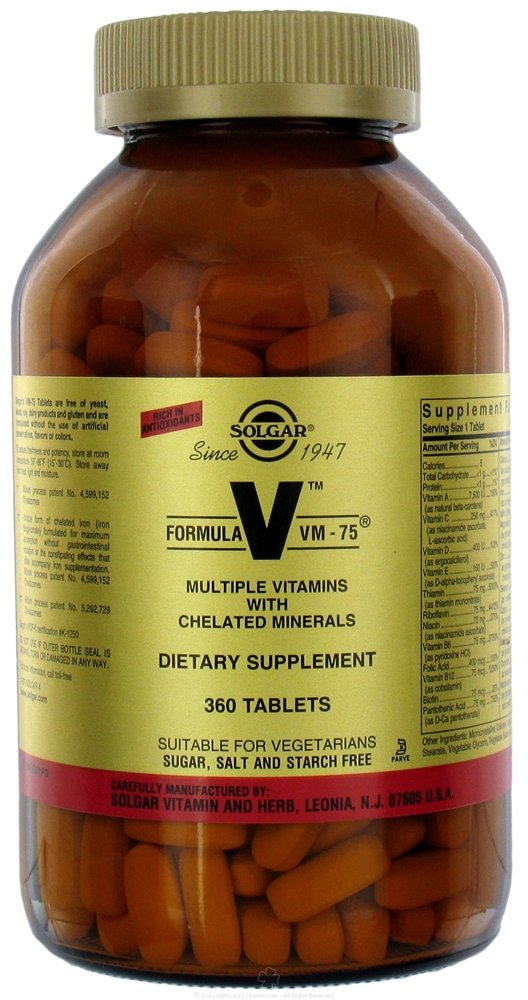
Solgar Formula VM-75 is, ingredient for ingredient, the most thoughtfully formulated multivitamin you can buy in India at any price point. The 75mg B-complex is genuinely therapeutic — not a percentage-of-RDA gesture but a dose at which the clinical literature shows measurable effects on energy metabolism, nerve function, and homocysteine. The chelated mineral forms (zinc bisglycinate, copper bisglycinate, manganese bisglycinate, iron bisglycinate, L-selenomethionine) are the highest-bioavailability forms available for each mineral. Vitamin E is the natural D-alpha form. Vitamin A comes partly from natural-source beta-carotene. The herbal base (Alfalfa, Acerola, Rose Hips, Watercress, Parsley) and flavonoid complex (Rutin, Citrus Bioflavonoids, Hesperidin) are real additions, not label decoration.
The one problem: Vitamin D. Solgar VM-75 uses Ergocalciferol (D2) at 400 IU. This formulation dates to an era when D2 and D3 were considered equivalent. They are not — Tripkovic et al. 2012 established D3 is approximately 87% more effective at raising serum 25(OH)D. At 400 IU of D2, the effective serum impact is modest. For an urban Indian who is, statistically, Vitamin D insufficient, this is the gap between the supplement's overall quality and its India-specific usefulness. You still need separate D3.
At ₹42–47/day, Solgar VM-75 is 6–7× more expensive than HK Vitals Multivitamin. The premium is justified if the B-complex and chelated minerals are what you're specifically paying for. It is not justified if you think you're solving your Vitamin D problem — you are not.
What the "75" actually means — and why it matters
The name VM-75 is not marketing. It is a specification: most B vitamins in this formula are dosed at 75mg per tablet. To put that in context:
B vitamins function as enzyme cofactors — they enable rather than directly drive metabolic reactions. The question of why 75mg instead of the RDA is not simply "more is better." At therapeutic doses (50–100mg range), B vitamins saturate enzyme systems and also serve as direct substrates for the synthesis of neurotransmitters (B6 in serotonin and dopamine synthesis), DNA methylation (folate, B12), and the NAD+ biosynthetic pathway (B3). The clinical literature on high-dose B-complex supplementation shows measurable reductions in stress markers, fatigue scores, and homocysteine in trials across multiple populations.1
None of this means 75mg is universally necessary. For someone eating adequate protein and leafy greens, most B vitamins will already be adequate from food. The clinical benefit is proportional to the degree of existing deficiency. Urban Indian professionals — particularly vegetarians eating high-grain, low-animal-protein diets — are more likely to benefit from the higher B-complex dose than Europeans eating mixed Western diets, which is one reason this product travels well to the Indian context despite originating as a US supplement.
Ingredient analysis — form by form
Solgar VM-75 was formulated in an era when Vitamin D2 (ergocalciferol) was the only commercially scalable supplemental form. The evidence since 2010 has consistently shown D3 (cholecalciferol) to be superior at raising serum 25(OH)D — the biologically active marker. Solgar has updated many aspects of their formulations since then but has not switched VM-75 from D2 to D3. At 400 IU of D2, the serum impact is real but modest. For an urban Indian with documented Vitamin D insufficiency (which applies to 70–90% of urban adults), this supplement is not a corrective. You need separate Vitamin D3 at 1,000–2,000 IU alongside it. See Vitamin D3 entry →
Why 75 mcg of cyanocobalamin actually works
The standard objection to cyanocobalamin (the form used in Solgar VM-75) is that it requires enzymatic conversion to methylcobalamin before the body can use it — a conversion that is impaired in individuals with MTHFR gene variants, which are disproportionately common in South Asian populations. This is a legitimate formulation concern at low doses. At 75 mcg, it becomes largely irrelevant.
B12 absorption operates through two distinct mechanisms: active absorption via intrinsic factor (IF), which is saturable at approximately 1.5–2 mcg per dose; and passive absorption, which is non-saturable and proceeds at approximately 1% of the ingested dose regardless of form. At 75 mcg of cyanocobalamin, passive absorption alone delivers approximately 0.75 mcg — just below the 2.4 mcg ICMR RDA but compounded by whatever active absorption occurs on top.2
In practical terms: a vegetarian Indian adult with moderate B12 deficiency taking Solgar VM-75 daily will, over weeks to months, see measurable improvement in serum B12. The cyanocobalamin form is still inferior to methylcobalamin in the sense that it doesn't directly supply the active form — but the volume compensates. For severe deficiency or for individuals with documented IF deficiency (pernicious anaemia), sublingual methylcobalamin remains the correct intervention regardless of VM-75.
Value analysis — ₹42–47 per day in India's multivitamin market


| Brand | B-complex dose | Mineral forms | Vit D form/dose | B12 form/dose | ₹/day | NC score |
|---|---|---|---|---|---|---|
| Solgar VM-75 (this review) | 75mg each | All chelated | D2 · 400 IU | Cyano · 75 mcg | ₹42–47 | 8.2 |
| Carbamide Forte Multivitamin | RDA-level | Mostly chelated | D3 · 1,000 IU | Methyl · high dose | ₹12–15 | 7.6 |
| Nutrabay Gold Multivitamin | RDA-level | Partial | D3 · 600 IU | Methyl · 1 mcg | ₹8–10 | 7.4 |
| HK Vitals Multivitamin | RDA-level | Non-chelated | D2 · 200 IU | Cyano · 1 mcg | ₹6.65 | 6.8 |
The table clarifies the decision tree. If Vitamin D correction is the primary goal, Carbamide Forte at ₹12–15/day with D3 at 1,000 IU outperforms Solgar VM-75 on the most India-relevant nutrient. If you need the full therapeutic B-complex plus chelated mineral forms and you are already handling D3 separately, VM-75 has no equivalent in the Indian market at any price.
Who should buy VM-75 — and the honest stack with it
- A high-stress professional in Bengaluru, Mumbai, or Delhi who wants the therapeutic B-complex dose that food and standard multivitamins don't provide
- A vegetarian who wants high-dose B12 at the level that compensates for the cyanocobalamin form limitation
- Anyone who wants chelated mineral forms without researching individual supplements for each mineral
- Willing to add separate Vitamin D3 to fill the one formulation gap
- Not constrained by the ₹42–47/day cost vs Indian alternatives
- Need Vitamin D correction as a primary goal — Carbamide Forte at ₹12–15/day with D3 1,000 IU is more India-appropriate
- Are on a budget — HK Vitals covers baseline RDA nutrients at ₹6.65/day
- Specifically want methylcobalamin B12 — Carbamide Forte or a standalone methylcobalamin supplement is more targeted
- Have iron-related concerns — VM-75's iron at 1.3mg bisglycinate is essentially maintenance level but the standard variant contains it
The honest stack with VM-75
To close the Vitamin D gap: add Vitamin D3 (cholecalciferol) → at 1,000–2,000 IU daily, taken with the VM-75 tablet and a fat-containing meal. This one addition turns the best-formulated multivitamin into the most complete multivitamin for Indian conditions. The combined daily cost of VM-75 + separate D3 at ₹42–47 + ₹4–6 is still less than some premium Indian multivitamin options that already include D3 but at lower B-complex doses.
Solgar as a manufacturer — 1947, amber glass, small batches
Solgar was founded in 1947 in New York and has operated under the same quality philosophy since: small-batch manufacturing, rigorous quality control, no synthetic colours or preservatives, amber glass bottling (glass does not leach plasticisers under temperature variation). The brand was acquired by NBTY Inc. in 2005 and subsequently became part of the Garden of Life / Nature's Bounty / Nestlé Health Science portfolio, but manufacturing quality has been maintained.
The amber glass bottle is not marketing — it provides genuine UV protection for light-sensitive vitamins (particularly riboflavin/B2 and beta-carotene), which most plastic-bottled supplements do not adequately protect. Solgar's NSF certification and manufacturing facility audits are publicly traceable. For an Indian buyer purchasing an imported supplement, Solgar's 78-year track record and US NSF certification is a meaningful quality assurance above what is required from either FSSAI or the import declaration process alone.
Frequently asked questions
Full rubric breakdown
Core vitamins and minerals have well-established nutritional science. The 75mg B-complex dose has clinical support in energy metabolism, stress response, and homocysteine reduction literature (Kennedy et al. 2016, RCT; Stough et al. 2011, systematic review). Selenium as L-selenomethionine and chelated mineral forms are supported by superior bioavailability evidence. The herbal and flavonoid additions (Rutin, Bioflavonoids, Inositol, Choline) have plausible mechanistic evidence at these doses. 1.5-point deduction: the Vitamin D2 form is directly contradicted by the 2012 Tripkovic meta-analysis, yet Solgar has not updated the formula; the herbal base components are at doses too small to show isolated effects in RCTs. Evidence tier: Strong — core vitamins/minerals · Moderate — high-dose B-complex at this dose range1
The mineral forms are best-in-class across the India market: zinc bisglycinate, copper bisglycinate, manganese bisglycinate, iron bisglycinate, L-selenomethionine. Vitamin E as natural D-alpha tocopheryl (vs DL-alpha in most Indian brands). Vitamin A partly from natural beta-carotene. Vitamin C as L-Ascorbic acid. B-complex as standard activated forms at therapeutic doses. The score stops at 8.0 rather than 9+ for two reasons: (1) Vitamin D2 instead of D3 — a clear, correctable form inferiority; (2) Vitamin B12 as cyanocobalamin, even at 75 mcg, is still inferior to methylcobalamin — the 75 mcg compensates in practice but the preferred form choice would increase this sub-score by a further point.3
Solgar has manufactured in NSF-certified, cGMP-compliant US facilities since 1947. No artificial colours, flavours, or preservatives — confirmed by the transparent "free of" declarations (gluten-free, wheat-free, yeast-free, sugar-free, dairy-free, kosher-certified). Amber glass bottling provides genuine UV protection for light-sensitive vitamins. The brand is owned by Garden of Life / Nestlé Health Science, with the original Solgar manufacturing quality standards intact. No independent Indian third-party verification (Trustified, Unbox Health) is available — this is an imported product. The NSF certification and 78-year US manufacturing track record is the relevant quality assurance framework. 1-point deduction for absence of Indian market-specific batch testing.
At ₹42–47/day, Solgar VM-75 is the most expensive multivitamin in this review series by a wide margin. The premium is internally consistent with what is delivered: therapeutic B-complex, chelated minerals, natural vitamin E — things that are genuinely unavailable in any Indian-brand multivitamin. The score stops at 7.0 rather than higher because: (1) the Vitamin D gap means you still need separate D3, adding ₹4–6/day; (2) for users whose primary concern is the nutrients most deficient in urban India (Vitamin D, B12, Zinc), Carbamide Forte at ₹12–15/day addresses D3 and methylcobalamin at a fraction of the cost; (3) the therapeutic 75mg B-complex benefit is meaningful for some users but not for all buyers of this product.
Solgar VM-75 is among the most transparently labelled multivitamins available. Every ingredient is listed with its specific chemical form (not just generic "zinc" but "zinc as bisglycinate, oxide"). Doses are all specified individually. Free-of declarations are complete and verifiable. No amino acid additions for nitrogen inflation, no soya protein hydrolysate marketing additions. No unsubstantiated structure-function claims beyond what is supported by the nutrient content. The "75" naming convention is exactly what it says. 1-point deduction: the product does not prominently disclose that Vitamin D is the D2 form — this distinction is buried in the full ingredient list and not called out in marketing, which is a material omission for Indian buyers given D2/D3's differential performance.
Weighted score: (8.5 × 0.30) + (8.0 × 0.20) + (9.0 × 0.20) + (7.0 × 0.15) + (9.0 × 0.15)
= 2.550 + 1.600 + 1.800 + 1.050 + 1.350 = 8.350 → 8.2 (rounded to one decimal)
Per Naked Compound rubric v3.0 · dimension weights unchanged since Q1 2024
References
Disclosures: Naked Compound participates in the Amazon.in affiliate programme. Some links earn a small commission. No manufacturer provided samples or funding for this content. Solgar / Garden of Life / Nestlé Health Science did not receive advance notice of this review. Full policy: conflicts-policy