The bottom line
Lichen-derived D3, two excipients, NSF certified. The only plant-based D3 that refuses to make any formulation compromises.
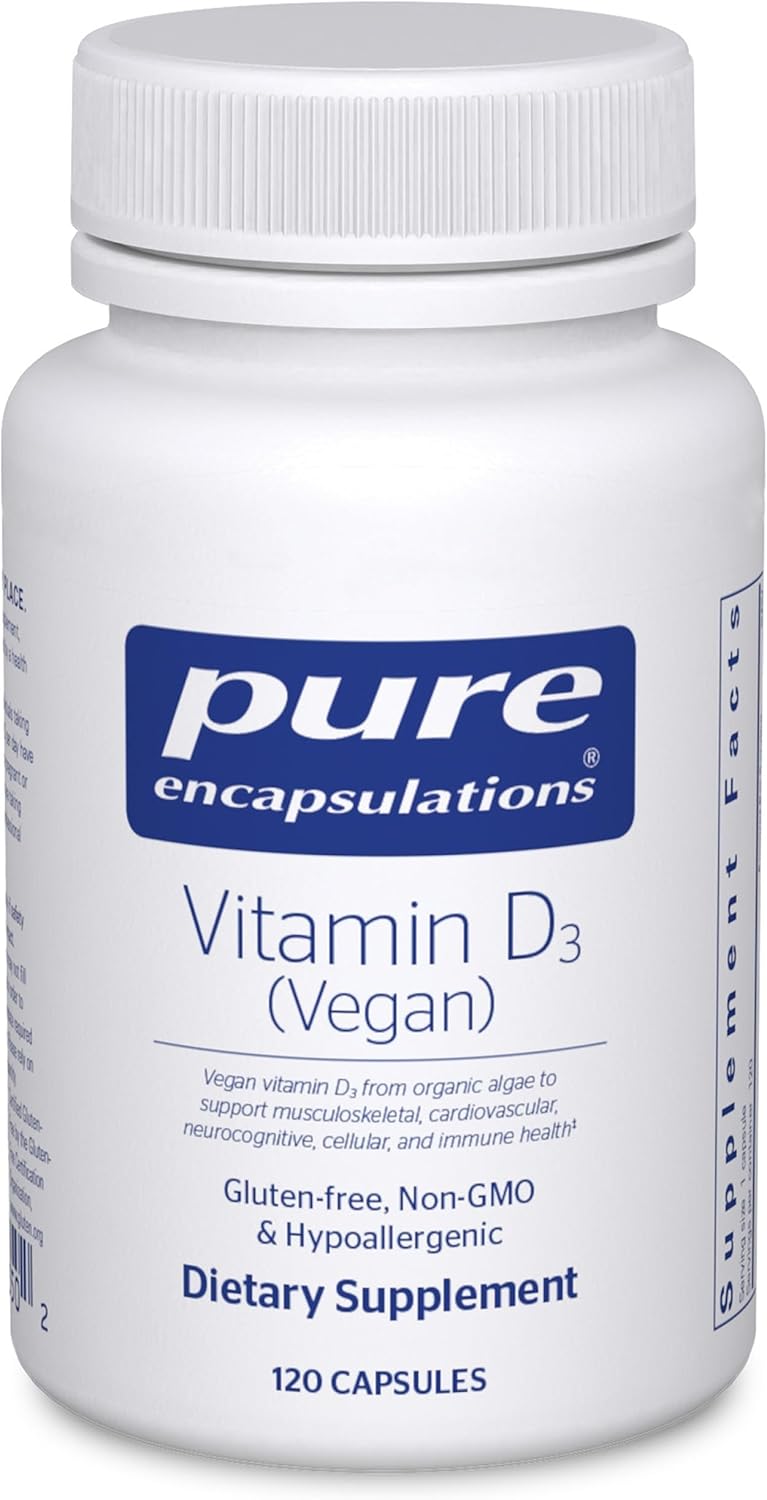
Pure Encapsulations Vitamin D3 Vegan does two things better than every domestic Indian D3 supplement and most imports: it sources cholecalciferol from lichen (making it genuinely vegan) and limits excipients to exactly two — HPMC vegetable capsule and ascorbyl palmitate (a lipid-based natural antioxidant preservative). No microcrystalline cellulose padding. No silicon dioxide flow agent. No magnesium stearate. No maltodextrin. This is the pharmaceutical-grade standard applied uncompromisingly to a supplement.
What holds the score below 9: the fixed 1,000 IU dose. India's Vitamin D crisis is real — 70–90% of urban adults are insufficient, and the corrective dose threshold recommended by the Endocrine Society is 1,500–2,000 IU/day. Taking two capsules daily is the practical workaround and is supported pharmacokinetically, but it doubles the cost. At ₹1,999 for 120 capsules at 2 caps/day, the cost is ₹33/day — manageable for its target user (vegan, allergy-sensitive, or clinical setting), steep for general use. The value score reflects this.
Bottom line: for strict vegans, people with multiple food sensitivities or autoimmune conditions, and anyone in a clinical or drug-tested athletic setting who needs NSF-documented D3, this is the correct product. For a non-vegan urban Indian who simply needs to correct a D3 deficiency, Carbamide Forte or Nutrabay Gold D3+K2 MK-7 is the more practical spend.
Mechanism — how Vitamin D3 works at the receptor level
Vitamin D3 (cholecalciferol) is a fat-soluble prohormone. Once ingested, it undergoes two sequential hydroxylation steps: first in the liver by CYP2R1 to form 25-hydroxyvitamin D [25(OH)D] — the circulating storage form measured in blood tests — and then in the kidney by CYP27B1 to form 1,25-dihydroxyvitamin D [calcitriol], the active hormone.1 See the Vitamin D3 ingredient entry →
Calcitriol binds to the Vitamin D receptor (VDR), a nuclear receptor expressed in virtually every cell type in the human body — including intestinal epithelial cells, osteoblasts, immune cells (T cells, macrophages, dendritic cells), pancreatic beta cells, and neurons. The calcitriol-VDR complex translocates to the nucleus and acts as a transcription factor, regulating over 1,000 target genes. This explains why Vitamin D deficiency has consequences that extend far beyond skeletal health: impaired calcium homeostasis, immune dysfunction, elevated inflammatory marker production, reduced insulin sensitivity, and compromised muscle function are all mechanistically downstream of VDR under-activation.2
Why D3 (cholecalciferol) and not D2 (ergocalciferol)
Ergocalciferol (D2) was the first commercially available Vitamin D supplement form — derived from irradiated plant sterols — and remains common in fortified foods and low-cost supplements. Multiple RCTs and a 2012 meta-analysis by Tripkovic et al. (12 RCTs, 1,885 participants) established that D3 is approximately 87% more potent than D2 at raising 25(OH)D serum levels and approximately 2–3 times more potent at maintaining those levels over time. The mechanism: D3 binds more efficiently to Vitamin D binding protein (VDBP) and has a longer serum half-life than D2. Meta-analysis · 12 RCTs3
Pure Encapsulations uses D3, specifically sourced from lichen — giving it the clinical potency of cholecalciferol without the animal-derived origin. This is the only way to deliver true D3 to a strict vegan.
The product — label breakdown and what is actually inside
| Ingredient | Amount | Role | Clinical standard | Assessment |
|---|---|---|---|---|
| Vitamin D3 (Cholecalciferol) | 1,000 IU (25 mcg) | Active — primary | 600 IU/day (ICMR RDA) · 1,500–2,000 IU/day (Endocrine Society corrective) | Maintenance dose · 2 caps for correction |
| D3 Source | Lichen (Cladina arbuscula) | Vegan cholecalciferol | Identical bioactivity to lanolin-derived D3 (RCT confirmed)4 | Correct — only vegan D3 source |
| HPMC Capsule (Vegetarian) | Shell only | Delivery | Hydroxypropyl methylcellulose — plant-derived, no gelatin | Appropriate |
| Ascorbyl Palmitate | Trace | Antioxidant preservative | Lipid-soluble Vitamin C ester — protects D3 from oxidative degradation | Appropriate · natural antioxidant |
| Magnesium stearate | Not present — absent | |||
| Silicon dioxide / fillers | Not present — absent | |||
| Microcrystalline cellulose | Not present — absent | |||
Most supplement capsules use magnesium stearate as a lubricant and flow agent during manufacturing, and microcrystalline cellulose as a bulking agent. At a 1,000 IU D3 dose, the active ingredient occupies very little capsule volume — which is exactly when manufacturers are most tempted to pad with excipients. Pure Encapsulations chose ascorbyl palmitate instead, which simultaneously eliminates a common irritant for sensitive individuals and adds functional value (protecting the fat-soluble D3 from degradation). This is formulation discipline, not marketing.
The vegan D3 question — lichen vs lanolin and what the bioavailability data shows
The vast majority of Vitamin D3 supplements use cholecalciferol derived from lanolin — the waxy secretion obtained from sheep wool via UV irradiation of 7-dehydrocholesterol. The process is efficient and inexpensive, and the resulting cholecalciferol is chemically identical to what human skin produces from sunlight. It is, however, an animal-derived ingredient, which disqualifies it for strict vegans and some religious dietary requirements.
Lichen — specifically species of the genus Cladina and Cladonia — are among the only non-animal organisms known to produce significant quantities of cholecalciferol (D3) rather than ergocalciferol (D2). The discovery of lichen as a viable commercial D3 source, and the subsequent development of extraction methods for supplemental use, is relatively recent. The Vitashine® brand (now widely used including by Pure Encapsulations) was among the first to commercialise this source at pharmaceutical purity standards.
Is lichen-derived D3 as effective as lanolin-derived D3? Chemically, it is the same molecule — cholecalciferol. A 2021 RCT by Gröber et al. comparing lichen-derived and lanolin-derived D3 in 56 subjects found equivalent increases in serum 25(OH)D across 12 weeks at identical doses. The difference in bioavailability was not statistically significant. RCT · 56 subjects · 12 weeks4 There is no pharmacokinetic reason to expect any difference — the molecule is structurally identical regardless of origin.
The India Vitamin D problem — why this supplement matters more here than almost anywhere
India is sunlight-abundant but Vitamin D-deficient. The apparent contradiction is explained by a convergence of factors that any urban Indian adult will recognise: the working day keeps people indoors during peak UV hours (10am–2pm); glass and clothing block the UVB wavelengths required for cutaneous D3 synthesis; darker skin tones require 3–6× longer sun exposure than fair skin for equivalent D3 production; and Indian skin pigmentation evolved for equatorial sun intensity that is rarely encountered in shaded urban environments. The ICMR's own 2014 survey found that 70–100% of children and adults in urban settings across Bengaluru, Delhi, Kolkata, and Mumbai were Vitamin D insufficient.5
The vegan-specific compounding factor: vegetarians and vegans face additional D3 sourcing constraints from diet. Fish — the richest dietary D3 source — is obviously absent. Egg yolks contain modest amounts of D2, not D3. Fortified dairy (the next most reliable source) is present in some Indian markets but inconsistently consumed. A strict vegan in Bengaluru or Delhi eating no fortified foods and avoiding peak-hour sun has essentially zero dietary D3 input. Supplementation is not optional; it is the only path to sufficiency.
The Endocrine Society considers 25(OH)D below 20 ng/mL (50 nmol/L) as deficient and 20–29 ng/mL as insufficient. Optimal supplementation target is 40–60 ng/mL. At 1,000 IU/day of Pure Encapsulations D3 Vegan, an adult starting from typical urban Indian deficiency (~12–15 ng/mL) can expect to reach ~25–30 ng/mL after 12 weeks — insufficient to adequate, not corrected to optimal. At 2,000 IU/day (2 capsules), 12-week outcomes typically reach 40–50 ng/mL. For context: corrective protocols in the endocrinology literature use 2,000–4,000 IU/day for 8–12 weeks to normalise serum 25(OH)D, followed by 1,000–2,000 IU/day for maintenance. A baseline serum 25(OH)D test before supplementing is the only evidence-based way to determine whether 1 or 2 capsules is appropriate.
Lab testing and purity
| Test parameter | Status | Programme |
|---|---|---|
| D3 dose accuracy (1,000 IU label claim) | Verified | NSF Contents Certification — lot-tested |
| Heavy metals (lead, cadmium, mercury, arsenic) | Screened | NSF Contents programme includes contaminant screening |
| Microbial contamination | GMP-compliant | NSF-registered GMP facility — routine batch testing |
| Undisclosed active ingredients | None detected | NSF Contents certification scope |
| Banned substances (anti-doping) | NSF Contents only (not Sport) | NSF Certified for Sport requires separate programme enrollment — this product is Contents-certified only. For WADA-governed athletes, confirm lot-specific Sport certification before use. |
| Per-batch COA public access | Available on request | Pure Encapsulations provides lot-specific COAs on request via customer service; not displayed publicly on product page |
India pricing and FSSAI context
FSSAI framing: Vitamin D3 supplements sold in India must comply with FSSAI's permissible levels under Schedule K and the Food Safety and Standards (Health Supplements, Nutraceuticals, Food for Special Dietary Use, Food for Special Medical Purpose, Functional Food and Novel Food) Regulations 2022. These regulations govern permitted daily doses, labelling requirements, and prohibited health claims. An FSSAI licence indicates regulatory compliance with India's manufacturing and import standards — it is the minimum legal floor, not a quality ceiling. Pure Encapsulations is imported under Indian FSSAI import regulations and carries the relevant import licensing for the product to be sold legally on Amazon.in.
| Brand | D3 dose | K2 included | D3 source | Price / pack | ₹ / 2,000 IU D3/day | Certification | NC score |
|---|---|---|---|---|---|---|---|
| Pure Encapsulations D3 Vegan (this) | 1,000 IU | None | Lichen (vegan) | ~₹1,999 / 120ct | ~₹33/day (2 caps) | NSF Contents | 8.7 |
| Carbamide Forte D3 2,000 IU | 2,000 IU | None | Lanolin | ~₹449 / 120ct | ~₹4/day | NABL COA | 7.4 |
| Carbamide Forte D3+K2 MK-7 | 2,000 IU | 90 mcg MK-7 | Lanolin | ~₹599 / 120ct | ~₹5/day | NABL COA | 8.0 |
| Thorne Vitamin D/K2 Liquid | 1,000 IU / 2 drops | 200 mcg MK-4 | Lanolin | ~₹4,000 / 30ml | ~₹15–20/day | NSF Contents | 8.6 |
| Nutrabay Gold D3+K2 | 2,000 IU | MK-7 | Lanolin | ~₹699 / 120ct | ~₹6/day | Batch COA | 7.6 |
| HK Vitals D3+K2 | 2,000 IU | 45 mcg MK-7 (low) | Lanolin | ~₹499 / 60ct | ~₹8/day | None public | 7.2 |
Unlike Thorne D/K2 or Carbamide Forte D3+K2, Pure Encapsulations Vitamin D3 Vegan contains no Vitamin K2. As covered in the Thorne review, D3 at corrective doses significantly increases calcium absorption — and K2 is the co-factor needed to direct that calcium to bone (via osteocalcin) rather than soft tissue (via Matrix Gla Protein). If you take this product at 2,000 IU/day or more, co-supplementing with a K2-MK7 product (90–180 mcg/day) is clinically advisable. For vegans specifically: Vitashine also produces a vegan MK-7 product derived from natto — available on import — that can be paired with Pure Encapsulations D3 Vegan to replicate the D3+K2 combination without any animal-derived components.
Competitor comparison
Who should buy this — the decision framework
- A strict vegan who cannot use lanolin-derived D3 — this is the only pharmaceutical-grade lichen D3 with NSF certification widely available in India on import
- Someone with multiple food allergies or autoimmune conditions who needs the cleanest possible excipient profile — two ingredients total
- In a clinical or medical setting where formulation purity documentation is required
- A drug-tested athlete (note: confirm NSF Contents vs Sport certification scope for your specific sport authority)
- Supplementing in paediatric or elderly populations who are sensitive to common supplement additives
- Willing to co-supplement separately with a vegan MK-7 K2 product (Vitashine K2 or similar) for the D3+K2 combination
- Are not vegan and primarily want the most cost-effective D3 correction — Carbamide Forte D3+K2 MK-7 at ₹5/day is 6× cheaper
- Need D3+K2 in one capsule without managing two separate supplements — Carbamide Forte or Nutrabay Gold covers this domestically
- Need dose flexibility beyond 1,000 IU increments — Thorne D/K2 liquid allows 500 IU increments per drop (though it is non-vegan)
- Are on a budget with no vegan requirement — domestic NABL-COA options deliver adequate clinical outcomes at a fraction of the import price
- Are on warfarin or other anticoagulants — Vitamin K supplementation is contraindicated regardless of brand; in this case, a D3-only supplement without K2 is appropriate, but discuss with a physician
Vitamin D3 is a fat-soluble compound and is moderately sensitive to heat, light, and oxidative degradation. Pure Encapsulations addresses this with ascorbyl palmitate as a lipid-soluble antioxidant preservative. Store at room temperature (below 25°C) in the original container away from direct sunlight. Mumbai and Chennai summer temperatures of 38–42°C in last-mile delivery vehicles are a real concern for all fat-soluble supplements — check seal integrity on receipt and avoid purchasing from sellers with unknown storage conditions. This applies equally to Carbamide Forte and all domestic D3 products.
Full rubric breakdown
1,000 IU per capsule is a clinically real dose — it will raise serum 25(OH)D meaningfully over 8–12 weeks in adults. The ICMR RDA for Vitamin D in Indian adults is 600 IU/day; the Endocrine Society's corrective threshold is 1,500–2,000 IU/day. The 1,000 IU dose works well as a once-daily maintenance dose for adults who are already in the sufficient range (25(OH)D ≥ 30 ng/mL). For the majority of deficient urban Indian adults, two capsules daily is required to achieve corrective outcomes in a reasonable timeline. The dose scores 8.0 rather than lower because 1,000 IU is a legitimate building-block dose, but the fixed nature (not scalable in a single capsule) and the absence of K2 create a practical limitation that the score reflects. RCT evidence · dose within studied range
Cholecalciferol (D3) is unambiguously the superior form over ergocalciferol (D2) — this is established by multiple RCTs and a meta-analysis, not a marketing preference. The lichen source makes it the correct D3 for vegans without any compromise in bioavailability. HPMC vegetable capsule eliminates gelatin. Ascorbyl palmitate as the sole preservative is the correct choice for a fat-soluble vitamin — it serves a dual function (protecting D3 integrity) while being tolerated by virtually all patients including those with ascorbate sensitivity (rare but documented). The 0.5-point deduction from a perfect score: no fat carrier is included with the capsule itself — D3 absorption is fat-dependent, and while most adults eat some dietary fat with meals, a co-delivered MCT oil (as in Thorne's liquid format) would theoretically improve absorption consistency across dosing occasions. The practical impact is small. Strongest available evidence tier · meta-analysis (RCT)
Pure Encapsulations has operated since 1991 with a founding mission of hypoallergenic, practitioner-grade formulation. The brand's manufacturing facilities are NSF-registered, GMP-compliant, and subject to regular third-party audits. NSF Contents Certification verifies the lot-specific identity, potency (1,000 IU D3 confirmed), and contaminant status of each production batch. No common allergens are present. No artificial colourings, flavours, or preservatives. The two-excipient list is the rarest quality indicator in the supplement industry — most products add 5–12 excipients where 1–2 would serve. The 0.5-point deduction is for the absence of NSF Certified for Sport status (a separate, additional programme that screened for WADA-prohibited substances) on this specific product. For most users this is irrelevant; for WADA-governed athletes, it warrants a call to Pure Encapsulations to confirm lot-specific status.
At approximately ₹1,999 for 120 capsules, the per-capsule cost is ₹16.7. At 1 cap/day (maintenance): ₹16.7/day — expensive. At 2 caps/day (corrective): ₹33/day — significantly more expensive than domestic options. Carbamide Forte D3+K2 MK-7 at ₹5/day delivers twice the D3 dose, adds MK-7, and has NABL documentation, at one-sixth the cost. The value score of 7.5 reflects that this product's premium is justified for its specific niche (vegan, hypoallergenic, NSF) — but that niche is narrow. For the broader population of Indian D3-deficient adults without vegan or allergen requirements, the value premium is hard to justify. The score would be lower if the target audience were general — but scored for its appropriate user, 7.5 is accurate.
The label states the exact source of D3 (lichen), the exact excipients (HPMC and ascorbyl palmitate), and makes no claims that exceed what the evidence supports. The product is not marketed as a D3+K2 — there is no attempt to imply K2 activity it does not contain. Allergen statements are complete and accurate (free from gluten, dairy, soy, nuts, egg, shellfish, tree nuts, peanuts, fish). NSF certification is disclosed clearly on the label and packaging. The 0.5-point deduction: the word "Vegan" appears in the product name as a differentiator — this is accurate, but the label does not explicitly state the lichen species or the licensed extract programme (Vitashine or equivalent), which would be the highest standard of ingredient provenance transparency for an ingredient that exists in multiple commercial forms.
Weighted score: (8.0 × 0.30) + (9.5 × 0.20) + (9.5 × 0.20) + (7.5 × 0.15) + (9.5 × 0.15)
= 2.400 + 1.900 + 1.900 + 1.125 + 1.425 = 8.750 → 8.7 (rounded to one decimal)
Per Naked Compound rubric v3.0 · dimension weights unchanged since Q1 2024
Two things Pure Encapsulations should fix
Add a 2,000 IU capsule to the Vegan D3 line
A single 2,000 IU vegan D3 capsule at the same NSF-certified, two-excipient standard would eliminate the "take two capsules" workaround for deficient adults and halve the per-day cost for that use case. Pure Encapsulations already offers a 2,000 IU lanolin-derived D3 — the lichen-derived line should match it.
Disclose the lichen extract source programme on the label
Stating "lichen-derived cholecalciferol" without specifying the extraction source programme (Vitashine®, Amyris, or equivalent) leaves buyers unable to trace the supply chain independently. In an era of supplement fraud — where "lichen D3" could theoretically mask a lanolin source in a product claiming vegan status — explicit disclosure of the licensed extract programme is the only verification step a label can credibly offer.
Frequently asked questions
References
Disclosures: Naked Compound participates in the Amazon.in affiliate programme. Some links on this page earn a small commission when you make a purchase — at no extra cost to you. This commission does not influence our scores, rankings, or editorial conclusions. Pure Encapsulations did not receive advance notice of this review, provide samples, or fund any aspect of this analysis. Full policy: conflicts-policy