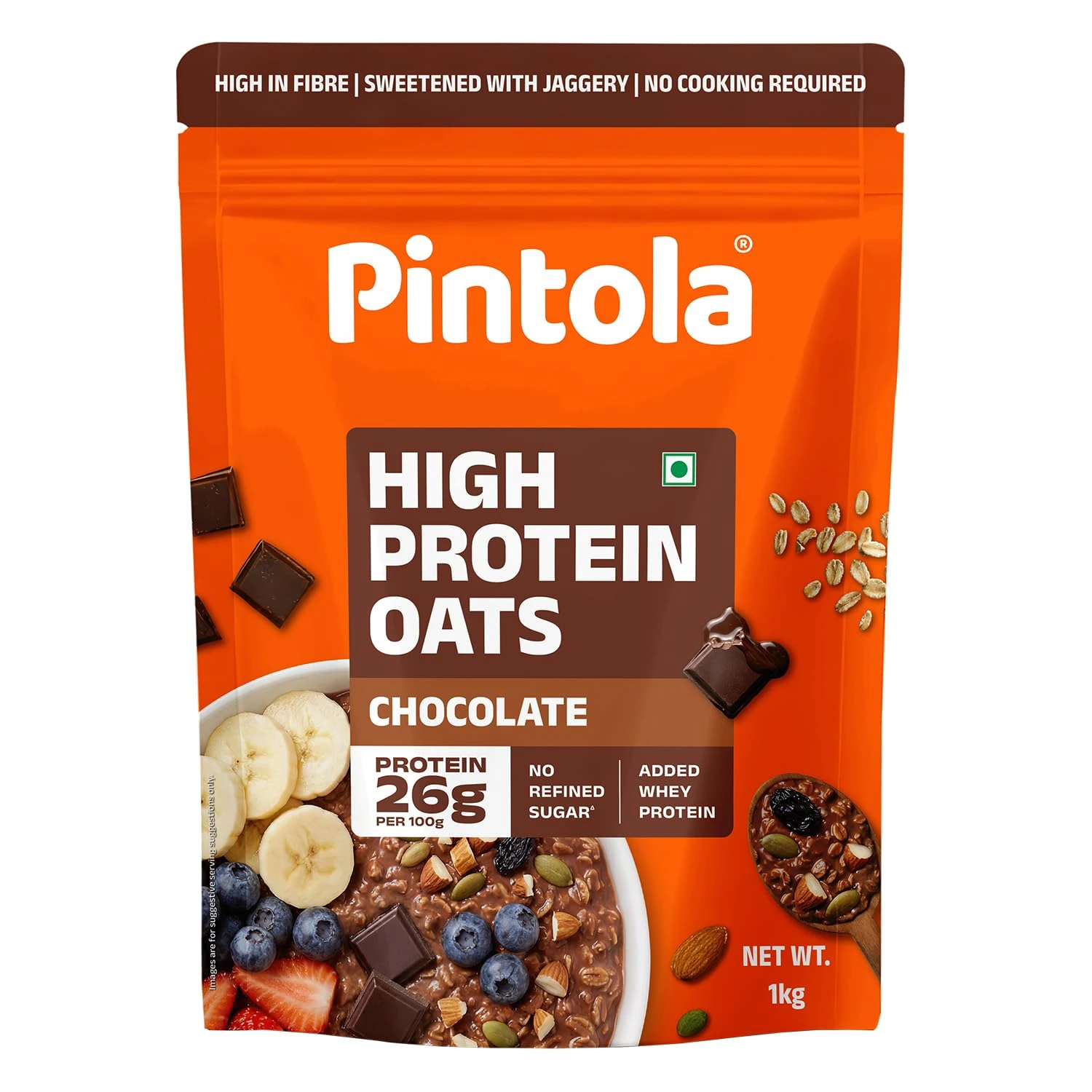
The bottom line
A reasonably priced protein-fortified oats product from a credible Indian brand — undermined by a misleading sugar claim and a soy-heavy protein blend that the marketing quietly buries.
Pintola High Protein Oats is the peanut butter brand's entry into India's booming protein food market. The headline number — 26g protein per 100g — is legitimately high for a breakfast cereal product. The ingredient list includes real oats (42%), genuine dry fruits, nuts, and seeds (12%), cocoa solids, jowar flakes, and Himalayan pink salt. There is a real food product here, not just flavoured protein powder pressed into oat shapes.
What holds it back: Two things. First, the protein blend is dominated by texturized soy protein and soy protein isolate, with whey protein concentrate listed last — meaning it is the smallest fraction. Soy protein is a complete protein, but it has lower leucine content than whey (6.8% vs 10.9%), a marginally lower PDCAAS (0.91 vs 1.0), and is perceived as inferior by the protein-conscious Indian consumer who reads "high protein" and assumes whey.1 Second, and more critically, the front-of-pack "No Refined Sugar" claim is technically true but nutritionally misleading. The product contains approximately 14g of sugar per 100g from organic jaggery. Jaggery is 65-85% sucrose — chemically identical to the molecule in refined white sugar.2 Your pancreas does not distinguish between sucrose from jaggery and sucrose from a sugar mill.
Who this is genuinely for: People who eat oats for breakfast and want more protein in their morning bowl without adding a separate protein scoop. Office workers who want a quick, reasonably nutritious breakfast with minimal prep. Parents looking for a higher-protein cereal option for teenagers. This is not a gym product — it is a kitchen product with a gym label.
Pintola High Protein Oats ingredients list
Pintola High Protein Oats comes in two main variants, Dark Chocolate and Magic Masala. This review covers Dark Chocolate, the more popular one. Here is its ingredient list as currently shown on Pintola's product page and Amazon.in (checked 23 Sep 2026):6
| Ingredient | Share | What it is |
|---|---|---|
| Oats | 42% | Rolled oats, the base grain |
| Protein blend | 27% | Texturized soy protein, soy protein isolate, whey protein concentrate (in that order) |
| Dry fruits, nuts & seeds | 12% | Raisins, almonds, pumpkin seeds, chia seeds |
| Organic jaggery | 10% | The sweetener: unrefined cane sugar |
| Cocoa solids | 7% | Real cocoa for the chocolate flavour |
| Jowar flakes | — | Sorghum, a gluten-free millet |
| Himalayan pink salt | — | Salt |
Ingredients on Indian food labels are listed in descending order of weight, so within the protein blend, soy comes before whey. The recipe has changed since our June review: the pack we first reviewed listed oats at 43–48%, the protein blend at 22–26%, and a nut mix that included cashews, sunflower and flax seeds. Always check the ingredient list on the pack in your hand.
Magic Masala: we couldn't confirm its current recipe. The online listing we found shows oats, spices and vegetables with hydrolysed vegetable protein (soya) as a flavouring, but no protein blend, which doesn't square with its "26g protein" claim. Check the pack before buying if the protein source matters to you.7
Does Pintola oats have soya chunks?
Pintola High Protein Oats doesn't contain the large soya chunks you'd cook in a curry. But the first ingredient in its protein blend is texturized soy protein, the same material soya chunks are made from: defatted soy flour or concentrate pushed through an extruder and dried, here in small pieces that blend into the oats. Together with soy protein isolate, soy is the largest part of the protein blend.
So if you're asking "does Pintola oats contain soya chunks?" or whether Pintola High Protein Oats have soya chunks mixed in, the accurate answer is: the same soy ingredient, in granule form rather than chunks. That isn't a hidden ingredient; it's on the label. But "26g protein" with chocolate and almonds on the front of the pack leads many buyers to assume a whey-based product. For the full explanation of what texturized soy protein is and whether it matters, read our explainer: Does Pintola Oats have soya chunks?
Does Pintola oats contain whey protein?
Yes, but it's the smallest part of the protein blend. Whey protein concentrate is listed third, after texturized soy protein and soy protein isolate, so there is less whey than either soy ingredient. Pintola doesn't disclose the exact split. Two practical consequences:
- It isn't vegan. Whey comes from milk, so the product is vegetarian but not vegan.
- It contains milk and soy, both common allergens, plus tree nuts. Avoid it if you're allergic to any of them.
If you specifically want whey protein at breakfast, plain oats plus a scoop of whey gives you more whey for less money. See the protein-blend breakdown below.
Pintola recommends a 40g serving. At that serving size: ~10.4g protein, ~157 calories, ~3.8g fibre, ~5.6g sugar. Most people eating oats for breakfast serve themselves 60-80g. At 60g: ~15.6g protein, ~235 calories, ~5.8g fibre, ~8.4g sugar. At 80g: ~20.8g protein, ~314 calories, ~7.7g fibre, ~11.2g sugar. The per-100g figures paint a flattering picture. The per-serving figures tell the real story.
The sugar question — "No Refined Sugar" decoded
This is the section that matters most in this review. Pintola positions "No Refined Sugar" as a primary front-of-pack health claim, printed prominently on every variant. Let us be precise about what this means and what it does not mean.
What "No Refined Sugar" technically means: The product does not contain white crystalline sugar (sucrose) that has been processed through a refinery. The sweetener used is organic jaggery — unrefined or minimally refined cane sugar.
What it does NOT mean: That the product is low in sugar. Pintola High Protein Oats contains approximately 14g of sugar per 100g. Per 40g serving, that is ~5.6g of sugar. Per realistic 60-80g serving, that is 8.4-11.2g of sugar.
| Sugar source | Sucrose % | Glycaemic impact | Micronutrient bonus |
|---|---|---|---|
| Refined white sugar | 99.9% | High (GI 65) | Zero |
| Organic jaggery (used in Pintola) | 65-85% | High (GI 65-84) | Trace iron, potassium |
| Honey | ~82% total sugars | High (GI 58) | Trace antioxidants |
| No added sweetener | 0% | N/A | N/A |
GI values from International Tables of Glycemic Index (Foster-Powell et al., 2002). Jaggery GI range reflects variation in processing degree.
The trace mineral content of jaggery (iron, potassium, calcium) is real but nutritionally insignificant at the quantities present in a 40g serving of oats. You would get more iron from a single spinach leaf. The glycaemic impact of jaggery sucrose is identical to refined sugar sucrose because your body breaks both down to the same glucose and fructose molecules.
Pintola is not alone here. At least a dozen Indian protein food brands use "no refined sugar" or "no maida, no refined sugar" as a primary health claim while sweetening with jaggery, honey, or palm sugar at 10-15% of total weight. This is a category-wide labelling pattern that FSSAI has not yet addressed. The consumer reads "no sugar" — the label says "no refined sugar." The gap between perception and reality is the entire marketing strategy.
The protein — soy first, whey last
Pintola's protein blend makes up 27% of the product by weight on the current label (22–26% on the pack we first reviewed) and contains three protein sources listed in descending order: texturized soy protein (TSP), soy protein isolate (SPI), and whey protein concentrate (WPC).
Let us be clear about what this ordering means. Indian food labelling law (FSSAI Packaging and Labelling Regulations) requires ingredients to be listed in descending order of their proportion by weight. Texturized soy protein is listed first, meaning it is the largest fraction of the protein blend. Whey protein concentrate is listed last, meaning it is the smallest fraction.
| Protein source | PDCAAS | Leucine % | Digestion rate | Cost (₹/kg) |
|---|---|---|---|---|
| Whey protein concentrate | 1.00 | 10.9% | Fast (60-90 min peak) | ₹800-1200 |
| Soy protein isolate | 0.91 | 6.8% | Medium (2-3 hr peak) | ₹400-600 |
| Texturized soy protein | 0.91 | 6.8% | Medium-slow | ₹150-250 |
PDCAAS values from WHO/FAO (2013). Leucine content from USDA FoodData Central. Raw material prices are approximate bulk B2B ranges in India.
The economics are clear. Texturized soy protein (soy chunks/granules) costs ₹150-250/kg at bulk procurement. Whey protein concentrate costs ₹800-1200/kg. A soy-heavy protein blend is significantly cheaper to formulate than a whey-heavy one. This is not inherently wrong — soy protein is a legitimate, complete protein — but it is relevant context when the product is marketed alongside whey protein brands and priced to compete in the "high protein" space.
Is soy protein bad? No. Soy protein isolate has a PDCAAS of 0.91 (close to whey's 1.0), contains all nine essential amino acids, and has a substantial body of RCT evidence supporting its efficacy for lean mass maintenance.1 The 2017 Messina meta-analysis of 9 RCTs found no significant difference between soy and animal protein for lean body mass and strength gains when total protein intake was matched.3 The issue is not that soy protein is bad — it is that the marketing does not make it obvious that soy, not whey, is doing most of the work here.
At 12% by weight, the dry fruit, nut and seed mix is not cosmetic. Raisins, almonds, pumpkin seeds and chia seeds add some protein, healthy fats (including plant omega-3 from chia) and micronutrients such as magnesium from pumpkin seeds and vitamin E from almonds. The raisins also add some sugar. This is the strongest ingredient-quality signal in the product.
Value — where does ₹620/kg sit?
At MRP ₹620 for 1kg, Pintola High Protein Oats occupies a middle ground between standard oats and premium protein breakfast foods. The value proposition depends entirely on what you are comparing it to:
| Product | Protein/100g | Price | ₹/g protein | Sugar/100g |
|---|---|---|---|---|
| Pintola High Protein Oats (this review) | 26g | ₹620/kg | ₹2.38 | ~14g (jaggery) |
| Quaker Oats (plain) | 13g | ~₹220/kg | ₹1.69 | 0g |
| Yogabar High Protein Muesli | 22g | ~₹550/kg | ₹2.50 | ~12g |
| MuscleBlaze High Protein Oats | 25g | ~₹650/kg | ₹2.60 | ~11g |
| Quaker Oats + 1 scoop whey | ~38g | ~₹313/serving | ₹2.12 | 0g added |
Prices as of June 2026. MRP / typical Amazon.in pricing. "Quaker + whey" calculation: 80g Quaker (₹18) + 1 scoop Nakpro Gold (₹93) = ~₹111 for ~38g protein.
The honest framework: If you are buying Pintola as a convenient, higher-protein breakfast that requires zero effort beyond adding milk or water, the pricing is fair. At ₹2.38 per gram of protein, it is competitive within the protein breakfast food category. If you are optimising for protein-per-rupee, plain oats plus a scoop of whey protein will always win — more protein, no added sugar, lower cost per gram. The convenience premium Pintola charges is real but modest.
The 1kg pack size is the standard SKU. Amazon pricing fluctuates between ₹550-620, with Subscribe & Save options occasionally dropping below ₹550. At the deal price, value for money improves noticeably.
Manufacturing — Pintola's infrastructure
Pintola is a brand of Ariga Foods, a Rajkot (Gujarat) based food processing company that built its initial market position in the peanut butter category. Pintola is one of the top-selling peanut butter brands on Amazon India and has expanded into protein foods, trail mixes, and nut butters.
Manufacturing credentials:
- FSSAI licensed — regulatory baseline for food safety compliance in India
- ISO 22000 certified — international food safety management system standard
- Gluten-free claim — using gluten-free oats and jowar flakes
- Vegetarian — whey protein concentrate is the only animal-derived ingredient
The brand's peanut butter manufacturing has established a track record for food processing quality. Expanding into protein oats is a natural category extension — the manufacturing capabilities (blending, portioning, packaging) transfer directly from nut butter production. The Gujarat food processing corridor has well-established supply chains for both oats and soy protein ingredients.
Pintola High Protein Oats lab test report
As of 23 September 2026, we have found no published independent lab test of Pintola High Protein Oats: no blind-purchase test, no NABL-accredited certificate of analysis for the oats, and nothing from the brand itself. Blind-testing programmes such as Trustified have published results for Pintola's peanut butter, but not for the protein oats.8 Be wary of any "Pintola oats lab test" result that doesn't name the lab, the batch number and the test method.
That matters because the "26g protein per 100g" claim is the product's main selling point, and right now it rests on the label alone. If this product were lab tested, these are the checks that would matter:
- Protein content vs the 26 g claim, ideally with an amino acid profile to rule out "amino spiking" (padding the protein number with cheap amino acids).
- Total and added sugar, to check the jaggery and raisin sugar against the nutrition panel.
- Aflatoxins, relevant for any product containing nuts, seeds and grains.
- Heavy metals (lead, cadmium, arsenic, mercury), a standard check for cocoa-containing foods.
- Microbial counts, a basic safety check for a ready-to-cook cereal.
Until a report exists, our score treats the protein claim as unverified. We'll update this section if we test the product or an independent report is published.
How to actually eat this — preparation matters
Pintola High Protein Oats is not instant oats. The texturized soy protein chunks require some cooking or extended soaking to soften. Here is what works and what does not:
What works:
- Hot preparation (best): Add 40-60g to 150-200ml of hot milk or water. Stir well. Let it sit for 3-5 minutes. The TSP chunks hydrate properly, the oats soften, and the chocolate flavour develops fully.
- Overnight oats: Soak in cold milk or yoghurt overnight in the fridge. The extended soaking time (8+ hours) fully hydrates the soy protein chunks. Add fruit in the morning.
- With milk for extra protein: Using 200ml of whole milk adds ~6.6g of protein to your bowl. A 60g serving with milk: ~22g total protein — approaching the meaningful MPS threshold.
What does not work:
- Dry eating like granola: The TSP chunks are tough and chewy when dry. This is not designed to be eaten out of the bag.
- Quick 1-minute prep with cold water: Insufficient hydration time for the soy protein granules. Texture will be unpleasant.
Taste verdict (Dark Chocolate variant): The chocolate flavour comes from 7% cocoa solids — enough to be genuine rather than artificial. The jaggery sweetness is noticeable but not cloying. The dry fruit and nut pieces add genuine texture variation. The soy protein chunks, when properly hydrated, have a neutral taste that blends into the oat base. Overall, this tastes like a chocolate muesli with extra chewiness from the soy chunks — acceptable, not exceptional.
Who should buy this — and who should not
Buy this if
You eat oats regularly and want more protein without the hassle of adding a separate protein source. You want a convenient, shelf-stable breakfast with a reasonable macro profile. You are comfortable with soy protein as your primary protein source. You understand that "no refined sugar" still means sugar. You want a breakfast food — not a supplement.
Do not buy this if
You are looking for a serious post-workout protein source — a scoop of whey gives you 2.5x the protein for similar cost. You are trying to minimise sugar intake — plain oats have zero added sugar. You have soy sensitivity or prefer to avoid soy-dominant products. You expect whey protein to be the primary protein source based on the "high protein" marketing. You are diabetic or insulin-resistant and need to closely manage sugar intake — 14g/100g from jaggery is not a low-sugar product.
Frequently asked questions
Full rubric breakdown
Soy protein isolate has a solid RCT base for muscle protein synthesis and lean mass maintenance — Messina et al. 2017 (9 RCTs) found no significant difference vs animal protein when total intake is matched. Whey protein has the strongest evidence of any protein form. However, this is a protein-fortified food, not a supplement — and the 26g/100g claim has zero independent verification. No Trustified, no Unbox Health, no NABL COA. The soy protein evidence is strong in isolation; the product-specific verification is absent. Evidence tier for protein blend: Moderate (RCT — ingredient level). Product verification: None
The oats base (43-48%) is nutritionally sound — beta-glucan fibre, low GI carbohydrates. The dry fruit/nut/seed inclusion at 12-14% is genuinely above average for the category. Cocoa solids at 7% are real, not synthetic flavouring. The protein blend uses TSP as the primary source — the cheapest form of soy protein — with SPI and WPC as secondary sources. This ordering suggests cost optimisation in the protein component. The sweetener choice (organic jaggery) is marginally better than refined sugar due to trace minerals, but the ~14g/100g sugar content negates most of the "healthier sweetener" benefit. Jowar flakes add diversity. Overall: a real food product with genuine ingredients, held back by the protein source hierarchy and the sugar load.
ISO 22000 certified manufacturing from Ariga Foods (Rajkot, Gujarat). FSSAI licensed. Pintola has built a credible food manufacturing operation through its peanut butter line — the infrastructure and quality systems are established. The brand has real market presence, real distribution (Amazon, Flipkart, BigBasket, offline retail), and a reputation to protect. The 3.5-point deduction: (1) no independent third-party lab verification of the 26g protein claim; (2) the "no refined sugar" marketing creates a misleading health perception that a responsible manufacturer should not rely on; (3) individual ingredient percentages for the protein blend are not disclosed beyond the regulatory minimum ordering requirement.
₹620/kg with 26g protein per 100g = ₹2.38/g protein. Within the protein breakfast food category, this is competitive — Yogabar High Protein Muesli costs ₹2.50/g, MuscleBlaze High Protein Oats costs ₹2.60/g. The real dry fruit/nut/seed content at 12-14% adds genuine nutritional value beyond just the protein number. The 1kg pack size at this price is accessible. The 2.5-point deduction: (1) plain oats + whey scoop delivers more protein for less money if you are willing to do the work; (2) the protein is primarily from soy (cheaper raw material) but the product is priced at the premium protein food tier; (3) Amazon pricing fluctuates significantly — buying at MRP rather than a deal materially changes the value proposition.
This is the weakest dimension. The "No Refined Sugar" front-of-pack claim is technically accurate and deliberately misleading. The product contains ~14g sugar per 100g from organic jaggery — a fact that directly contradicts the health-conscious positioning the claim is designed to create. Jaggery is 65-85% sucrose. Your body does not care whether sucrose arrives from a refinery or a village press. The "High Protein" claim at 26g/100g is valid but the marketing does not disclose that the protein is primarily soy-based. The 5-point deduction is driven entirely by the sugar claim strategy — this is not accidental mislabelling, it is deliberate positioning designed to create a false impression of a low-sugar product.
Weighted score: (5.0 × 0.30) + (5.5 × 0.20) + (6.5 × 0.20) + (7.5 × 0.15) + (5.0 × 0.15)
= 1.500 + 1.100 + 1.300 + 1.125 + 0.750 = 5.775 → 5.8
Per Naked Compound rubric v3.0 · dimension weights unchanged since Q1 2024
References
Disclosures: Naked Compound did not receive samples or funding from Pintola / Ariga Foods for this review. Pintola did not receive advance notice of this review. The Amazon link above is an affiliate link — Naked Compound may earn a small commission on qualifying purchases at no additional cost to you. This does not influence the review score or content. Full policy: conflicts-policy