The bottom line
A genuinely clean RTD protein coffee from India's biggest private dairy — held back by a modest 15g protein dose and the absence of any independent product testing.
Avvatar Protein Cold Coffee is Parag Milk Foods' entry into India's nascent ready-to-drink protein category. The formulation is legitimately clean: cow's milk protein concentrate as the sole protein source, real coffee powder, stevia and monk fruit as the only sweeteners, 4.8g fibre, and no artificial sweeteners, no artificial colours, no fillers. That ingredient profile is better than most RTD protein drinks globally, not just in India.
What holds it back: 15g of protein per 250ml pack falls below the 20–25g threshold most research identifies for maximally stimulating muscle protein synthesis in a single sitting.1 At ₹120 per pack (₹8/g protein), you are paying a significant convenience premium over whey powder — a scoop of Nakpro Gold delivers nearly twice the protein for less money. And critically, this product launched in May 2026 with zero independent third-party testing. No Trustified, no Unbox Health, no NABL COA. The Avvatar whey protein line has some independent verification, but the RTD product has none.
Who this is genuinely for: People who want protein with their coffee but won't carry a shaker. Office commuters, gym-adjacent consumers, and anyone who currently buys sweetened cold coffee from convenience stores and wants to upgrade to a no-sugar, protein-fortified alternative. This is a lifestyle convenience product, not a serious sports nutrition product.
The product — two variants, same nutrition
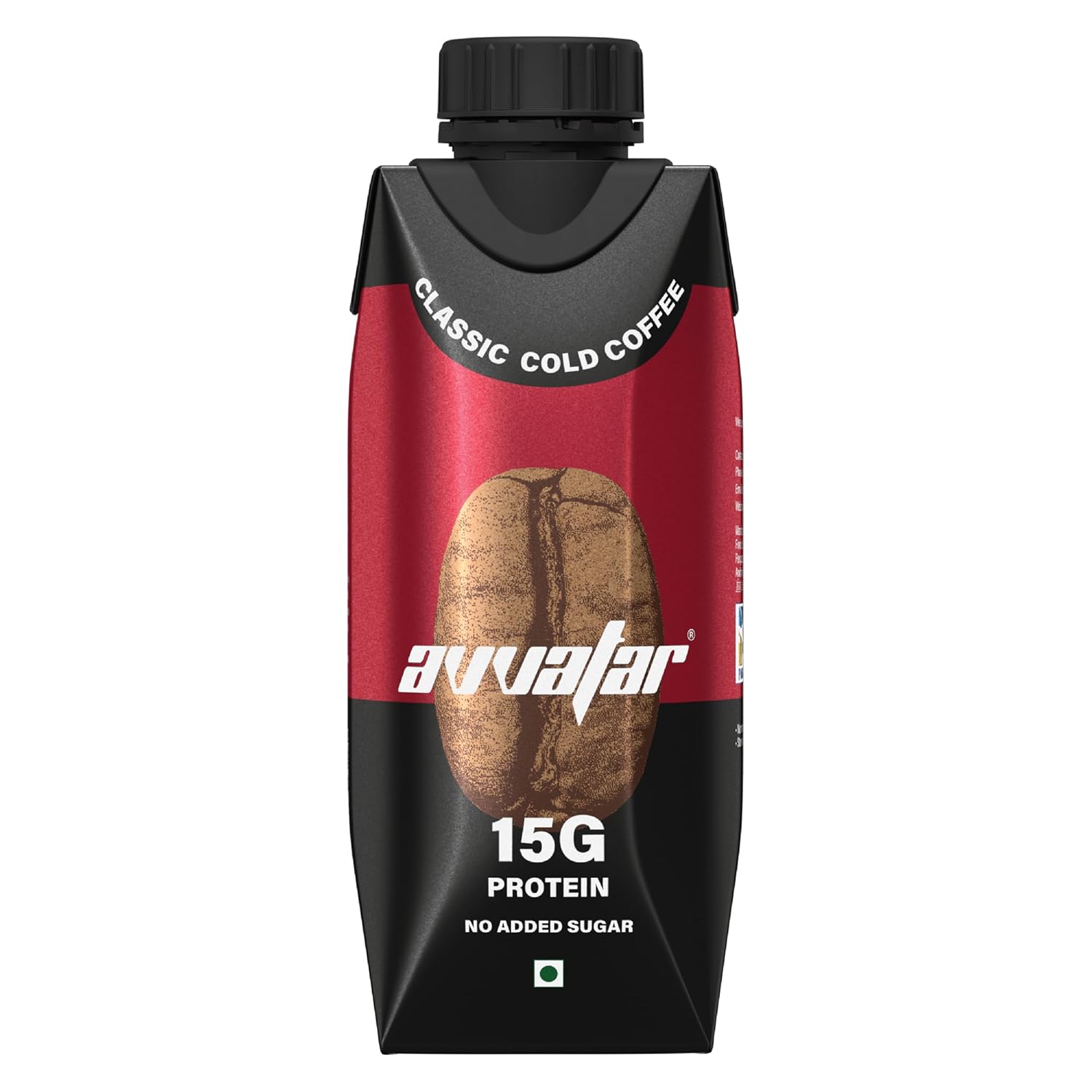
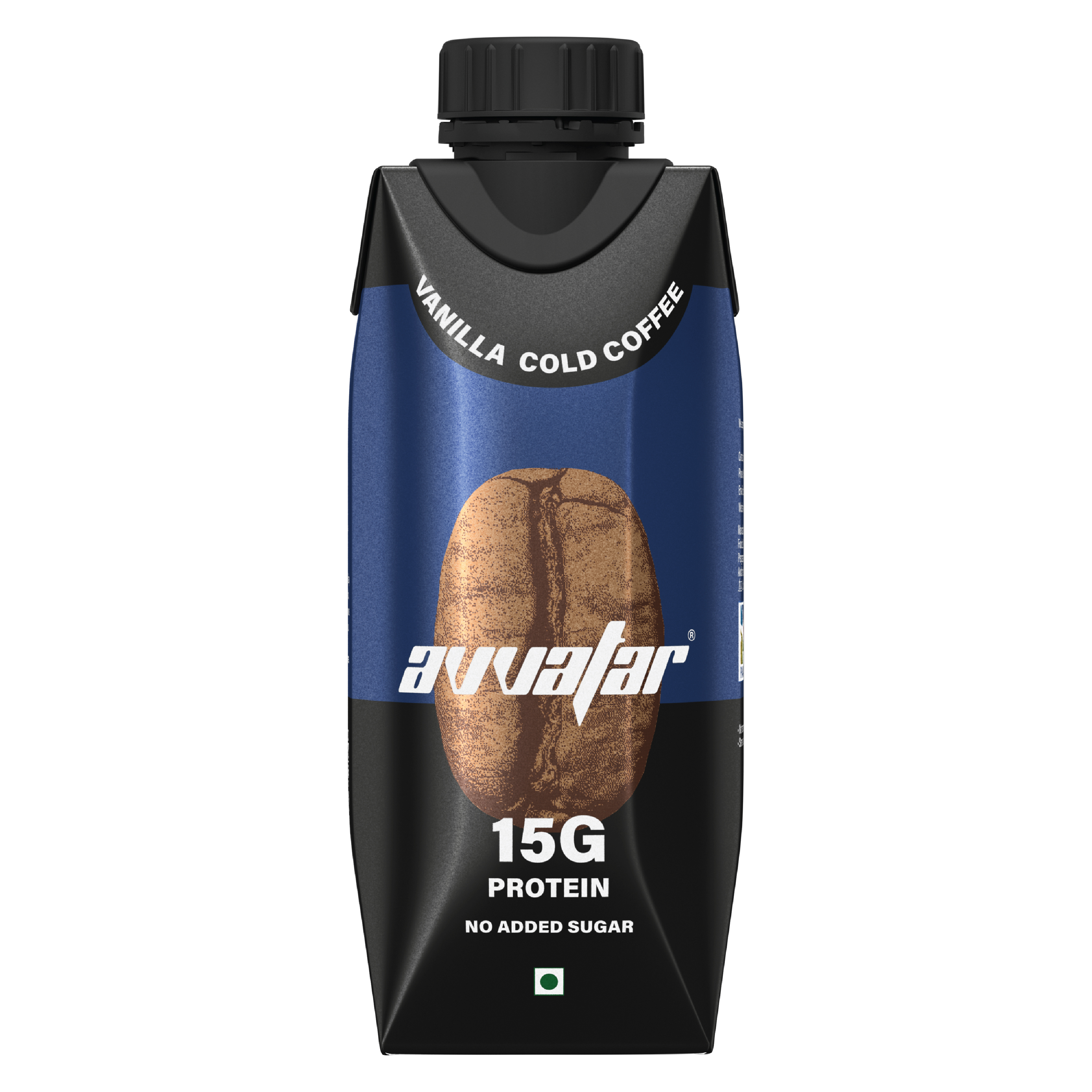
Avvatar Protein Cold Coffee is available in two variants: Classic Cold Coffee and Vanilla Cold Coffee. Both deliver 15g of protein per 250ml pack from cow's milk protein concentrate. Both use stevia and monk fruit as the sole sweeteners. The nutritional profile is identical between variants — the difference is flavouring only.
Ingredients (Classic variant): Cow's milk, milk protein concentrate, real coffee powder, dietary fibre, stevia, monk fruit concentrate. That is a remarkably short and clean ingredient list for a shelf-stable RTD beverage. No sucralose. No acesulfame potassium. No artificial colours. No emulsifiers or thickeners listed in marketing materials. If this ingredient list matches the actual label, it is one of the cleanest protein RTD formulations available in India.
Key nutritional highlights:
- 15g protein from milk protein concentrate (MPC) — a complete protein containing both casein (~80%) and whey (~20%) fractions, providing both fast and slow amino acid release
- No added sugar — sweetened exclusively with stevia and monk fruit concentrate
- 4.8g dietary fibre — an unusually high fibre content for an RTD protein drink, supporting satiety and gut health
- Low calorie — the combination of no added sugar and natural sweeteners keeps caloric density well below standard sweetened cold coffee beverages
MPC contains both whey (~20%) and casein (~80%) fractions of milk protein. Whey is fast-digesting (peak aminoacidaemia in 60–90 minutes), while casein is slow-digesting (sustained release over 4–7 hours). The blend provides both an acute MPS stimulus and sustained amino acid availability. For a grab-and-go beverage meant to bridge meals, MPC is arguably a more appropriate protein source than pure whey isolate — you get sustained amino acid delivery rather than a fast spike. The trade-off: MPC has slower peak kinetics than WPI, so it is not ideal as an immediate post-workout protein source.
The 15g question — is it enough?
The most important question about this product is whether 15g of protein per serving is a meaningful dose. The short answer: it depends on what you are using it for.
The current evidence consensus, led by the Moore et al. (2009) dose-response study in young men, identifies approximately 20–25g of high-quality protein as the dose required to maximally stimulate muscle protein synthesis (MPS) in a single meal.1 Beyond 25g, the rate of MPS plateaus — the excess amino acids are primarily oxidised rather than incorporated into muscle tissue. At 15g, Avvatar Protein Cold Coffee delivers approximately 60–75% of the dose needed for maximal MPS stimulation.
What this means practically:
- As a protein-fortified coffee replacement: 15g is excellent. Starbucks cold coffee has 5–6g of protein and 30–40g of sugar. This product delivers 3× the protein with zero sugar. If you are replacing a sweetened cold coffee habit, this is a significant nutritional upgrade.
- As a post-workout protein source: 15g is suboptimal. You would need 1.5–2 packs (₹180–240) to reach the 20–25g MPS threshold — at which point you are paying ₹8–12/g for protein that a ₹93 scoop of whey powder delivers more efficiently.
- As a between-meals protein boost: 15g is reasonable. The MPC-based slow-release profile means amino acids remain elevated for hours, and the 4.8g fibre adds genuine satiety value.
Most Indian RTD protein drinks deliver 15–18g per serving. By comparison, Premier Protein (US) delivers 30g per 325ml, and Fairlife (US) delivers 26g per 340ml. The Indian market has converged on a lower protein standard partly due to cost constraints and partly due to the prevailing consumer definition of "high protein" in India. 15g is adequate for a lifestyle beverage. It is insufficient for a dedicated protein supplementation serving.
Manufacturing — Parag Milk Foods and the dairy advantage
Avvatar Protein Cold Coffee is manufactured by Parag Milk Foods Ltd. (BSE: 539889 / NSE: PARAGMILK), one of India's largest private dairy FMCG companies, established in 1992 in Manchar, Maharashtra. Parag operates a vertically integrated dairy supply chain — from owned/partnered farms through processing to retail distribution. The company's manufacturing facilities are located at Manchar (Maharashtra), Palamaner (Andhra Pradesh), and Sonipat (Haryana).
Why this matters for a protein RTD: Most Indian supplement brands contract-manufacture their products through third-party facilities. Parag controls the raw material (cow's milk) from source. The milk protein concentrate in this RTD comes from the same dairy infrastructure that processes milk for Parag's broader dairy portfolio (Gowardhan, Go, Pride of Cows). This vertical integration provides supply chain assurance that contract manufacturers cannot match — you know where the protein came from.
Avvatar is also India's first 100% vegetarian whey protein brand — their whey is a by-product of their cheese manufacturing process at Manchar, extracted using proprietary technology. The company recorded 91% year-on-year growth in FY26 for their new-age business segment (which includes Avvatar), indicating strong market traction.
This is India's first protein-fortified cold coffee in Tetra Pak's Tetra Prisma Aseptic 250E pack — an octagonal-shaped, lightweight, paper-based carton that is shelf-stable without refrigeration. The aseptic UHT processing kills micro-organisms while preserving protein integrity, eliminating the need for cold chain logistics. The packaging is recyclable and aligns with Parag's sustainability commitments. For a protein RTD in India's ambient-temperature retail environment, aseptic packaging is the correct engineering choice.
Value — ₹8 per gram of protein in context
At ₹120 for 15g of protein, the cost per gram is ₹8. This is within the expected range for RTD protein beverages globally — you are paying for processing, packaging, shelf stability, and convenience. The question is whether that convenience premium is justified relative to alternatives:
| Product | Format | Protein | Price | ₹/g protein | Sugar |
|---|---|---|---|---|---|
| Avvatar Protein Cold Coffee (this review) | RTD 250ml | 15g | ₹120 | ₹8.0 | 0g added |
| MuscleBlaze Protein Shake | RTD 200ml | 18g | ~₹120 | ₹6.7 | 0g added |
| Nakpro Gold Whey (mixed) | Powder 35g scoop | 25g | ~₹93 | ₹3.7 | Low |
| Starbucks Cold Coffee (Bottled) | RTD 200ml | ~5g | ~₹150 | ₹30.0 | ~25g |
| Amul Kool Cafe | RTD 200ml | ~6g | ~₹40 | ₹6.7 | ~20g |
Prices as of June 2026. MRP / typical Amazon.in pricing. Starbucks and Amul protein is naturally occurring milk protein, not fortified.
The honest comparison framework: If you compare Avvatar to whey powder, it loses on value — ₹8/g vs ₹3.7/g. If you compare it to the sweetened cold coffee you are currently buying, it wins overwhelmingly — you get 3× the protein with zero sugar at a comparable or lower price point. The right comparison depends on what Avvatar is replacing in your daily routine.
The pack-of-12 format (₹1,440 for 12 × 250ml) brings the per-pack cost down slightly and is the recommended purchase format for regular consumption.
The testing gap — what's missing
Avvatar Protein Cold Coffee launched in May 2026. As of this review date, we have found no independent third-party lab testing for this specific RTD product. No Trustified blind-purchase test. No Unbox Health certification. No NABL-accredited COA. No Labdoor analysis.
This is the single biggest factor constraining the NC score. The parent brand Avvatar has some testing history for their whey protein powder line, and Parag Milk Foods as a listed dairy company operates under FSSAI regulation and internal quality systems. But none of that constitutes independent verification of the RTD product's label claims.
What we want to see: A blind-purchase Trustified or Unbox Health test confirming (a) the 15g protein claim is accurate, (b) no undisclosed additives, and (c) heavy metal content within safe limits. Until that exists, the protein claim is taken on trust from the manufacturer — a listed company with a reputation to protect, but not independently verified.
One argument in Avvatar's favour: ready-to-drink beverages produced in Tetra Pak aseptic lines are significantly harder to adulterate than powder supplements. The manufacturing process involves UHT sterilisation, automated filling, and sealed packaging — there is no "open tub" stage where ingredients can be swapped. The counterfeiting risk is also much lower than for powder supplements. This partially mitigates the absence of independent testing, but does not replace it.
Who should buy this — and who should not
Buy this if
You want protein in your daily cold coffee without added sugar. You commute, travel, or work in an office where mixing protein powder is impractical. You are currently buying sweetened cold coffee from cafes or convenience stores and want a cleaner alternative. You value natural sweeteners (stevia + monk fruit) over artificial ones. You want a between-meals protein top-up, not a post-workout protein dose.
Do not buy this if
You need 20–25g of protein per serving for serious sports nutrition. You are optimising cost-per-gram of protein. You require independently lab-tested protein products. You are a competitive athlete who needs certified supplements. For all of these use cases, whey protein powder remains the correct choice — Nakpro Gold, AS-IT-IS, or ON Gold Standard will serve you better and cheaper.
Frequently asked questions
Full rubric breakdown
Milk protein (casein + whey blend) has strong RCT evidence for MPS stimulation and lean mass gain as an ingredient class (Morton et al. 2018). However, this specific RTD product has zero independent lab verification. No Trustified, Unbox Health, or NABL COA confirms the 15g protein claim. The parent company (Parag Milk Foods) is a listed dairy FMCG company with FSSAI compliance, but that is regulatory baseline, not independent verification. The 15g dose is also below the evidence-based optimal dose of 20–25g for maximal MPS. Evidence tier for milk protein base: Strong (RCT). Product-specific verification: None
The ingredient list is genuinely impressive for an RTD: cow's milk protein concentrate (complete amino acid profile with both fast and slow fractions), real coffee powder, dietary fibre (4.8g — unusual and welcome), stevia, and monk fruit. No artificial sweeteners, no artificial colours, no thickeners, no emulsifiers. The protein source (MPC from cow's milk) is nutritionally sound. The natural sweetener choice is among the cleanest in any Indian protein product we have reviewed. The 2-point deduction: MPC is a good protein source but not a premium one (vs WPI or hydrolyzed forms), and the fibre source is not specified (could be chicory root, could be added soluble fibre — the quality matters).
Manufactured by Parag Milk Foods — a listed dairy company (BSE: 539889) with vertically integrated supply chain, in-house dairy processing, and FSSAI compliance. Tetra Prisma aseptic packaging provides shelf stability and tamper evidence. The aseptic UHT process is inherently resistant to contamination and adulteration — significantly safer than open-tub powder manufacturing. The 3-point deduction: (1) no independent third-party testing of the RTD product (no Trustified, no Unbox Health, no NABL COA); (2) product is too new (May 2026 launch) for any track record; (3) heavy metal and contaminant testing results are not publicly available for this specific product.
₹120 for 15g of protein = ₹8/g. Within the RTD protein category, this is acceptable — MuscleBlaze Protein Shake delivers 18g for a similar price (₹6.7/g). Against whey powder, RTDs lose: Nakpro Gold delivers 25g for ~₹93 (₹3.7/g). The score of 5.5 reflects the RTD convenience premium as partially justified — you are paying for aseptic packaging, shelf stability, and zero-prep convenience. But the protein dose at 15g is low enough that you may need two packs to hit a meaningful protein target, doubling the cost to ₹240 for 30g (₹8/g). The value proposition improves significantly if you are replacing a ₹150–200 cafe cold coffee, not supplementing gym protein.
The marketing claims are restrained and accurate: "15g protein" is clearly stated, "no added sugar" is a specific and verifiable claim, the ingredients list is transparent and short. Parag does not overclaim — they are not calling this a "muscle builder" or a "post-workout recovery drink." The positioning as a protein-fortified lifestyle beverage is honest. The 2-point deduction: (1) "high quality protein" language is vague — milk protein concentrate is a good source but the marketing implies premium-tier protein without qualification; (2) the protein claim is unverified by any independent lab, so while the claim appears honest, we cannot confirm it.
Weighted score: (5.0 × 0.30) + (8.0 × 0.20) + (7.0 × 0.20) + (5.5 × 0.15) + (8.0 × 0.15)
= 1.500 + 1.600 + 1.400 + 0.825 + 1.200 = 6.525 → 6.5
Per Naked Compound rubric v3.0 · dimension weights unchanged since Q1 2024
More questions
What flavours are available in Avvatar Protein Cold Coffee?
Two variants are available: Classic Cold Coffee and Vanilla Cold Coffee. Both deliver the same 15g of protein per 250ml pack with identical nutritional profiles. The Classic variant uses real coffee powder for an authentic cold coffee taste, while Vanilla adds vanilla flavouring over the coffee base.
References
Disclosures: Naked Compound did not receive samples or funding from Parag Milk Foods / Avvatar for this review. Avvatar / Parag Milk Foods did not receive advance notice of this review. The product link points to the official Avvatar website (not an affiliate link). Full policy: conflicts-policy