Bought & used by us Personally purchased & tested Bought in 2026Still in daily use What this means
Pankaj Singh bought this with his own money and drinks one cup a day. That's hands-on use, not a lab test, and it doesn't change the score, which comes from the rubric.
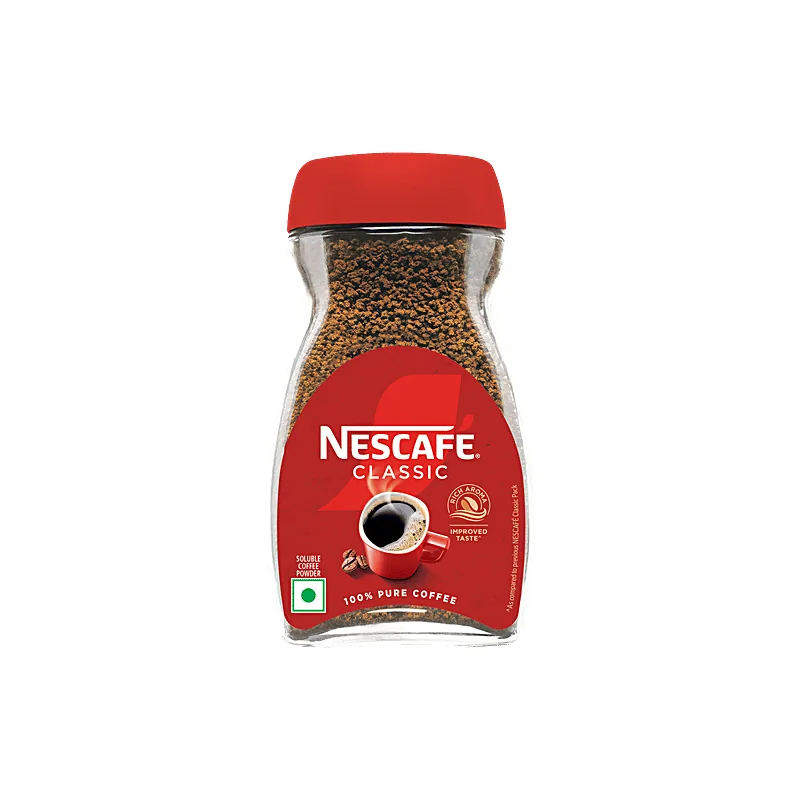
My verdict
A strong, plain, honest coffee. I like it with milk. I don't like it black.
Nescafé Classic does one thing well. It gives me a proper caffeine kick from one cup, and with hot milk it still tastes like coffee. It's 100% coffee with no chicory, which our team says is less common on Indian shelves than people think.
It's not a coffee to sip black. That's the robusta talking, and if black coffee is your thing, a freeze-dried jar like Bru Gold or Nescafé Gold Blend will suit you better. I'd also like Nestlé to print the caffeine on the jar. Right now you have to guess.
My cup, every day
I bought my jar of Nescafé Classic this year with my own money, and it's been my one cup a day since. Most days it's a hot cup with milk.
The thing I notice most is the kick. One cup is enough. It wakes me up and keeps me alert, and that's the main reason it's still my daily coffee.
I've tried it black and as cold coffee too. Black, it's too bitter for me, and I went back to milk. That's my honest summary: strong, plain, and at its best with milk.
What's on the jar
Our research team went through the label, Nestlé's own product page and retail listings. Here's what the jar tells you, and the one thing it doesn't.
Drawn from the 90 g jar. Numbers match the notes on the right.
| Label point | Nescafé Classic |
|---|---|
| Ingredients | Coffee (100%). No chicory, sugar or flavouring |
| Beans | Robusta, from South Indian farms1 |
| Roast | Medium-dark1 |
| Caffeine | Not declared |
| Made by | Nestlé India Ltd., Nanjangud, Karnataka (retailer listing)2 |
| Packs | Jars from 25 g to 200 g, plus sachets |
The "100% pure coffee" line matters more than it looks. FSSAI says a coffee with chicory in it has to be sold as a coffee-chicory mixture, has to print how much of each it contains, and can't call itself pure.3 Nescafé Sunrise, on the same shelf, is that kind of blend. Classic isn't.
Why it's strong, and why it's bitter black
Both come from the same place: the beans. Classic is all robusta. Robusta beans carry roughly twice the caffeine of arabica, and more chlorogenic acids too.4 Caffeine itself tastes bitter. So the jar that gives me the kick I like is also the one I can't drink black. With milk, the bitterness softens and I mostly taste coffee.
The powder form plays a part as well. Instant coffee that's dried into a powder loses more of its aroma than freeze-dried crystals do, and aroma is a lot of what makes black coffee pleasant. Milk covers that gap. Black, you notice it.
How much caffeine is in it?
Nestlé doesn't say. Our team estimated it from USDA lab data, which puts regular instant coffee at 3,142 mg of caffeine per 100 g, so about 63 mg in a 2 g teaspoon.5 Because Classic is all robusta, it probably sits a bit above that. Here's how that compares with other jars on the shelf.
Solid bar: printed by the brand. Pale bars: our estimates from USDA data and the coffee share on the label. Green band: ICMR's 50–65 mg for a cup of instant coffee.
Figures from our instant coffee guide. Classic's arrow shows it's likely higher: robusta carries more caffeine than arabica.
ICMR advises keeping caffeine under 300 mg a day.6 Europe's food safety authority puts the limit for healthy adults at 400 mg a day and 200 mg in one go, and 200 mg a day in pregnancy.7 My one cup a day is nowhere near that. Timing still matters: in a sleep-lab study, a big caffeine dose taken six hours before bed still cut sleep by over an hour,8 so it's worth keeping coffee out of the evening. Work out your own day below.
Caffeine calculator
Count your Nescafé Classic and tea, and see where you land against the daily limits.
Estimates: 31.4 mg of caffeine per gram of instant coffee (USDA), and 45 mg per cup of tea (middle of ICMR's 30–65 mg). Real values vary with the beans and the brew.
Make it the way I do
I drink mine with hot milk, so the builder starts there. Pick how you like it and it gives you the amounts. If you want every method step by step, with spoon sizes and cold coffee, see our guide on how to make Nescafé Classic.
Cup recipe builder
Choose a style, cup size, strength and sugar.
Spoon weights are approximate. Weigh a spoonful once on a kitchen scale if you want to be exact.
What a cup costs
| Pack | Price seen | Per gram | Per 2 g cup |
|---|---|---|---|
| 90 g jar | ₹365 (MRP ₹390)9 | ₹4.06 | ~₹8.1 |
| 100 g jar | ₹390 (MRP ₹445)9 | ₹3.90 | ~₹7.8 |
| 180 g jar | ₹72510 | ₹4.03 | ~₹8.1 |
| 200 g jar | ₹80810 | ₹4.04 | ~₹8.1 |
Prices from Amazon.in and Blinkit in October 2026. They change with offers and city. The surprise is that the big jars aren't cheaper per gram, so there's no point stocking up. Buy a size you'll finish while it's fresh. At one 2 g cup a day, a 90 g jar lasts about six weeks.
Ranges reflect pack sizes and offers. Nescafé Classic is highlighted.
Per-cup prices from our instant coffee guide (October 2026). The cheapest two are coffee-chicory blends.
So Classic sits in the middle. Chicory blends cost half as much, but you're not getting pure coffee. Bru Gold costs about the same in its 200 g pack and is freeze-dried, which makes it the better buy for black coffee. In a milky cup, that smoother taste matters a lot less.
Lab test and purity
We didn't lab-test Nescafé Classic, and our team couldn't find an independent test or certificate of analysis for it. It's made by Nestlé India in its own factory, from a single ingredient. Like all roasted coffee it contains some acrylamide, which forms during roasting. The EU sets a benchmark of 850 µg per kg for instant coffee,11 which works out to under 2 µg in a 2 g cup. Nestlé doesn't publish its levels for the Indian jar.
Coffee itself has a decent health record. A BMJ review of observational studies linked three to four cups a day with lower death rates than drinking none.12 That's an association, not proof, and it doesn't count the sugar.
Should you buy it?
Yes, if
You drink your coffee with milk. You want pure coffee and not a chicory blend. You want one cup to actually wake you up. You want a jar you can find at almost any shop or delivery app.
No, if
You drink it black and care about taste. Try Bru Gold, Sleepy Owl or Davidoff. If robusta is too harsh for you, Nescafé Gold Blend is smoother. And if you're sensitive to caffeine or pregnant, keep the count low: this is one of the stronger jars per spoon.
Frequently asked questions
How the score adds up
Caffeine is about as well studied as an ingredient gets, with daily limits from ICMR and EFSA. Coffee and long-term health has a big observational record but no trial proof. Classic makes no health claims. Minus 2.5 because there's no declared caffeine, so you have to estimate your dose. Evidence tier: Strong (caffeine) · Observational (coffee and health)
Pure coffee with no chicory is the right base. Robusta brings the caffeine but also the bitterness, and a powder keeps less aroma than freeze-dried crystals. Minus 3.5 because, taste-wise, it's a clear step below freeze-dried jars, especially black.
One ingredient, made by Nestlé India in its own Karnataka factory under an FSSAI licence. Minus 3.5 because there's no published independent test, certificate of analysis, caffeine figure or acrylamide level for the Indian jar, and we haven't tested it.
About ₹4 a gram, or ₹8 for a 2 g cup, is fair for pure coffee. Minus 3 because chicory blends cost half as much per cup, Bru Gold gets you freeze-dried coffee for about the same money, and the bigger jars bring no discount.
"100% pure coffee" is accurate, and Nestlé names the bean and where it's grown. Minus 3 for no caffeine on the pack, no drying method, a vague "improved taste" badge, and a suggested serving of half a teaspoon that makes each cup look cheaper and milder than most people make it.
Weighted score: (7.5 × 0.30) + (6.5 × 0.20) + (6.5 × 0.20) + (7.0 × 0.15) + (7.0 × 0.15)
= 2.250 + 1.300 + 1.300 + 1.050 + 1.050 = 6.95 → 7.0
Per Naked Compound rubric v3.0 · dimension weights unchanged since Q1 2024
References
Disclosures: I bought this jar with my own money. Naked Compound got no samples or money from Nestlé India, and Nestlé didn't know about this review in advance. We didn't lab-test the product; the label, price and caffeine research is by the Naked Compound Research Team. The illustrations are drawn by us. The Amazon link is an affiliate link, so we may earn a small commission at no extra cost to you. It doesn't affect the score. Full policy: conflicts policy