Top 7 Energy Drinks
in India 2026
7 energy drinks sold in India, scored on caffeine dose per can, sugar load, and label honesty — the three numbers marketing usually buries. In mid-2026, FSSAI gave every major brand here 90 days to drop the term "energy drink" from packaging entirely; the caffeine and sugar haven't changed, but reading the fine print now matters more than the branding.
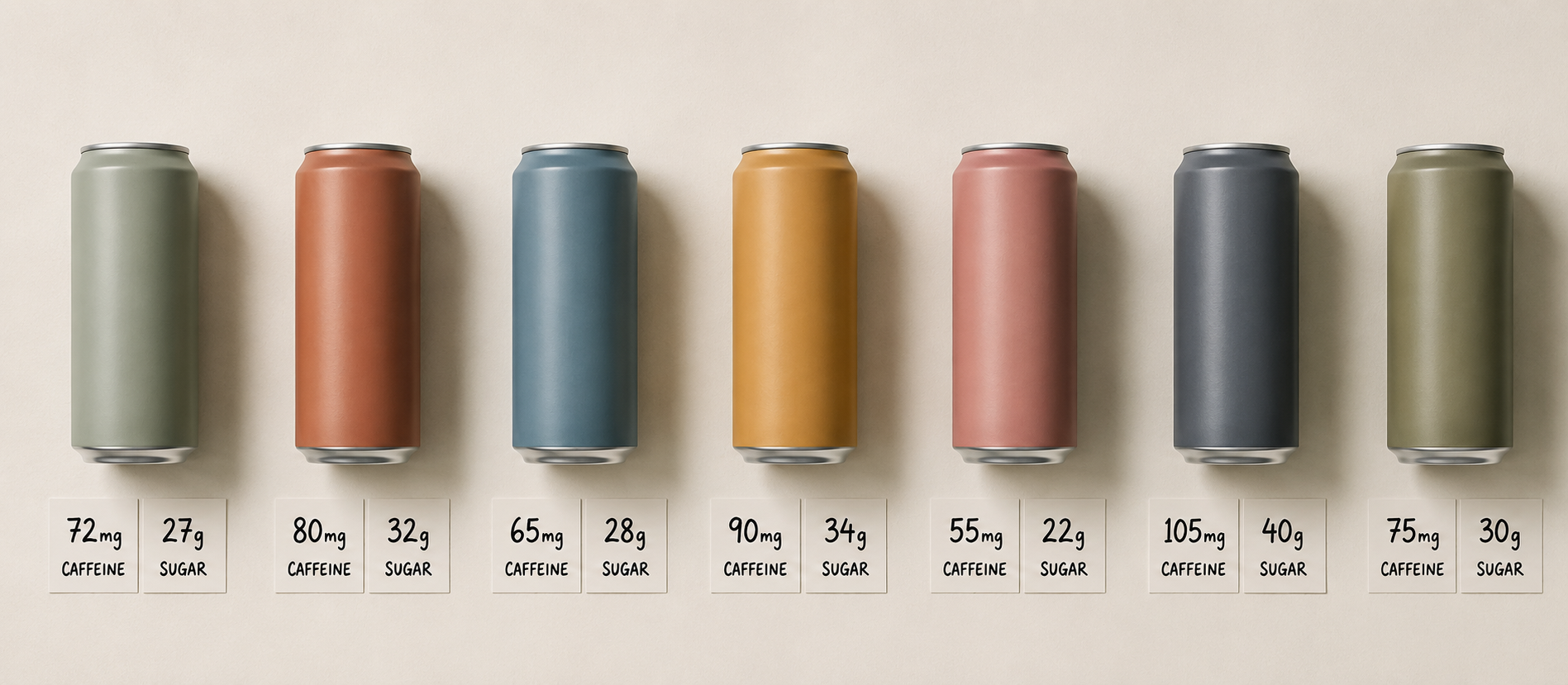
Caffeine itself has strong evidence for alertness and short-term exercise performance. What drags the category score down is everything bundled around it: high added-sugar loads in most cans, a regulatory history of companies stretching "energy" branding past what FSSAI now permits, and per-can caffeine doses that can add up fast if you're drinking more than one. None of the 7 brands here are dangerous in isolation at one can a day for a healthy adult — the risk is almost entirely about frequency and stacking, not the individual product.
Caffeine and sugar, side by side
FSSAI's own standard for "caffeinated beverages" sets a band of 145–300mg caffeine per litre, with mandatory disclosure of per-serving caffeine and a "not recommended for children, pregnant or lactating women, or persons sensitive to caffeine" warning on every can. Every brand below sits inside that legal band — the real differences are in exactly where within it, and how much sugar rides along with the caffeine.
The FSSAI warning label, decoded
Every can in this guide legally carries some form of: "Not recommended for children, pregnant or lactating women, or persons sensitive to caffeine" and "Consume no more than 500ml per day." That second line is easy to miss — 500ml is just two 250ml cans, or one 500ml Monster. It is not a suggestion; it reflects where most published caffeine safety data starts showing a meaningfully higher risk of jitteriness, elevated heart rate, and sleep disruption in a single day for an average adult.
Why India taxes these like a vice, not a drink
Energy drinks in India carry an effective 40% tax rate — 28% GST plus a 12% compensation cess, the same bracket used for tobacco and luxury goods, not ordinary beverages. That framing matters for how to think about frequency: FSSAI and India's tax code both treat energy drinks as an occasional, deliberately-priced-up category rather than a daily hydration or nutrition product — closer to how a soft drink or dessert should be budgeted than a sports supplement.
Brand breakdown
Monster's own budget sub-brand for the Indian market, and the best balance of the group: 30mg caffeine per 100ml (75mg per 250ml serving), 100mg taurine per 100ml, and — unlike most of the field — sugar cut down to roughly 14g per 250ml by blending sucrose with sucralose rather than sugar alone. Full per-serving nutrition panel published on the brand's India site, including added-sugar RDA percentage.
At ₹50–60 it costs more than Sting or Tzinga but noticeably less than its parent Monster brand, while carrying a meaningfully lower sugar load than either. If your priority is genuine caffeine effect with the least sugar baggage, this is the pick.
Coca-Cola's newest mass-market entrant, launched to compete directly with Sting and Tzinga on price. States its caffeine dose plainly on-pack: "HIGH CAFFEINE 72.5mg/250ml" — one of the clearest, most explicit front-of-can caffeine disclosures in this entire guide, well ahead of what most competitors print. Sugar comes from a mix of real sugar and sucralose, landing at roughly 18g per 250ml (7.3g/100ml).
At ₹20–25 it undercuts Predator and Hell Energy on price while staying close on caffeine dose. The main reason it doesn't top this guide: it's the newest product here with the shortest track record, and Coca-Cola has not published independent third-party testing beyond the mandatory FSSAI declarations.
India's best-selling energy drink by volume, and the product most responsible for making energy drinks a mass-market rather than premium category here. 72mg caffeine per 250ml — nearly matching Red Bull's 80mg at roughly a sixth of the price — with 17.5g sugar plus a small amount of artificial sweetener. Available almost everywhere, from metro supermarkets to single-shop rural retailers.
The trade-off for the price: less third-party scrutiny and a shorter public testing history than the multinational premium brands, though it has never had a documented FSSAI compliance issue at scale. For most people who just want the caffeine effect without paying a brand premium, this is the rational default.
India's homegrown answer to Red Bull and Sting, from the makers of Paper Boat. 72mg caffeine and 18g sugar per 250ml — essentially the same profile as Sting at the same price. Available in more flavour variants than Sting, and positioned slightly more toward students and younger buyers in its marketing.
Functionally near-identical to Sting on the numbers that matter (caffeine dose, sugar, price); the choice between the two mostly comes down to flavour preference and local availability rather than any meaningful difference in what you're actually consuming.
An imported Hungarian brand that has become a quick-commerce staple in Indian metros — 30mg caffeine per 100ml (75mg per 250ml can), positioned explicitly against Red Bull on price ("similar effect, lower cost"). Sugar is on the higher side at roughly 27g per 250ml, with no sucralose or sweetener blend to reduce it — this is straight sugar, matching Red Bull's sugar profile almost exactly.
At ₹60 it sits in the middle of the price range: pricier than the domestic budget brands, cheaper than Red Bull or full-size Monster, with a caffeine dose competitive with either. The per-100ml labelling is genuinely clear, which we credit — but the sugar load holds it back from a higher score.
The brand that created and still defines the category in India, and the reference point every other can in this guide gets compared against. 80mg caffeine per 250ml (32mg/100ml) with 27g sugar, taurine, and B-vitamins — a formula essentially unchanged since it entered India in 2009. Longest independent testing history and the most consistent batch quality record of any brand here.
What it doesn't offer at this price point is a meaningfully different caffeine dose from Sting or Tzinga at a sixth of the cost, or from Predator at half the cost with less sugar. The premium buys brand trust and consistency, not more caffeine or a cleaner formulation — worth knowing if price sensitivity matters to you.
The highest caffeine dose in this guide by a wide margin: approximately 160mg per 500ml can (32mg/100ml), close to 40% of the general adult daily caffeine ceiling in a single serving. Sugar is also the highest of the group at roughly 54g per can — more than double the WHO daily added-sugar guideline in one drink. This is not a flaw in the product; Monster's positioning has always been "stronger, bigger can," and it delivers exactly that.
It scores lowest here specifically because the combination of highest caffeine and highest sugar in one 500ml serving is the profile most likely to push a casual buyer past sensible daily limits without realising it — especially since 500ml is already FSSAI's stated daily ceiling. Fine occasionally for someone with established caffeine tolerance; the one to be most deliberate about if you're a light or infrequent caffeine user.
Full comparison — all 7 brands (August 2026 prices)
| Brand | Size | Price | Caffeine | Sugar | Sweetener | Score |
|---|---|---|---|---|---|---|
P Predator (Monster) Best overall | 250–300ml | ₹50–60 | 75mg | ~14g | Sucrose + sucralose | 7.4 |
C Charged by Thums Up Most transparent label | 250ml | ₹20–25 | 72.5mg | ~18g | Sugar + sucralose | 7.2 |
S Sting Energy Cheapest per mg | 250ml | ₹20 | 72mg | 17.5g | Sugar | 6.9 |
T Tzinga 250ml | 250ml | ₹20 | 72mg | 18g | Sugar | 6.7 |
H Hell Classic Energy Imported | 250ml | ₹60 | 75mg | 27g | Sugar | 6.5 |
R Red Bull Premium reference | 250ml | ₹125 | 80mg | 27g | Sugar | 6.4 |
M Monster Energy Original Use with caution | 500ml | ₹125–140 | 160mg | 54g | Sugar | 5.8 |
Scoring rubric
How we score →1. Evidence quality
Caffeine's effects on alertness and short-term exercise performance are among the best-replicated findings in nutrition science — 3–6mg/kg pre-exercise reliably improves power output and perceived exertion in RCTs. What's weaker is evidence for the "energy drink matrix" beyond caffeine alone: taurine, B-vitamins, and guarana at the doses used in these cans have limited independent trial support once caffeine's own effect is accounted for.
2. Dosage confidence
Most brands here (72–80mg/250ml) sit in a well-studied, moderate range. Monster's 160mg/500ml is the outlier — a single can already delivers close to 40% of the general adult daily ceiling, leaving little room for other caffeine sources that day. Dose confidence is high for the 6 lower-caffeine brands and meaningfully lower for Monster specifically.
3. India market fit
Extremely high market fit by availability and price spread — from ₹20 (Sting, Tzinga) to ₹140 (Monster), every budget tier is covered, and FSSAI's caffeine band (145–300mg/L) plus mandatory warnings give a consistent regulatory floor across every brand. The category's 40% effective tax rate also nudges pricing toward occasional-use framing rather than daily consumption, which is arguably the correct positioning.
4. Safety profile
Caffeine at moderate doses is safe for most healthy adults, but energy drinks specifically carry documented case reports of cardiac events and severe reactions at high intake, concentrated in young people, those with undiagnosed cardiac conditions, and stacked-dose scenarios (multiple cans, or energy drinks mixed with alcohol or pre-workout). FSSAI's explicit warnings — not for children, pregnant/lactating women, or caffeine-sensitive individuals; max 500ml/day — exist because of this evidence, not as boilerplate.
5. Label accuracy
Post-2024 FSSAI rules meaningfully improved disclosure across the category — every brand here now states caffeine per serving and carries the mandatory warning. The 2026 order to drop "energy drink" terminology entirely reflects a regulator that still isn't satisfied with how the category represents itself, particularly around child-directed marketing despite the on-pack warnings. Charged and Predator currently lead on front-of-pack clarity; the rest comply with the legal minimum rather than exceeding it.
How to use it
Frequently asked
How much caffeine is safe to drink in a day from energy drinks?
Why did FSSAI order companies to remove the term "energy drink" from labels?
Which energy drink in India has the most caffeine?
Which energy drink has the least sugar?
Are budget Indian energy drinks like Sting and Tzinga weaker than Red Bull or Monster?
Is it safe to drink energy drinks before a workout?
Related content
Caffeine — Full Evidence Review
Adenosine antagonism mechanism, exercise performance dosing, tolerance and half-life, and India-specific consumption context.
Caffeine Tolerance in a Chai-Drinking Population
Why baseline caffeine habits in India change how energy drinks actually feel — and how much is "too much."
Top 10 Best Instant Coffee Brands in India
Caffeine per spoon, chicory share and price per cup for Bru, Nescafé, Sleepy Owl, Davidoff and more.
Best Of — All Categories
Creatine, whey protein, omega-3, ashwagandha, magnesium, vitamin D3+K2. All brands on the same rubric.
Not medical advice. This guide is educational and reflects published caffeine and food-safety research. Energy drinks are not recommended for children, pregnant or lactating women, or people sensitive to caffeine or with cardiac conditions — consult a physician if you have any underlying health concern before regular use. conflicts-policy