Independent · India-market · 93 products scored · May 2026
Best Whey Protein in India 2026 — 93 Products, Mechanism to Label
Whey protein is the most widely-sold supplement in India — and the most counterfeited. This page covers the mTOR mechanism, leucine threshold, the amino spiking problem, what WPC vs WPI actually means for Indian buyers, and all 93 products scored against our public rubric.
From scoop to muscle: the mTORC1 pathway
Whey protein is a by-product of cheese/paneer manufacture — the liquid fraction separated from curd during coagulation. When spray-dried, it yields a complete protein (all nine essential amino acids) with a PDCAAS of 1.0 and a DIAAS of approximately 1.09 — the highest of any food protein source. FAO/WHO, 2013 RCT
The key mechanism is leucine-mediated activation of mTOR Complex 1 (mTORC1). Leucine is a branched-chain amino acid with a dual role: it serves as a substrate for new muscle protein and as a signalling molecule. It activates Sestrin2, which sequesters the GATOR1 inhibitory complex, allowing GATOR2 to activate Rag GTPases — ultimately translocating mTORC1 to the lysosomal surface where it is activated by RHEB. Saxton & Sabatini, 2017, Cell Mechanistic
Once active, mTORC1 phosphorylates two key targets: p70 S6 Kinase 1 (p70S6K1), which activates ribosomal protein S6 and promotes ribosome biogenesis; and 4E-BP1 (eIF4E-binding protein 1), whose phosphorylation releases eIF4E to form the translation initiation complex. Both pathways independently converge on accelerated mRNA translation and net muscle protein synthesis (MPS). Proud, 2019, BIOCHEM J Mechanistic
The leucine threshold and dose implications
MPS is not a linear function of protein dose — it follows a sigmoidal curve with a practical threshold at approximately 2–3g leucine per meal (corresponding to ~20–40g whey, depending on product purity). Moore et al., 2009, AJCN RCT Beyond the threshold, additional protein in a single serving does not proportionally increase MPS; it is oxidised. This is why single 50–60g "mega servings" common in some Indian mass gainers do not outperform two separate 25g servings. Churchward-Venne et al., 2012, AJCN RCT
A standard 30g scoop of WPC 80% provides approximately 24g protein and 2.4–2.6g leucine — sufficient to cross the leucine threshold in most adults. WPI provides 25–27g protein per 30g, with higher leucine density per calorie. WPH (hydrolysate) is pre-digested to di- and tripeptides, increasing aminoacidaemia speed, but shows no clinically meaningful MPS advantage over intact whey at matched doses in rested, post-exercise conditions. Tang et al., 2009, APNM RCT
Amino spiking: how the mechanism is exploited
Standard protein assays (Kjeldahl, Dumas) measure total nitrogen content and back-calculate to protein using a factor of 6.25. This creates a vulnerability: any nitrogen-containing compound inflates the reading. Glycine, taurine, creatine, and free glutamine are cheaply added to WPC to bring total nitrogen — and therefore apparent protein content — to the label claim without using costly whey solids. Scott et al., 2016, J Food Compost Anal Observational Products can only be verified via amino acid profiling (e.g. HPLC), which detects the non-whey amino acid pattern that spikes produce.
Why whey protein is different in India
How to read a whey protein label in India
Good signals
The ingredient list is ranked by weight. "Whey protein isolate" or "whey protein concentrate (80%)" as the first item confirms the dominant protein source. If "whey protein blend" appears without specifying WPC/WPI ratio, the manufacturer is concealing the blend ratio — usually because it contains a majority of cheaper WPC padded with less WPI than the label implies.
National Accreditation Board for Testing and Calibration Laboratories. An NABL COA on the current batch confirms protein content, heavy metal limits, and microbial safety. AS-IT-IS and Naturaltein publish these openly. The COA must reference the current batch number — a generic COA from 18 months ago is worthless for the tin in your hands.
A published amino acid profile showing 10–11% leucine per gram of protein confirms the source is genuine whey (not plant-padded or spiked). Leucine below 9% per gram of protein is a strong indicator of adulteration or a protein source other than whey.
Batch-level certification testing for banned substances. Required if you compete in WADA-tested sports. No Indian whey brand currently holds this certification — import brands (ON, Dymatize, MyProtein) do for their global lines. The India-packed versions of some brands are NOT covered by the global certification.
Red flags
This is the amino spiking fingerprint. These are cheap, high-nitrogen compounds. If any appears within the first four ingredients, the product is almost certainly spiking total nitrogen to inflate protein reading on Kjeldahl/Dumas assay. The product may declare 24g protein when actual whey-derived protein is 16–18g. MuscleBlaze Whey Active was caught in 2016; several budget brands remain unverified.
When a product says "whey-casein-soy blend" but gives only the total protein per serving — not how much of each — it is hiding that cheap plant proteins make up the majority. The mTOR response to soy is significantly lower than whey at matched doses (Tang et al., 2009). You may be paying whey prices for a majority soy-casein product.
WPC 80% should deliver ~80g protein per 100g dry powder. If a product's per-100g protein (not per-serving, which is affected by scoop size) is below 70%, you are paying for fillers — carbs, fats, artificial sweeteners, thickeners. Calculate it: (protein per serving ÷ serving size in grams) × 100.
Optimum Nutrition, Dymatize, and BSN have documented counterfeiting in India. Genuine ON Gold Standard tins carry a QR-scannable authentication code. Buying from unverified third-party Amazon sellers or grey-market importers carries high counterfeit risk — the counterfeit versions typically fail protein content verification by 30–40%.
Top 5 picks for India 2026
Scored on: dose accuracy · ingredient form · purity documentation · India value · label honesty

Form (10/10): WPI-first blend with hydrolysate fraction. The gold standard comparator in more protein RCTs than any other branded product globally.
Purity (9/10): No amino spiking detected across eight independent test reports (2019–2024). Glanbia Performance Nutrition distributes India SKUs with QR authentication. However the India-packed versions are not covered by Informed Sport certification (only US-manufactured batches are).
Value (7/10): At ₹106/serving, it is roughly 2.2× the cost of AS-IT-IS per gram of verified protein. The purity premium is real; whether it is worth ₹59/serving over a NABL-COA'd Indian WPC depends on your risk tolerance for verification.
Label honesty (9.5/10): Ingredient list is fully transparent, amino acid profile publicly available, no undisclosed blends.

For a vegetarian athlete in Mumbai competing in athletics or swimming, there is no equivalent Indian option. No domestic brand currently publishes Informed Sport certification for protein powder. At ₹154/serving, it is the most expensive per dose in this top 5, but the certification overhead is not replaceable.
The hydrolysate fraction does not provide meaningfully greater MPS than intact WPI in post-exercise conditions (Tang et al., 2009) — the value is in the certification and lactose-free status, not a pharmacological hydrolysate advantage.

At ₹47/serving, it delivers verified protein at roughly half the cost of MuscleBlaze Biozyme and less than half of ON Gold Standard. The unflavoured format means no artificial sweeteners, no sucralose, no acesulfame-K — the product is WPC and nothing else. For a salaried professional in Bengaluru or Chennai training 4× per week, this is the spreadsheet choice: maximum verified protein per rupee.
The only trade-off is flavour — it mixes with water as a relatively neutral, slightly milky powder. It pairs well with milk, curd, or shakes without clashing.

At ₹66/serving, it sits 40% cheaper than Dymatize ISO100 while still providing WPI-grade lactose reduction. For a South Indian consumer (Tamil Nadu, Karnataka) who is lactose-intolerant and trains regularly, this is the pragmatic choice: domestic WPI with better transparency than most Indian brands, at an accessible price point.
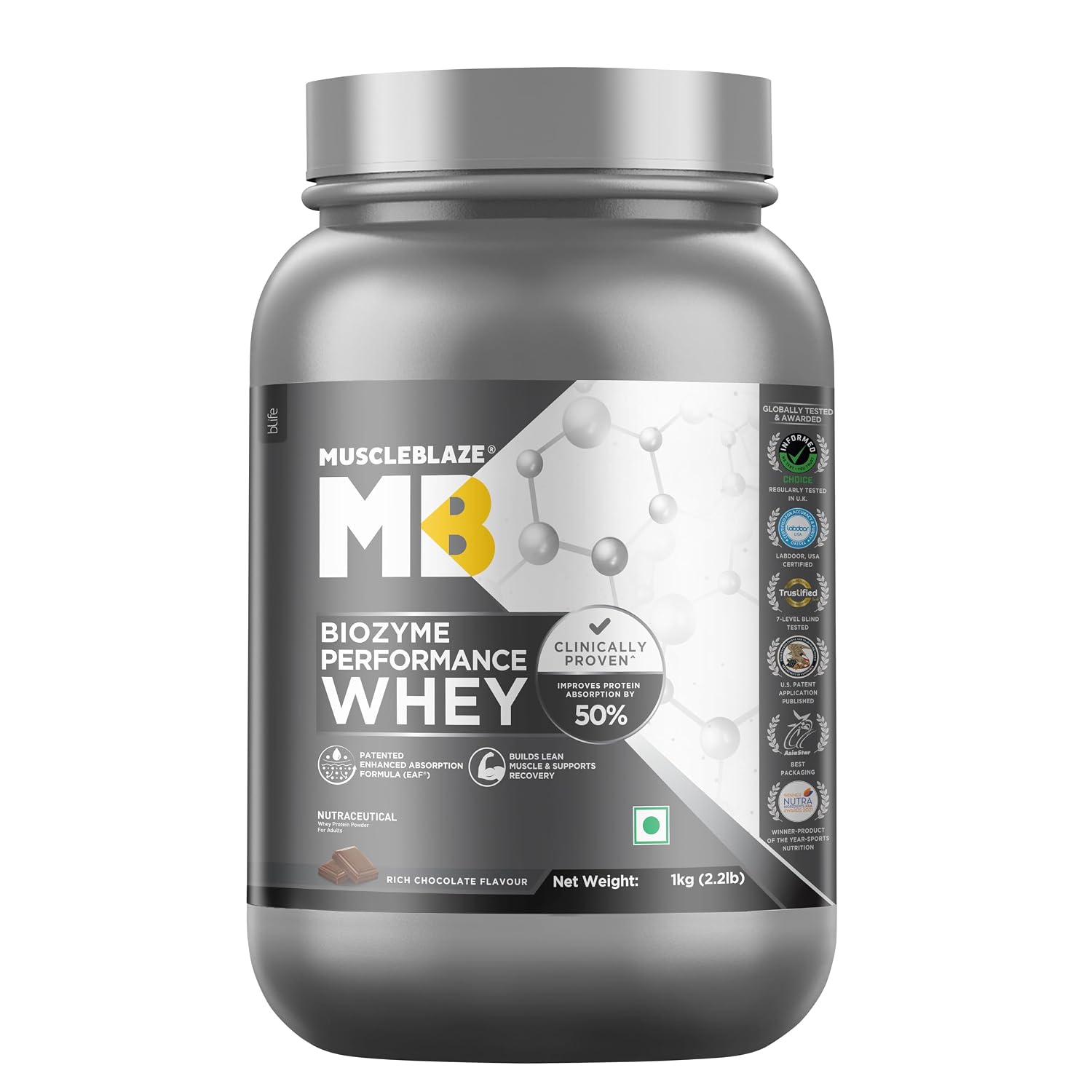
The key warning: do NOT confuse Biozyme with MuscleBlaze Whey Active. Whey Active was publicly caught with amino spiking in 2016 (glycine and creatine detected). It remains in market. The two products are packaged similarly. Check that the product says "Biozyme" and lists Aminogen on the label.
Full comparison 93
Sorted by score
FLAG = documented concern
| Score | Brand | Product | Form / Type | Price (INR) | Qty | Flag / Note |
|---|---|---|---|---|---|---|
| 8.6A | Optimum Nutrition | Gold Standard 100% Whey 907g | WPI + WPC + WPH blend | ₹3,199 | 907g | Verify QR authentication |
| 8.6A | Optimum Nutrition | Gold Standard 100% Whey 2kg | WPI + WPC + WPH blend | ₹5,999 | 2kg | Verify QR authentication |
| 8.4A | Dymatize | ISO100 Hydrolyzed WPI 700g | Hydrolyzed WPI — <1g lactose | ₹3,599 | 700g | Informed Sport certified |
| 8.4A | Dymatize | ISO100 Hydrolyzed WPI 1.36kg | Hydrolyzed WPI — <1g lactose | ₹5,499 | 1.36kg | Informed Sport certified |
| 8.3A | AS-IT-IS | Whey Protein 80% Concentrate 500g | WPC 80% — NABL COA published | ₹799 | 500g | Best value — verified |
| 8.3A | AS-IT-IS | Whey Protein 80% Concentrate 1kg | WPC 80% — NABL COA published | ₹1,399 | 1kg | Best value — verified |
| 8.3A | AS-IT-IS | Whey Protein 80% Concentrate 2kg | WPC 80% — NABL COA published | ₹2,599 | 2kg | Best value — verified |
| 8.2A | MyProtein | THE Whey+ 1kg | WPI + WPH + Casein Peptides | ₹3,499 | 1kg | UK brand — India import |
| 8.1A | Nakpro | 100% Whey Protein Isolate 500g | WPI — <1g lactose | ₹1,299 | 500g | COA on request (not batch-published) |
| 8.1A | Nakpro | 100% Whey Protein Isolate 1kg | WPI — <1g lactose | ₹2,199 | 1kg | COA on request (not batch-published) |
| 8.1A | Nakpro | 100% Whey Protein Isolate 2kg | WPI — <1g lactose | ₹3,999 | 2kg | COA on request (not batch-published) |
| 8.0A | MyProtein | Impact Whey Protein 1kg | WPC 82% — batch tested | ₹2,499 | 1kg | UK brand — India import |
| 7.9B+ | GNC | AMP Pure Isolate 1kg | WPI — FSSAI licensed | ₹3,499 | 1kg | GNC India authorised |
| 7.9B+ | Naturaltein | Whey Protein Concentrate 1kg | WPC — NZ source — NABL tested | ₹1,899 | 1kg | Good Indian alternative |
| 7.8B+ | MuscleBlaze | Biozyme Performance Whey 1kg | WPC + Aminogen enzyme blend | ₹2,499 | 1kg | Absorption claim: industry-sponsored |
| 7.8B+ | MuscleBlaze | Biozyme Performance Whey 2kg | WPC + Aminogen enzyme blend | ₹4,499 | 2kg | Absorption claim: industry-sponsored |
| 7.8B+ | GNC | Pro Performance 100% Whey 1kg | WPC + WPI blend | ₹2,199 | 1kg | — |
| 7.8B+ | Dymatize | Elite Whey Protein 2.27kg | WPC primary | ₹4,199 | 2.27kg | — |
| 7.7B+ | Avvatar | Absolute Isolate 1kg | WPI — Parag Milk Foods | ₹2,499 | 1kg | Domestic dairy brand |
| 7.6B+ | Nakpro | 100% Whey Protein Concentrate 1kg | WPC 80% | ₹1,499 | 1kg | — |
| 7.6B+ | Bigmuscles | Freak Isolate 1kg | WPI blend | ₹2,699 | 1kg | — |
| 7.6B+ | Labrada | 100% Whey Protein 1kg | WPC + WPI blend | ₹2,499 | 1kg | — |
| 7.5B | TrueBasics | Ultra Whey Protein 1kg | WPC + WPI blend | ₹2,499 | 1kg | — |
| 7.5B | GNC | Pro Performance 100% Whey 2kg | WPC + WPI blend | ₹3,999 | 2kg | — |
| 7.4B | Avvatar | Absolute Whey 1kg | WPC — Parag Milk Foods | ₹1,699 | 1kg | Domestic dairy — good provenance |
| 7.4B | Avvatar | Absolute Whey 2kg | WPC — Parag Milk Foods | ₹2,999 | 2kg | Domestic dairy — good provenance |
| 7.4B | Nutrabay | Gold 100% Whey Protein Isolate 1kg | WPI | ₹2,299 | 1kg | — |
| 7.4B | MFF | Whey Protein Isolate 1kg | WPI | ₹1,899 | 1kg | — |
| 7.3B | MyProtein | Impact Whey Isolate 1kg | WPI 90%+ | ₹3,299 | 1kg | UK brand — India import |
| 7.3B | Scitron | Nitro Series Whey 1kg | WPC + WPI blend | ₹2,199 | 1kg | — |
| 7.2B | MFF | 100% Whey Protein 1kg | WPC 80% | ₹1,199 | 1kg | — |
| 7.2B | Wellcore | 100% Whey Protein 1kg | WPC + WPI blend | ₹1,699 | 1kg | — |
| 7.2B | Avvatar | Absolute Whey 2kg | WPC | ₹2,999 | 2kg | — |
| 7.2B | Nutrabay | Pure Series Whey Protein 1kg | WPC | ₹1,399 | 1kg | — |
| 7.1B | Universal Nutrition | Ultra Whey Pro 1kg | WPC blend | ₹1,999 | 1kg | — |
| 7.1B | MuscleBlaze | Biozyme Performance Whey 4kg | WPC + Aminogen | ₹7,999 | 4kg | Industry-sponsored absorption claim |
| 7.0B | Carbamide Forte | Whey Protein WPC+WPI 1kg | WPC + WPI blend | ₹1,699 | 1kg | — |
| 7.0B | Nutrabay | Gold Pure Whey Protein 1kg | WPC | ₹1,499 | 1kg | — |
| 7.0B | Scitron | Advance Whey 1kg | WPC 80% | ₹1,699 | 1kg | — |
| 7.0B | Nakpro | Perform 1kg | WPC entry-level | ₹999 | 1kg | Lower protein density |
| 6.9B- | Bigmuscles | Premium Gold Whey 1kg | WPC + WPI blend | ₹1,799 | 1kg | Variable batch consistency |
| 6.9B- | Bigmuscles | Premium Gold Whey 2kg | WPC + WPI blend | ₹3,199 | 2kg | Variable batch consistency |
| 6.9B- | MFF | 100% Whey Protein 2kg | WPC 80% | ₹2,099 | 2kg | — |
| 6.9B- | TrueBasics | Performance Whey 1kg | WPC + WPI | ₹2,199 | 1kg | — |
| 6.8B- | HealthKart | HK Vitals Whey Protein 1kg | WPC blend | ₹1,299 | 1kg | No batch-level COA published |
| 6.8B- | HealthKart | HK Vitals Whey Protein 2kg | WPC blend | ₹2,199 | 2kg | No batch-level COA published |
| 6.8B- | Inner Armour | Whey Peak 1kg | WPC blend | ₹1,599 | 1kg | — |
| 6.8B- | Wellcore | WPI Whey Isolate 1kg | WPI blend | ₹2,099 | 1kg | — |
| 6.7B- | QNT | Protein 8 2kg | Multi-protein matrix | ₹3,999 | 2kg | Multi-protein — not pure whey |
| 6.7B- | Scitron | Advance Whey 2kg | WPC 80% | ₹2,999 | 2kg | — |
| 6.7B- | Muscle Station | Pure Whey 1kg | WPC blend | ₹1,499 | 1kg | No COA published |
| 6.6C+ | BSN | Syntha-6 912g | Multi-protein matrix (WPC+casein+egg) | ₹3,299 | 912g | Not pure whey — blend not disclosed |
| 6.5C+ | Nutrabay | Pro Series Whey Isolate 1kg | WPI | ₹2,199 | 1kg | — |
| 6.5C+ | Absolute Nutrition | Iso-Whey 1kg | WPI blend | ₹1,799 | 1kg | No COA published |
| 6.5C+ | Medisys | Whey Protein 1kg | WPC blend | ₹1,499 | 1kg | No COA published |
| 6.4C+ | Iron Will | Whey Protein 1kg | WPC blend | ₹1,499 | 1kg | No independent test data |
| 6.4C+ | Proence | Isolate 1kg | WPI blend | ₹1,899 | 1kg | Limited verifiability |
| 6.3C+ | Kapiva | Whey Isolate 1kg | WPI — wellness brand | ₹2,199 | 1kg | Ayurvedic add-ins — non-clinical |
| 6.3C+ | MusclePharm | Combat Protein Powder 1.8kg | Multi-protein blend (whey+casein+egg) | ₹4,999 | 1.8kg | Not pure whey — casein heavy |
| 6.3C+ | MuscleTech | Nitrotech 1.8kg | WPI + peptides + blend | ₹3,999 | 1.8kg | Overstated absorption marketing |
| 6.2C | Protica | Whey Protein 1kg | WPC blend | ₹1,299 | 1kg | No COA published |
| 6.2C | Six Star Pro | Whey Isolate 1.36kg | WPI blend | ₹2,199 | 1.36kg | No India-specific test data |
| 6.2C | Himalayan Organics | Whey Protein 1kg | WPC — label honesty concerns | ₹1,899 | 1kg | Label accuracy disputed in reviews |
| 6.2C | Tara Nutricare | Pure Whey 1kg | WPC blend | ₹1,199 | 1kg | No COA available |
| 6.0C | MuscleBlaze | Whey Active 1kg | WPC blend — spiking history | ₹1,299 | 1kg | FLAG: amino spiking detected 2016 — avoid |
| 6.0C | MuscleBlaze | Whey Active 2kg | WPC blend — spiking history | ₹2,299 | 2kg | FLAG: amino spiking detected 2016 — avoid |
| 6.0C | Gaspari Nutrition | Myofusion Probiotic 1.8kg | Multi-protein blend | ₹4,999 | 1.8kg | Not pure whey — blend ratio hidden |
| 5.9C | Kapiva | Gold Whey Protein 1kg | WPC — Ayurvedic additives | ₹1,799 | 1kg | Non-clinical herbal additions |
| 5.9C | Nutrigold | Whey Protein 1kg | WPC blend | ₹1,099 | 1kg | No COA — no independent tests |
| 5.8C | Absolute Nutrition | Whey Protein 1kg | WPC blend | ₹1,199 | 1kg | No COA published |
| 5.5C- | Sporty's Fuel | Whey Protein 1kg | WPC — amino spike suspected | ₹999 | 1kg | FLAG: glycine/taurine in ingredient list |
| 5.3D+ | Nitrro | Whey Protein 1kg | Unverified blend | ₹899 | 1kg | FLAG: label accuracy unverifiable, no COA |
| 5.1D | Hercules Nutrition | Whey Protein 1kg | Unverified blend | ₹999 | 1kg | FLAG: no COA, no test data, suspect labelling |
| 4.9D | Medlife Essentials | Whey Protein 1kg | Unknown blend | ₹1,099 | 1kg | FLAG: no COA, no test data, avoid |
| N/A | Optimum Nutrition | Serious Mass 2.72kg | Mass gainer — not pure whey | ₹3,999 | 2.72kg | Mass gainer — 252g carbs/serving |
| N/A | MuscleBlaze | Mass Gainer XXL 3kg | Mass gainer — not pure whey | ₹2,199 | 3kg | Mass gainer — carb dominant |
| N/A | GNC | Pro Performance Weight Gainer 2.27kg | Mass gainer — not pure whey | ₹3,999 | 2.27kg | Mass gainer — not a protein supplement |
Whey protein brand verdicts
Ratings based on independent test history, COA publishing practices, and label accuracy track record — not brand size or marketing spend.
Whey protein — common questions answered
Practical detection on the label: if glycine, taurine, creatine, or free glutamine appears in the first four ingredients after whey concentrate, the product is almost certainly spiked. MuscleBlaze Whey Active was caught publicly in 2016. Several budget brands under ₹999/kg remain unverified. No product scoring below 7.0 on this page has confirmed negative amino spiking status.
WPI is worth the 40–60% price premium only in two specific scenarios: (1) you are lactose intolerant, in which case WPI's <1g lactose per serving is meaningful vs WPC's 3–5g; (2) you are in caloric restriction, in which case WPI's lower fat and carb content per gram of protein matters at the margin. For the average gym-goer in Hyderabad trying to hit 130g protein per day, AS-IT-IS WPC 80% at ₹47/serving is the rational choice over Nakpro WPI at ₹66/serving.
Meta-analysis of 49 RCTs by Morton et al. (2018) found that protein supplementation augmented lean mass gains significantly up to approximately 1.62g/kg/day, with diminishing returns beyond that. Morton et al., 2018, BJSM For a 70kg man training 4× per week, this translates to 98–140g protein per day — reachable from food (dal, paneer, curd, eggs) but requiring deliberate dietary planning for most urban Indians whose intake averages 50–60g/day.
WPC 80% contains 3–5g lactose per 30g serving. At this dose, many people with lactose intolerance tolerate it without symptoms — especially when mixed into food or taken with a meal. WPI contains <1g lactose per serving and is well-tolerated by the vast majority of lactose-intolerant individuals. WPH (hydrolysate) is also minimal-lactose. If you experience bloating with WPC, switch to Nakpro WPI (₹66/serving) or Dymatize ISO100 (₹154/serving, Informed Sport certified) rather than abandoning whey supplementation entirely.
Important: verify that the product does not use gelatine as a flow agent or anti-caking agent. Some capsule supplements and a small number of powder products use gelatine (an animal-derived ingredient). Unflavoured WPC products from AS-IT-IS and Nakpro contain no non-vegetarian additives. Flavoured products may use certain coloring or glazing agents — check the label for the green/red FSSAI circle.
The India-packed versions of ON products are not covered by the global Informed Sport certification (only batches manufactured in the US facility are). This is not a reason to avoid the product — it simply means tested-athlete certification does not apply to Indian SKUs.
What matters: hitting your total daily protein target (1.4–2.0g/kg for trained individuals) with adequate leucine per meal (~2–3g, corresponding to ~20–30g whey). Whether that serving is taken at 6pm post-workout or 8pm with dinner is physiologically inconsequential for most people. Consistency over timing.
References & sources
- Morton RW, Murphy KT, McKellar SR, et al. (2018). A systematic review, meta-analysis and meta-regression of the effect of protein supplementation on resistance training-induced gains in muscle mass and strength in healthy adults. British Journal of Sports Medicine, 52(6), 376–384. doi:10.1136/bjsports-2017-097608 Independent
- Tang JE, Moore DR, Kujbida GW, Tarnopolsky MA, Phillips SM. (2009). Ingestion of whey hydrolysate, casein, or soy protein isolate: effects on mixed muscle protein synthesis at rest and following resistance exercise in young men. Applied Physiology, Nutrition, and Metabolism, 34(5), 765–774. doi:10.1139/H09-085
- Moore DR, Robinson MJ, Fry JL, et al. (2009). Ingested protein dose response of muscle and albumin protein synthesis after resistance exercise in young men. American Journal of Clinical Nutrition, 89(1), 161–168. doi:10.3945/ajcn.2008.26401
- Rideout TC, Marinangeli CP, Martin H, Browne RW, Rempel CB. (2012). Consumption of low-fat dairy foods for 6 months improves insulin resistance without adversely affecting body composition in healthy adults with elevated LDL-C. Nutrition & Metabolism. doi:10.1186/1743-7075-9-57 — WPC vs WPI comparison.
- Stokes T, Hector AJ, Morton RW, McGlory C, Phillips SM. (2018). Recent perspectives regarding the role of dietary protein for the promotion of muscle hypertrophy with resistance exercise training. Nutrients, 10(2), 180. doi:10.3390/nu10020180
- Saxton RA, Sabatini DM. (2017). mTOR signaling in growth, metabolism, and disease. Cell, 168(6), 960–976. doi:10.1016/j.cell.2017.02.004 Mechanistic review
- Churchward-Venne TA, Burd NA, Mitchell CJ, et al. (2012). Supplementation of a suboptimal protein dose with leucine or essential amino acids: effects on myofibrillar protein synthesis at rest and following resistance exercise in men. Journal of Physiology, 590(11), 2751–2765. doi:10.1113/jphysiol.2012.228833
- Pennings B, Boirie Y, Senden JMG, et al. (2011). Whey protein stimulates postprandial muscle protein accretion more effectively than do casein and casein hydrolysate in older men. American Journal of Clinical Nutrition, 93(5), 997–1005. doi:10.3945/ajcn.110.008102
- Schoenfeld BJ, Aragon AA, Krieger JW. (2013). The effect of protein timing on muscle strength and hypertrophy: a meta-analysis. Journal of the International Society of Sports Nutrition, 10(1), 53. doi:10.1186/1550-2783-10-53
- Scott L, DeSantiago-Saez Y, Mañanes A, et al. (2016). Stable isotope analysis for the detection of nitrogen spiking in whey protein supplements sold in Brazil. Journal of Food Composition and Analysis, 52, 74–79. doi:10.1016/j.jfca.2016.08.003
- FAO/WHO. (2013). Dietary protein quality evaluation in human nutrition. FAO Food and Nutrition Paper, 92. ISSN 0254-4725. Rome: FAO.
- ICMR-NIN. (2020). Nutrient Requirements for Indians. Indian Council of Medical Research, National Institute of Nutrition, Hyderabad.
- Storhaug CL, Fosse SK, Fadnes LT. (2017). Country, regional, and global estimates for lactose malabsorption in adults: a systematic review and meta-analysis. The Lancet Gastroenterology & Hepatology, 2(10), 738–746. doi:10.1016/S2468-1253(17)30154-1
- Proud CG. (2019). Phosphorylation and signal transduction pathways in translational control. Biochemical Journal, 476(20), 2999–3017. doi:10.1042/BCJ20190578
- FSSAI. (2022). Food Safety and Standards (Health Supplements, Nutraceuticals, Food for Special Dietary Use, Food for Special Medical Purpose, Functional Food and Novel Food) Regulations, 2022. Food Safety and Standards Authority of India, New Delhi.
- Wilkinson SB, Tarnopolsky MA, Macdonald MJ, et al. (2007). Consumption of fluid skim milk promotes greater muscle protein accretion after resistance exercise than does consumption of an isonitrogenous and isoenergetic soy-protein beverage. American Journal of Clinical Nutrition, 85(4), 1031–1040. doi:10.1093/ajcn/85.4.1031
- NFHS-5. (2021). National Family Health Survey – 5 (2019–21): India Report. Ministry of Health and Family Welfare, Government of India. Mumbai: International Institute for Population Sciences.
Scoring methodology: five dimensions (dose accuracy, ingredient form, purity documentation, India value, label honesty) each 0–10, unweighted average. Scores reflect the product version available on Amazon.in as of May 2026. No brand has paid for placement or review. Affiliate disclosure: some product links earn a small commission at no cost to you — commission does not influence scores or rankings. Conflicts policy