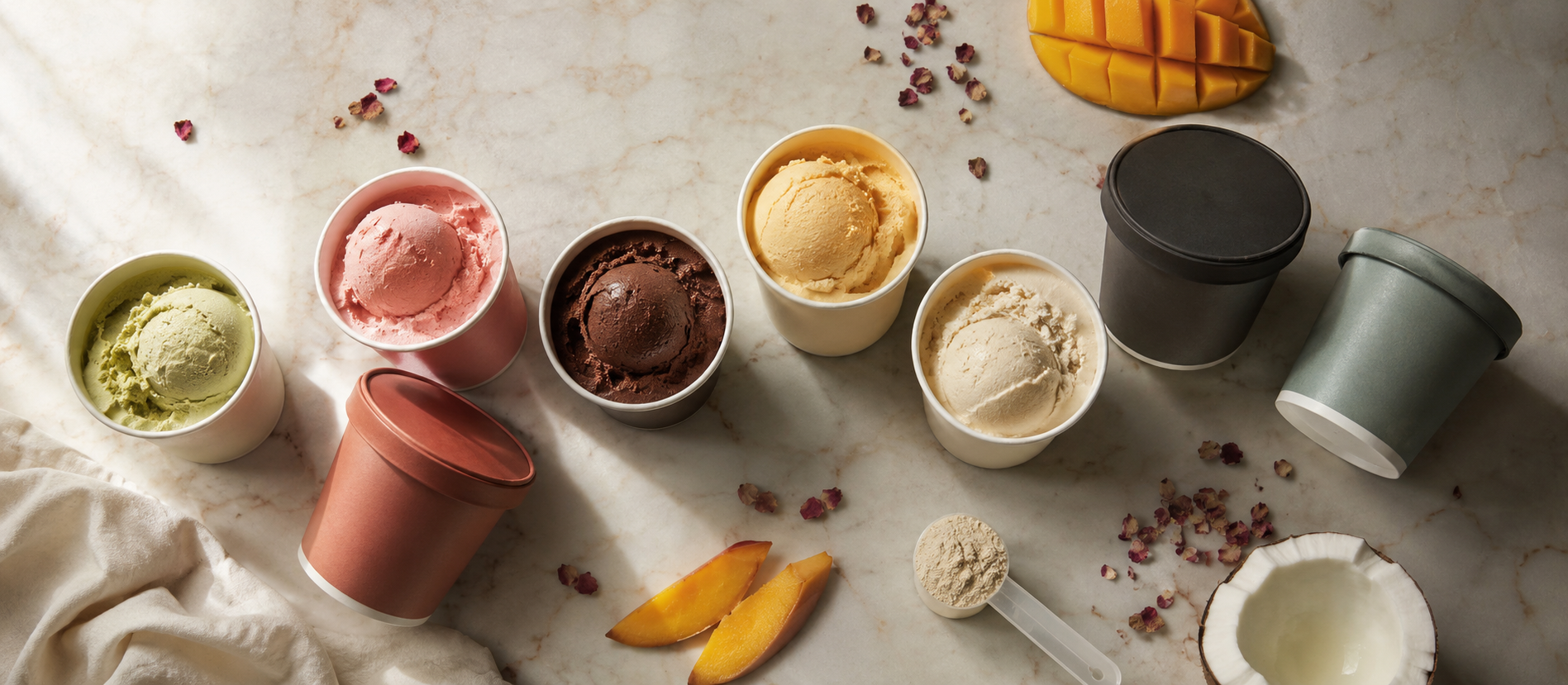
India's ice cream market has split into three structurally different tiers. Pick yours first — then the best brand becomes obvious.
Tier 1 — Health-first: Noto or Go Zero if you're managing sugar, tracking protein macros, or want a dairy-free option. Tier 2 — Artisanal: Naturals or NIC if authentic fruit flavour and clean ingredients are the point. Tier 3 — Everyday value: Amul for the widest availability anywhere in India; Vadilal for more variety; Havmor for above-commodity richness in North and West India; Kwality Wall's / Magnum for cone and bar formats.
The mistake every other guide makes is ranking all eight in the same column. They are not competing for the same customer. The rest of this article is the evidence for that structure.
The market split nobody's writing about
Every summer, the same ten brands appear in the same order in the same listicle. Amul is always first. Havmor makes it by virtue of longevity. Naturals appears because it would be odd not to include it. And somewhere near the bottom, a newer brand is squeezed in after a recent funding round generated enough press.
The problem with that format is not that it's lazy — it's that it's wrong. Between 2021 and 2026, the Indian ice cream market underwent a structural change significant enough that brands from different tiers are no longer usefully comparable. Noto, Naturals, and Amul do not sell the same thing — they sell ice cream, yes, but they answer completely different questions for completely different buyers.
The three tiers are not marketing segments — they reflect genuinely different product propositions, distribution models, and customer expectations. Tier 1 is the health-first category: sugar-free, high-protein, formulated for buyers who want the pleasure of ice cream without the metabolic trade-off. Tier 2 is the artisanal and flavour-first category: brands whose proposition is that ice cream made from three real ingredients tastes categorically different from anything made with synthetic flavours. Tier 3 is the everyday value category: nationally distributed, reliably made, honestly priced, and available at 11pm from your neighbourhood store.
Buying from the wrong tier is not a brand failure — it's a category error. The structure below prevents that mistake.
Tier 1 — The health-first brands: Noto and Go Zero
The emergence of a health-first ice cream tier in India is the single most significant structural shift the market has seen since Naturals proved real-fruit ice cream could scale beyond a single outlet. In roughly four years, Noto and Go Zero went from novelty to genuine quick-commerce staples across Mumbai, Bengaluru, Delhi, and Hyderabad — fuelled by a generation of Indian consumers already reading supplement labels, tracking dietary protein, and asking why ice cream couldn't be designed with the same ingredient discipline as their whey powder.
These brands do not reduce sugar cosmetically. They rebuild the recipe from scratch, using erythritol and stevia as the sweetener base, and in Noto's case integrate a protein source into the base itself — so the ice cream genuinely functions differently metabolically, not just in its label claims.
Noto and Go Zero use erythritol and stevia — neither problematic for most adults at normal serving sizes, though some individuals notice GI discomfort with erythritol in large amounts. "Sugar-free" refers to added sucrose, not the natural lactose present in the milk base. If you are managing blood sugar for clinical reasons, check individual product labels rather than relying on the brand-level claim.
Noto
Sugar-free · High-protein · Quick commerce, D2C · ₹180–299 per unit
If Naturals proved that three honest ingredients could build a loyal brand over 42 years, Noto is the proof that the same philosophy applies to formulated-for-health ice cream in the 2020s. The brand's core proposition — no added sugar, meaningfully high protein per 100ml, texturally indulgent — is harder to deliver than it sounds. The category is littered with "healthy" ice cream products that taste like frozen protein shake or icy compote. Noto genuinely doesn't. Flavours like salted caramel and dark chocolate have built real followings in fitness communities precisely because the texture holds up without the sucrose crutch.
The erythritol-stevia blend delivers sweetness without the glycaemic spike. The protein integration — a whey protein base in several SKUs — pushes protein-per-100ml to levels that make it the only ice cream in this guide that functions as a meaningful protein source. At ₹180–299 per unit, it is the most expensive brand in this guide, and availability remains concentrated in metros with mature quick-commerce infrastructure. For the buyer Noto is designed for, those are acceptable trade-offs.
Go Zero
Sugar-free · Plant-based range · Founded July 2022 · Swiggy Instamart, Blinkit, Zepto
Kiran Shah founded Go Zero in July 2022 with a decade of ice cream industry experience and a precise target: match indulgent ice cream on taste and texture while delivering no added sugar, high protein, and a genuine plant-based line. DSG Consumer Partners' investment thesis cited the product's taste profile as the primary reason for their backing2 — in a category where "healthy" has historically meant "less good," investor conviction here was predicated on it actually tasting right.
Where Go Zero differentiates from Noto is range breadth: it covers sugar-free, low-calorie, high-protein, and plant-based lines under one brand roof, while Noto is more tightly focused on the sugar-free and high-protein angle. For someone who wants dairy-free ice cream that also makes nutritional sense, Go Zero currently has India's strongest offering in that specific overlap. Quick commerce is Go Zero's primary acquisition channel — structurally smart, since ice cream's cold chain requirements make 10-minute delivery the most reliable last-mile for a perishable D2C product.
"The better-for-you ice cream market in India is expected to be worth US$500 million by 2030 — and both brands here are positioned to capture most of it."
— DSG Consumer Partners, Go Zero partnership investment thesis2Tier 2 — The artisanal brands: Naturals and NIC
These brands exist to answer a completely different question from Tier 1. Not "how do I enjoy ice cream with less metabolic guilt?" but "what does ice cream actually taste like when it's made from real alphonso mango, or real tender coconut, instead of synthetic mango flavour?" The answer, if you have ever had a Naturals sitafal scoop, is self-evidently different — and raises uncomfortable questions about what the industry has been selling under "natural flavour" for decades.
Neither Naturals nor NIC competes on health claims. Both use real sugar, full-fat milk, and real fruit — an honest, additive-free formulation that is neither low-calorie nor apologetic about it. The customer bases both brands have built — loyal enough in Naturals' case to be accurately described as evangelical — suggest that for a significant segment of Indian consumers, that trade-off is not even a trade-off. It is simply the better ice cream.
Naturals Ice Cream
Founded 1984 · 170+ outlets · 15+ states · Three ingredients only: fruit, milk, sugar
There are very few food businesses in India that have genuinely built their entire model on a three-ingredient formula and held it there for 42 years. Naturals is one of them: fresh fruit, milk, sugar — nothing else. No artificial colours, flavours, or preservatives. An ingredient list so short it would look like disruptive positioning if Raghunandan Srinivas Kamath had started the brand in 2019 rather than in 1984, from a single outlet at Juhu in Mumbai.3
The products that made the brand legendary — Tender Coconut, Sitafal, seasonal Alphonso Mango — remain exactly what they were. The sitafal has actual custard apple pulp. The mango tastes like alphonso, not like a synthetic flavour calibrated to approximate alphonso. Naturals has now expanded to 170+ outlets across 15+ states.3 In May 2026, the brand partnered with Bombay Sweet Shop to launch limited-edition Tender Coconut Naga Chilli and Coffee Fudge Crunch flavours4 — the most ambitious product extension they have attempted, and a confident signal that the brand knows its core proposition well enough to experiment at the edges without abandoning it.
The honest limitation remains outlet dependency. The three-ingredient model means you go to Naturals; Naturals does not easily come to you. That is a feature of the proposition, not a flaw — but it matters for weekly buying decisions.
NIC Ice Creams
Pune-based · 50+ flavours · Zero preservatives · ₹171 crore revenue FY2023
NIC is the closest the Indian premium natural ice cream space has to a genuine challenger for Naturals' positioning — and unlike many challenger brands that announce ambition and then quietly plateau, NIC has actually delivered at scale. Starting from a strong Pune base, the brand has built over 50 flavours on a foundation of pure milk and zero preservatives, reached ₹171 crore in revenue by FY2023,5 and continued expanding since.
The differentiation from Naturals is twofold: a larger flavour palette, and better at-home tub availability through quick commerce and select retail channels. If Naturals is the brand you make a deliberate trip for, NIC is the brand you order on a Tuesday evening without planning around outlet proximity.
Tier 3 — The everyday scale brands
This is where most ice cream is actually bought in India — not in a quick-commerce app tracking macros, not at a specific outlet chosen for its ingredient philosophy, but at the neighbourhood kiryana store, at a petrol station, at a supermarket during the weekly shop. The brands in this tier compete on consistent quality at national scale, cold chain reliability, and pricing that works for regular rather than occasional consumption.
Reading this as "these brands are inferior" would be the same category error in reverse. A consistently made, well-priced, nationally available ice cream is not a compromise version of artisanal; it is a different thing entirely. In that different thing, several of these brands are genuinely excellent.
Amul
India's #1 by volume · GCMMF cooperative · ₹20 entry-level · 650,000+ village reach
There is something quietly reassuring about Amul that no amount of D2C disruption has managed to undermine. The cooperative model means the milk comes from a network of farmers rather than a corporate dairy supply chain. The pricing has stayed pegged to genuine national accessibility for thirty-plus years. The quality floor — not the ceiling, but the minimum — has been consistently maintained, which matters far more for an everyday household product than the occasional exceptional batch.
Amul's cold chain infrastructure reaches 650,000+ villages6 — something no D2C brand or artisanal chain can plausibly replicate in the near term. The brand has continued expanding its range — sugar-free variants, kulfi lines, premium tub sizes — while keeping entry-level products genuinely affordable at ₹20–40 per serving.
Vadilal
Gujarat heritage, est. 1907 · Double-digit summer growth 2026 · Kulfi and sugar-free range
Vadilal reported double-digit ice cream volume growth in summer 2026, with plants running at full capacity.4 The brand occupies a smart middle position: more flavour variety than Amul's core range, better national availability than Havmor outside its home markets, and a price point that makes a 750ml family tub an ordinary grocery purchase. Vadilal also has one of the longer-standing sugar-free variant ranges in the everyday tier, predating many competitors' entry into that space.
Havmor (Lotte India)
Gujarat heritage, est. 1940s · Acquired Lotte Korea 2017 · Above-commodity creaminess
The Lotte Korea acquisition in 2017 gave Havmor the manufacturing investment to take its heritage national without losing the quality cues that had made the brand beloved in Gujarat. The result is an ice cream that sits noticeably above the commodity tier on richness and creaminess — genuinely richer than an equivalent Amul or Vadilal product — without reaching the premium price bracket. In North and West India, it is the everyday celebratory ice cream: what you buy when you want something slightly more special than the default, without paying twice the price.
Kwality Wall's / Magnum
Majority acquisition completed April 2026 · 4.5% Q1 organic growth · Cornetto · Magnum bar
In April 2026, The Magnum Ice Cream Company completed its majority acquisition of Kwality Wall's India, reporting Q1 organic sales growth of 4.5%.8 The portfolio — Cornetto, Magnum bars, Feast, Kwality Wall's Creamy Delight — remains intact. The quality of the chocolate coating on a Magnum bar, the structural integrity of the wafer cone on a Cornetto, are not cosmetic differences from a commodity ice cream at two-thirds the price. For format-specific cravings — cone, bar on a stick, ice cream sandwich — this is where the format is genuinely best executed.
Baskin-Robbins (operated by Jubilant FoodWorks in India) operates in a distinct premium-outlet format not directly comparable with the brands above. Its proposition is variety in a café-style outlet rather than at-home tub buying. It competes more with gelato shops and premium dessert brands than with the eight brands evaluated in this guide, and would warrant separate treatment in a guide focused on premium-outlet dessert experiences.
All 8 brands compared
| Brand | Tier | Best for | Price range | Key distinction | Availability |
|---|---|---|---|---|---|
| Noto | Health-first | Sugar-free, high-protein | ₹180–299/unit | Erythritol + stevia, whey protein base | Metro quick commerce, D2C |
| Go Zero | Health-first | Dairy-free, sugar-free | ₹199–349/unit | Plant-based + sugar-free combined | Quick commerce, D2C |
| Naturals | Artisanal | Authentic fruit flavour | ₹80–200/serving | 3 ingredients only since 1984 | 170+ outlets, 15+ states |
| NIC | Artisanal | Natural + home delivery | ₹100–300/unit | 50+ flavours, zero preservatives | Quick commerce + outlets |
| Amul | Everyday | Household daily buying | ₹20–80/serving | Widest national footprint | 650,000+ village reach |
| Vadilal | Everyday | Variety + value | ₹20–120/serving | Kulfi, sugar-free range since 1907 | National, strong North/West |
| Havmor | Everyday | Mid-premium, richer texture | ₹30–120/serving | Above-commodity creaminess | North and West India |
| Kwality Wall's / Magnum | Everyday | Cone and bar formats | ₹40–200/unit | Magnum bar, Cornetto quality | National retail + quick commerce |
The structural forces reshaping the market
The three-tier structure described above did not exist five years ago in anything like its current form. Two forces created it.
The first is quick commerce as a cold-chain democratiser. Ice cream has always had a cold chain problem for D2C brands: you need freezer infrastructure at the last mile, which is expensive and logistically complex. Blinkit, Swiggy Instamart, and Zepto solved this by turning dark stores into distributed freezer points. This is what made Noto and Go Zero possible at their current scale — they did not need to build retail freezer distribution across India. The platforms' dark-store networks gave them instant cold-chain coverage in every city where those platforms operate. Without 10-minute delivery, the health-first tier as it currently exists in India does not exist.
The second is what DSG Consumer Partners called "the better-for-you consumer"2 — a cohort of urban Indian buyers who are simultaneously more health-conscious than previous generations and more willing to pay a premium for that proposition. This is the same consumer who drives protein supplement growth, who reads FSSAI labels before buying, who chose Noto over a Magnum bar in the same quick-commerce cart. The ice cream market's growth in the premium and health-first segments tracks closely with the supplement market's growth in the same demographic — because they are largely the same buyer.
North India currently holds the largest regional share at roughly 35% of the national market, driven by a larger consumer base and stronger organised-brand presence in major cities.1 The South — specifically Bengaluru and Chennai — is the dominant quick-commerce and health-first market. The national market is projected to nearly double by 2032 at a CAGR of 9.84%.1 All three tiers will grow; the artisanal and health-first tiers will grow faster proportionally, starting from a smaller base and targeting the fastest-growing income segment in urban India.
Verdict — matched to your actual need
You came here for a recommendation. Here it is by use case, without hedging.
Sugar-free, genuinely high-protein, no taste penalty. The only ice cream in this guide that functions as a meaningful protein source rather than just a dessert.
Widest plant-based plus sugar-free range in India. Founded 2022 but growing fast on quick-commerce platforms in every major city.
42 years, three ingredients, no competitor in India touches the sitafal. Outlet-dependent — you go to Naturals, not the other way around.
Naturals-adjacent quality, zero preservatives, 50+ flavours, and better at-home availability through quick commerce and select retail.
Available anywhere in India, honestly priced, consistent floor quality. Cold chain reaching 650,000+ villages — no one else comes close.
Wider range, kulfi line, long-standing sugar-free options, double-digit summer growth in 2026.
Above commodity-tier creaminess without premium pricing. The everyday celebratory ice cream in North and West India.
Cornetto and Magnum bar are category-best in their formats. April 2026 majority acquisition by Magnum parent company; product lines unchanged.
Stop asking "which ice cream brand is best?" and start asking "which ice cream brand is best for the job I'm hiring it to do?" Noto and Amul are both genuinely good at what they do. The mistake is expecting them to do the same thing. Pick your tier first. The best brand in that tier almost picks itself.
Frequently asked questions
Which is the No. 1 ice cream brand in India in 2026?
By revenue and volume, Amul is India's number one ice cream brand. But the best brand for you depends on which of the three market tiers matches your actual need: Noto for managing sugar intake, Naturals for genuine fruit flavour, and Amul or Vadilal for reliable everyday value.
What is the best sugar-free ice cream brand in India?
Noto and Go Zero are the two leading sugar-free ice cream brands in India as of 2026. Both are available on Blinkit, Swiggy Instamart, and Zepto in major Indian cities.
Is Naturals Ice Cream healthier than regular ice cream?
Naturals uses only three ingredients — fresh fruit, milk, and sugar — with no artificial colours, flavours, or preservatives. It is cleaner on additives but still contains full sugar and milk fat. For reduced-sugar ice cream, Noto and Go Zero are the better picks.
What happened to Kwality Wall's in 2026?
In April 2026, The Magnum Ice Cream Company completed its majority acquisition of Kwality Wall's India, reporting Q1 organic sales growth of 4.5%. The Magnum, Cornetto, and Kwality Wall's product lines continue to operate.
References
Disclosures: Naked Compound participates in the Amazon.in affiliate programme. Some links may earn a small commission. No ice cream brand provided samples, funding, or paid to be featured. Tier structure, brand assessments, and conclusions are editorially independent. Full conflicts policy: conflicts-policy