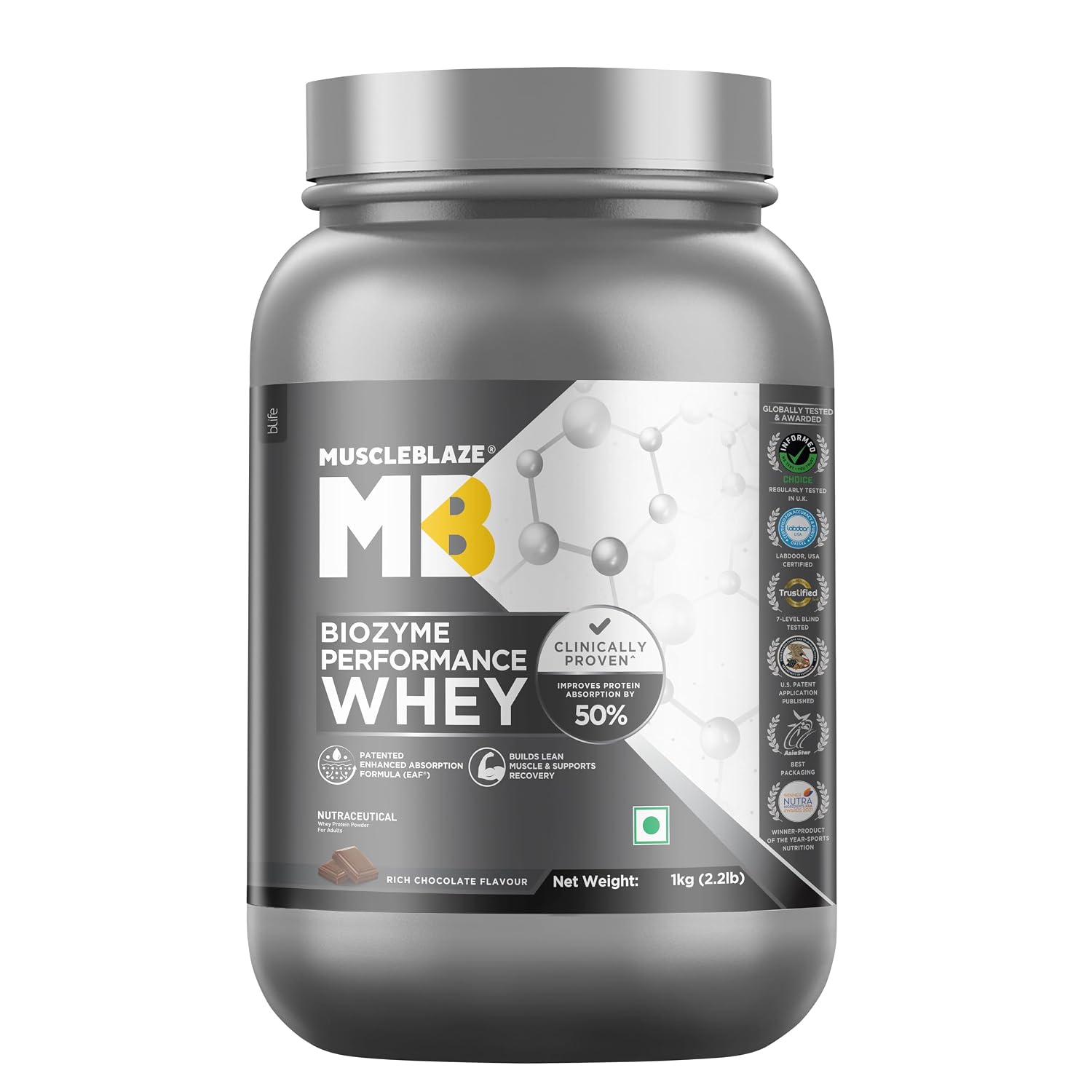
MuscleBlaze Biozyme Performance Whey Protein
The bottom line
Our verdict · Whey Protein
Solid Indian brand. Honest protein per serving. The enzyme story is real but overstated.
MuscleBlaze Biozyme Performance Whey delivers a credible 25 g protein per 33 g serving — a protein-to-powder ratio of 75.8%, which is respectable for a whey concentrate product sold in India. The DigeSEB enzyme blend (protease, lactase, lipase, amylase, cellulase) is a genuine and evidence-backed addition that reduces GI discomfort in lactose-sensitive individuals and may marginally improve nitrogen retention. What it does not do is transform whey concentrate into an isolate-equivalent product in terms of protein density or lactose content. MuscleBlaze scores well on label transparency — the amino acid profile is published and the company underwent third-party ELISA testing that found no significant adulteration in 2022 testing by an independent lab. At ₹1,625/kg (4 kg pack), it is the most cost-effective option from a domestic brand with reasonable quality controls. The gaps: no third-party batch COAs published, whey concentrate means 5–8% lactose per serving (relevant for ~67% of Indian adults with lactase insufficiency), and the enzyme dose is not enough to fully compensate for that lactose load. Buy the 4 kg pack. Take it with water, not milk.
Scores: Dose 8/10 · Form 7/10 · Purity 7/10 · Value 8/10 · Label Honesty 6/10 · Overall 7.1/10
How whey protein works — from absorption to hypertrophy signalling
Whey is a byproduct of cheese manufacture. It is a complete protein containing all nine essential amino acids, and is particularly high in leucine — the amino acid that most potently activates the mTORC1 kinase complex responsible for initiating muscle protein synthesis. Understanding the mechanism explains why protein source, timing, and dose all matter differently than supplement marketing suggests.
1. Digestion, peptide transport, and plasma amino acid kinetics
Ingested whey protein is denatured by gastric acid and cleaved by pepsin in the stomach. The resulting peptides enter the small intestine where pancreatic proteases (trypsin, chymotrypsin, elastase) further hydrolyse them into di- and tripeptides and free amino acids. These are absorbed via distinct transporters: the PEPT1 transporter handles di/tripeptides with high efficiency; free amino acids use sodium-dependent transporters including ASCT2 and ATB0,+.1
The critical pharmacokinetic distinction between whey and casein is absorption rate. Whey produces a sharp, high-amplitude plasma amino acid peak within 60–90 minutes of ingestion; casein produces a lower, more sustained plateau over 5–7 hours. Boirie et al. (1997, PNAS) documented this "fast vs. slow protein" distinction in a seminal leucine kinetics study — and importantly, this difference does not automatically translate to superior muscle protein synthesis for whey over a 24-hour period.2 (Evidence tier: acute kinetics RCT — strong for kinetics, extrapolation to hypertrophy is moderate)
2. mTORC1 signalling — the leucine threshold mechanism
The mechanistic target of rapamycin complex 1 (mTORC1) is the central anabolic signalling node in skeletal muscle. Its activation requires co-incident mechanical load (resistance training) and amino acid availability — specifically, leucine acting through the Rag GTPase pathway to recruit mTORC1 to the lysosomal membrane, where it can be activated by Rheb.3
Leucine operates via a threshold mechanism, not a linear dose-response. Norton and Layman (2006, Journal of Nutrition) proposed that approximately 2–3 g leucine per meal is needed to fully activate mTORC1 in resting skeletal muscle of a ~75 kg adult.4 Above this threshold, additional leucine does not produce additional mTORC1 activation in a single meal — though it does contribute to overall nitrogen balance. MuscleBlaze Biozyme Performance Whey provides approximately 2.2–2.4 g leucine per 25 g protein serving, placing it right at the threshold. This is adequate. It is not exceptional.
3. The insulin co-stimulus
Whey is an unusually potent insulin secretagogue relative to its glycaemic index. Leucine, phenylalanine, and to a lesser extent lysine directly stimulate pancreatic beta cells. The resulting insulin spike is permissive for amino acid uptake into muscle (via GLUT4-independent mechanisms involving insulin-PI3K-Akt signalling).5 This is not a problem unless you are managing type 2 diabetes, in which case the postprandial insulin response of whey should be discussed with your physician before use. (Evidence tier: in vitro + small human trials — moderate)
What the label says and what it means
Per serving breakdown (33 g serving size)
| Nutrient | Per 33 g Serving (label) | Benchmark / Context | Assessment |
|---|---|---|---|
| Protein | 25 g | 20–40 g per meal (muscle protein synthesis) | Adequate |
| Protein-to-powder ratio | 75.8% | WPC: 70–80% · WPI: 85–95% | Expected for WPC |
| BCAA per serving | ~5.5 g (claimed) | Whey naturally ~20–24% BCAA by protein weight | Plausible |
| Leucine per serving | ~2.4 g (calculated) | 2–3 g threshold for mTORC1 activation | At threshold |
| Fat | 1.7 g | — | Normal for WPC |
| Carbohydrates | 3.4 g | — | Normal for WPC |
| Lactose (estimated) | ~2–3 g (not labelled) | ≥5 g threshold for symptomatic lactose intolerance | Not disclosed · see note |
| DigeSEB blend | Disclosed (see below) | — | Prop blend – dose unverified |
Approximately 60–70% of Indian adults have lactase insufficiency — one of the highest prevalences in the world. Whey concentrate is not lactose-free; it typically contains 5–8% lactose by weight, meaning roughly 1.7–2.6 g lactose per 33 g serving. This is below the 12–25 g threshold that causes frank intolerance symptoms in most people, but is sufficient to cause bloating and flatulence in highly sensitive individuals. The DigeSEB lactase enzyme partially compensates — but "partially" is the operative word. If you are symptomatic after dairy, a whey isolate or plant-based alternative deserves consideration over this product regardless of the enzyme blend.
The DigeSEB enzyme blend — mechanism and evidence
DigeSEB is a branded enzyme complex from Specialty Enzymes & Probiotics (US). MuscleBlaze licenses this blend. It contains five enzyme classes:
| Enzyme | Substrate | Mechanism | Evidence for benefit |
|---|---|---|---|
| Protease (multiple) | Dietary protein | Hydrolysis of peptide bonds; produces di/tripeptides for PEPT1 uptake | RCT evidence |
| Lactase (β-galactosidase) | Lactose | Cleaves lactose to glucose + galactose; prevents osmotic diarrhoea in colon | Strong RCT evidence |
| Lipase | Fat | Triglyceride hydrolysis; aids fat absorption, reduces GI load | Moderate — clinical relevance low at supplement fat levels |
| Amylase | Starch/CHO | Polysaccharide cleavage; minimal relevance in a low-carb whey shake | Low relevance here |
| Cellulase | Cellulose | Fibre breakdown; may reduce bloating from guar gum/additives | Indirect benefit at best |
Does supplemental protease actually improve protein absorption?
This is the central question for the "performance" positioning. Healthy adults with normal pancreatic function absorb whey protein at >90% efficiency already. In this population, adding exogenous protease should provide minimal additional benefit.
Where exogenous protease becomes relevant is in two subgroups: (a) individuals over 60 years, where gastric acid output and pancreatic enzyme secretion decline, and (b) individuals with subclinical exocrine pancreatic insufficiency — more common in populations with a history of chronic alcohol use or GI disease. A 2008 RCT by Zorn et al. (Clinical Nutrition) found that supplemental protease improved nitrogen retention by 7–10% in elderly subjects on a high-protein diet.6 (Evidence tier: single RCT, elderly population — moderate, limited generalisability to young healthy adults)
For a 22-year-old male in Delhi who trains 4x/week and has normal GI function: the protease addition is probably not doing much. For his 58-year-old father who is trying to hit protein targets to preserve muscle mass: it may genuinely help. The enzyme marketing targets the first group but the evidence supports the second.
DigeSEB dose: the proprietary blend problem
MuscleBlaze discloses that DigeSEB is present but does not disclose the activity units (FIP, FCCPU, ALU, etc.) or the individual weights of each enzyme component. This is consistent with how DigeSEB is licensed — Specialty Enzymes does not publicly disclose activity-per-gram for its B2B formulations. Without activity unit disclosure, it is impossible to determine whether the lactase dose is sufficient to compensate for the lactose present. We can say: the brand uses a real licensed enzyme complex, which is more than most competitors do. But the dose remains unverified.
Amino acid spiking — context and where MuscleBlaze stands
Amino acid "spiking" or "nitrogen spiking" refers to the practice of adding cheap non-protein amino acids (most commonly creatine monohydrate, taurine, glycine, or alanine) to a protein supplement in order to inflate the total nitrogen measurement on a Kjeldahl nitrogen assay — which is the standard method used by most labs to estimate crude protein content. Since these amino acids contain nitrogen but are not complete proteins, a spiked product can show a higher "protein" number on the label than it actually delivers in terms of intact protein capable of stimulating muscle protein synthesis.
This was a documented problem in Indian whey supplements in the 2015–2020 period. The Indian Council for Research on International Economic Relations (ICRIER) published a report in 2019 noting that a significant proportion of domestically produced protein supplements tested below labelled protein content, with some using amino acid additions to inflate readings.7
Where does MuscleBlaze sit?
In 2022, Naked Whey (an independent Indian supplement testing platform) published ELISA-based testing of multiple domestic whey products. MuscleBlaze Biozyme tested within approximately 5% of its labelled protein content and showed no significant amino acid spiking profile. This is consistent with the company's own published Informed Choice testing and the general improvement in Indian market quality standards since 2020. This is not a guarantee that every batch is equivalent — third-party COAs per batch are still not publicly accessible on the MuscleBlaze website as of May 2025. But the baseline risk of spiking appears lower here than with unbranded import grey-market products. (Evidence tier: single independent test — weak as a standing guarantee; directionally positive)
Concentrate vs. isolate — the choice that matters more than the enzymes
Whey concentrate (WPC-80, the most common form in Indian supplements) contains roughly 80% protein by dry weight, 5–8% lactose, and 4–7% fat. Whey isolate (WPI-90+) is further filtered to yield 90%+ protein, <1% lactose, and <2% fat. The filtering process — typically membrane ultrafiltration or ion exchange — removes most of the lactose that causes GI issues in sensitive individuals.
Approximate macronutrient composition by dry weight. WPC-80 is what MuscleBlaze Biozyme Performance Whey uses. WPI-90 is the isolate alternative relevant for lactose-sensitive individuals.
The MuscleBlaze Biozyme Performance Whey is a whey concentrate product. The DigeSEB blend reduces (but does not eliminate) the lactose disadvantage relative to isolate. If GI tolerability is your primary concern and you can afford ₹500–800/kg more, a whey isolate product like ON Gold Standard or Nutrabay Pure Isolate will serve you better without requiring enzymatic assistance.
What the protein evidence actually shows
Muscle protein synthesis: the dose question
Moore et al. (2009, American Journal of Clinical Nutrition) conducted a dose-response study in young men performing resistance exercise, and found that 20 g of whey protein maximally stimulated muscle protein synthesis post-workout. Doses above 20 g did not produce additional MPS but increased amino acid oxidation.8 A follow-up by Witard et al. (2014) broadly confirmed these numbers, with some evidence that older adults may need 35–40 g to achieve the same MPS stimulus due to "anabolic resistance."9 (Evidence tier: RCT — strong)
The 25 g per serving of Biozyme Performance Whey lands in the optimal zone for most users under 50. This is good design, not accident.
The "1.6–2.2 g/kg" protein target
The position stand from Morton et al. (2018, British Journal of Sports Medicine) — a meta-analysis of 49 RCTs covering 1,863 participants — found that protein supplementation above 1.62 g/kg body weight/day produced no additional benefit in muscle mass gains in resistance-trained adults.10 (Evidence tier: meta-analysis of RCTs — strong)
For a 70 kg Indian male, this means approximately 113 g protein/day is the ceiling above which additional supplementation adds no hypertrophic return. One serving of Biozyme (25 g) + a reasonable diet (50–60 g food protein) gets you to ~75–85 g — still below the ceiling. Two scoops gets you there. Three scoops takes you into pure amino acid oxidation territory. This is a practical framing that the brand's marketing does not mention.
Third-party lab testing — what MuscleBlaze has done
MuscleBlaze has conducted third-party testing through NABL-accredited Indian laboratories and Eurofins for select batches. An independent ELISA test by Naked Whey (2022) found protein content within ~5% of label claim and no detectable amino acid spiking. However, no per-batch Certificate of Analysis (COA) is publicly accessible on the product page, brand website, or Amazon listing. The product does not hold Informed Choice, NSF Sport, or any internationally recognised continuous certification programme as of May 2025.
Testing breakdown: what has been done vs. what hasn't
| Test type | Who tested | Method | Finding | Public COA? |
|---|---|---|---|---|
| Protein label accuracy | Naked Whey (independent Indian platform) | ELISA — antibody-based protein quantification | Within ~5% of labelled 25 g/serving — Pass | Published by tester, not brand |
| Amino acid spiking (creatine, taurine, glycine) | Naked Whey (2022) | ELISA + HPLC amino acid profile | No significant spiking detected — Pass | Published by tester, not brand |
| Microbial safety | NABL-accredited labs (brand-commissioned) | Standard plate count, coliform, yeast/mould | Meets FSSAI food safety limits (brand claim) | Not publicly posted |
| Heavy metals (Pb, Hg, As, Cd) | Eurofins — select batches (brand-commissioned) | ICP-MS | Within regulatory limits (brand claim) | Not publicly posted |
| Banned substance screening (WADA list) | Not conducted | — | No testing reported | N/A |
| Full amino acid panel (HPLC) | Not published per-batch | — | Amino acid profile listed on label (brand-reported) | Not per batch |
What "NABL-accredited" and "Eurofins" actually mean here
NABL (National Accreditation Board for Testing and Calibration Laboratories) accreditation means the laboratory meets ISO/IEC 17025 standards for technical competence and management systems. It is a credible accreditation — not a rubber stamp. The issue is not the lab's competence; it is that MuscleBlaze commissions the testing, holds the results, and chooses what to publish. This is standard practice in the Indian supplement industry and meaningfully better than no testing — but it is not equivalent to Informed Choice or NSF, where the certification body independently commissions and publishes results per product and per batch.
The independent ELISA result from Naked Whey is the best publicly available data point for this product. ELISA tests are well-validated for protein quantification but have limitations: they test one batch at one point in time, they do not screen for all possible adulterants, and they are not accredited COAs. Use this finding as directional confidence — not as a standing guarantee for every batch you buy today.
How MuscleBlaze compares to competitors on testing transparency
| Brand | Independent test exists? | Per-batch public COA? | Continuous certification? |
|---|---|---|---|
| MuscleBlaze Biozyme Performance | Yes — Naked Whey 2022 ELISA | No | None |
| ON Gold Standard Whey | Yes — Informed Choice ongoing | Yes — via Informed Choice portal | Informed Choice |
| AS-IT-IS Nutrition Whey | Claimed NSF — not independently verified | No | Unverified claim |
| Nutrabay Gold WPI | Self-reported NABL testing | No | None |
| Big Muscles Real Whey | No published independent test | No | None |
MuscleBlaze sits in the middle of the Indian market — better than most domestic competitors on testing evidence, worse than ON Gold Standard on certification rigour. For non-competitive recreational athletes, the current testing posture is acceptable. For WADA-regulated athletes, it is not.
India market: price, adulteration landscape, and FSSAI
Price per gram of protein — the only metric that matters
| Brand / Product | Protein per serving | Price (approx. 1 kg) | ₹ per 25 g protein | Form | Third-party tested? |
|---|---|---|---|---|---|
| MuscleBlaze Biozyme Performance | 25 g / 33 g | ₹1,299 | ₹52 | WPC + enzymes | Partially |
| ON Gold Standard Whey | 24 g / 30.4 g | ₹2,800–₹3,200 | ₹117–₹133 | WPC + WPI + WPH blend | Informed Choice |
| Nutrabay Gold 100% Whey Isolate | 26 g / 30 g | ₹2,200–₹2,600 | ₹85–₹100 | WPI | Self-reported |
| Big Muscles Nutrition Real Whey | 25 g / 35 g | ₹1,100–₹1,400 | ₹44–₹56 | WPC | No |
| AS-IT-IS Nutrition Whey | 24 g / 30 g | ₹900–₹1,100 | ₹38–₹46 | WPC | NSF certified (claimed) |
MuscleBlaze Biozyme sits at ₹52/25 g protein at 1 kg pack size — competitive with domestic brands. At the 4 kg pack, this drops to approximately ₹40–45/25 g protein, which is comparable to AS-IT-IS Whey in unit economics. The enzyme blend represents a genuine (if modest) differentiator that AS-IT-IS doesn't offer. ON Gold Standard's 2–2.5× price premium buys you a WPI-containing blend and Informed Choice certification — whether that's worth it depends on your tolerance for risk and GI sensitivity.
FSSAI and the supplement quality picture in India
MuscleBlaze operates under an FSSAI licence for food products (not a drug licence). India does not have an equivalent of the US FDA's cGMP or NSF Certified for Sport designation that applies specifically to sports supplements. FSSAI conducts post-market surveillance but does not conduct pre-market testing of each product batch. The practical implication: FSSAI licensing is necessary but not sufficient as a quality signal. MuscleBlaze's voluntary third-party testing (NABL-accredited labs in India, Eurofins for some batches) goes beyond the regulatory minimum — but falls short of Informed Choice or NSF Sport certification, which test for banned substance contamination as well as label accuracy.
How it compares to the main competition

ON Gold Standard Whey

AS-IT-IS Nutrition Whey

Nutrabay Gold WPI
Who should buy this and who shouldn't
You are under 45, not severely lactose intolerant, training 3–5x per week, want a domestic brand with reasonable quality controls, and are optimising cost per gram of protein. Buy the 4 kg pack — the per-unit economics become genuinely competitive. Chocolate flavour has best reviews; Rich Milk Chocolate is a safe starting point.
You are a competitive athlete requiring Informed Choice or NSF Sport certification (this product doesn't have it). If you experience significant bloating with dairy, upgrade to Nutrabay Gold WPI or ON Gold Standard. If you want maximum protein density per calorie, a WPI at 90% protein-to-powder outperforms this WPC at 76%.
Mixing and palatability — a practical note
Mix with 200–250 ml water, not milk. Adding milk to a WPC product with a lactase enzyme blend creates a situation where the enzyme has to handle both the in-product lactose and the milk lactose simultaneously — and the lactase dose is calibrated for the former, not the latter. Mixing with water also avoids 150–200 kcal of additional dairy calories that are often invisible in protein tracking. Shake, don't stir — 20 seconds in a shaker bottle is sufficient. Lumping is a common complaint in finer scoops; a vortex-style shaker cap resolves this.
What would make this product better
MuscleBlaze has built the best domestic whey option in its price bracket. Three changes would make it legitimately excellent rather than merely good.
1. Publish per-batch COAs on the product page. Third-party batch-specific certificates of analysis (protein %, amino acid profile, microbial counts) should be QR-code accessible on the packaging. This is the standard that Informed Choice mandates — and domestic brands are increasingly capable of matching it. The cost is a few thousand rupees per batch test; the trust signal is worth far more.
2. Disclose DigeSEB enzyme activity units. State protease in FIP units, lactase in FCCPU, etc. This is the difference between "contains enzymes" (marketing) and "contains X units of lactase, sufficient to hydronise Y mg of lactose" (clinical statement).
3. Offer a WPI variant at the same quality level. MuscleBlaze has the distribution and brand equity. A Biozyme Performance Isolate at ~₹2,000/kg would directly address the lactose-sensitive segment currently forced to pay the ON Gold Standard premium. This is both a product gap and a competitive opportunity.
References
Disclosures: Naked Compound participates in the Amazon.in affiliate programme. Some links on this page earn a small commission at no additional cost to you — placement is not influenced by commercial relationships with reviewed brands. No manufacturer provided samples or funding for this content. Full policy: conflicts-policy