Nobody on our team drank this juice. This review covers the label, the published study and the ingredient evidence. It is general information, not medical advice. If you have diabetes, your doctor decides what you take.
The short answer
This is a food, not a treatment. It has one real study, but that study cannot show the juice lowers blood sugar, and the pack's "no medical advice needed" line is the wrong message for anyone on diabetes medicine.
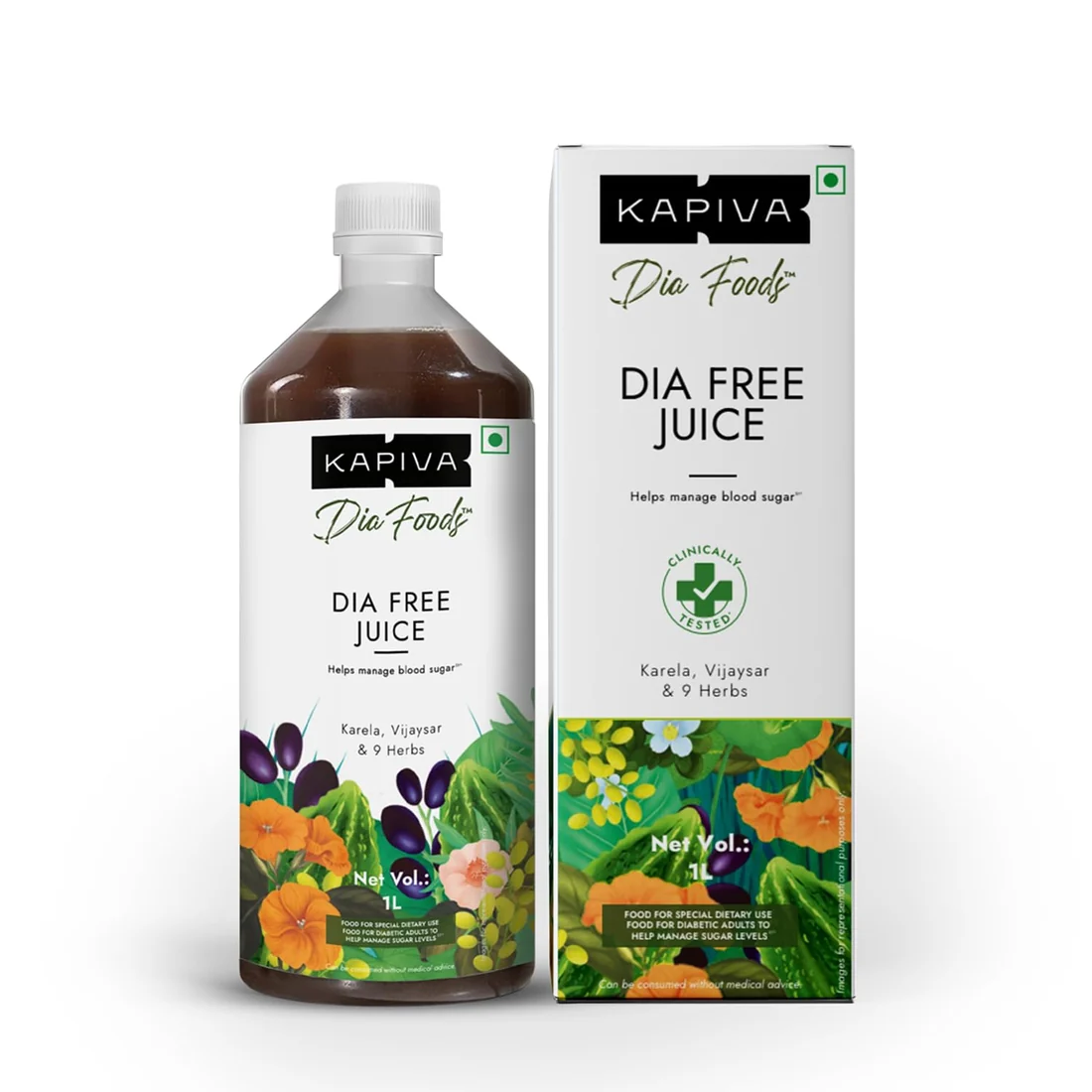
Dia Free Juice is sold by Kapiva (Adret Retail Pvt Ltd) and made by Ayushraj Enterprises in Jaipur. It is licensed as FSSAI category 13.5, "food for special dietary use". That is a food licence. It is not a drug approval, and nobody has checked that the juice treats diabetes.
The study behind the "clinically tested" badge enrolled 30 people who stayed on their usual diabetes medicines. After three months their average HbA1c fell from 9.36% to 8.32%. Kapiva paid for the study, two of the three authors work for Kapiva, there was no comparison group, and doctors were allowed to change medicine doses along the way.
The juice may help. We cannot tell. What we can tell: the label gives amounts for only four of the eleven herbs, the amounts shown are far below those used in single-herb trials, and several of these herbs can push blood sugar down on top of your tablets.
Reasonable to consider if
- You have type 2 diabetes, your doctor knows you want to try it and agrees.
- You will keep taking your medicines and keep testing your sugar.
- You accept it as a possible add-on and can afford about ₹1,000 a month.
Do not use it to
- Replace metformin, insulin or any other prescribed medicine.
- Reduce your doses yourself because a reading looks good.
- Self-treat if you are pregnant, breastfeeding or on insulin.
What the pack claims, and what each claim rests on
| On the pack | What stands behind it | Our read |
|---|---|---|
| "Clinically tested" | One open-label, single-arm study of 30 people (CTRI/2022/041781), paid for by Kapiva [3]. | True, but thin. "Tested" is not "proven". |
| "Helps manage blood sugar" | The study saw lower readings in people also on diabetes drugs. No control group. | Allowed wording for a food. It does not show the juice caused the drop. |
| "Can be consumed without medical advice" | Trial patients were supervised, on stable oral drugs, and insulin users were excluded [3]. Kapiva's own site offers doctor consultations. | Wrong message for people on glucose-lowering drugs. Ignore it. |
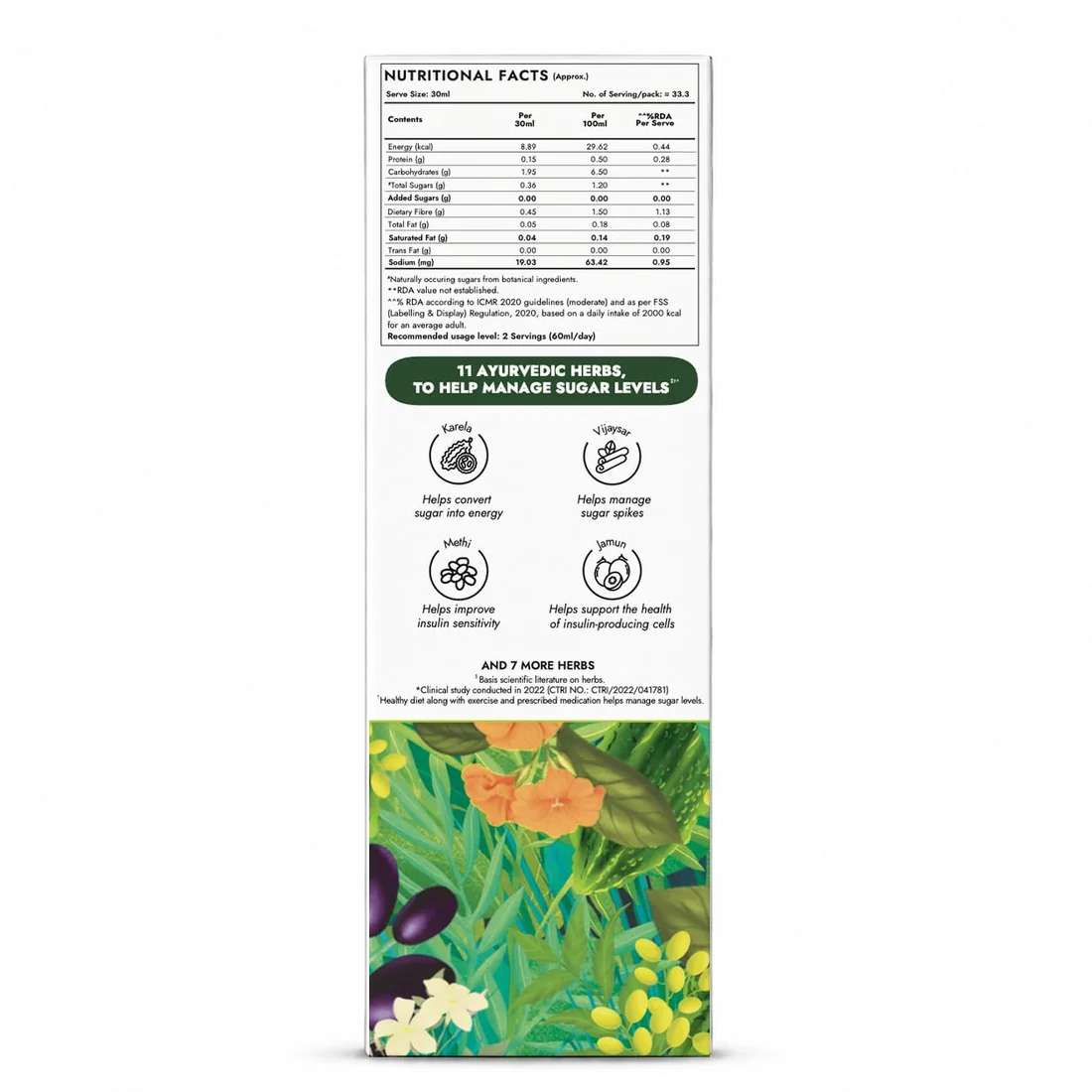
| "11 Ayurvedic herbs" | Eleven herbs are listed, but amounts are given for four. | Names without doses cannot be checked. |
| "Karela helps convert sugar into energy" | Cochrane found insufficient evidence for karela in type 2 diabetes [1]. | Mechanism language with no human proof behind it. |
| "Methi helps improve insulin sensitivity" | A meta-analysis saw effects at 5g a day or more of fenugreek seed [2]. This juice has about 0.36g of extract a day. | Different dose, different material. |
A retailer listing for the same bottle goes further. It says the juice lowers "blood sugar and HbA1c levels by 30% in just three months" and that it "has been shown to have no side effects". The paper reports a 30% fall in fasting glucose and an 11% relative fall in HbA1c, and its adverse-event data come from 30 people. Treat any 30% HbA1c claim as wrong.
What is in the bottle
The ingredient list, in the order printed on the box:
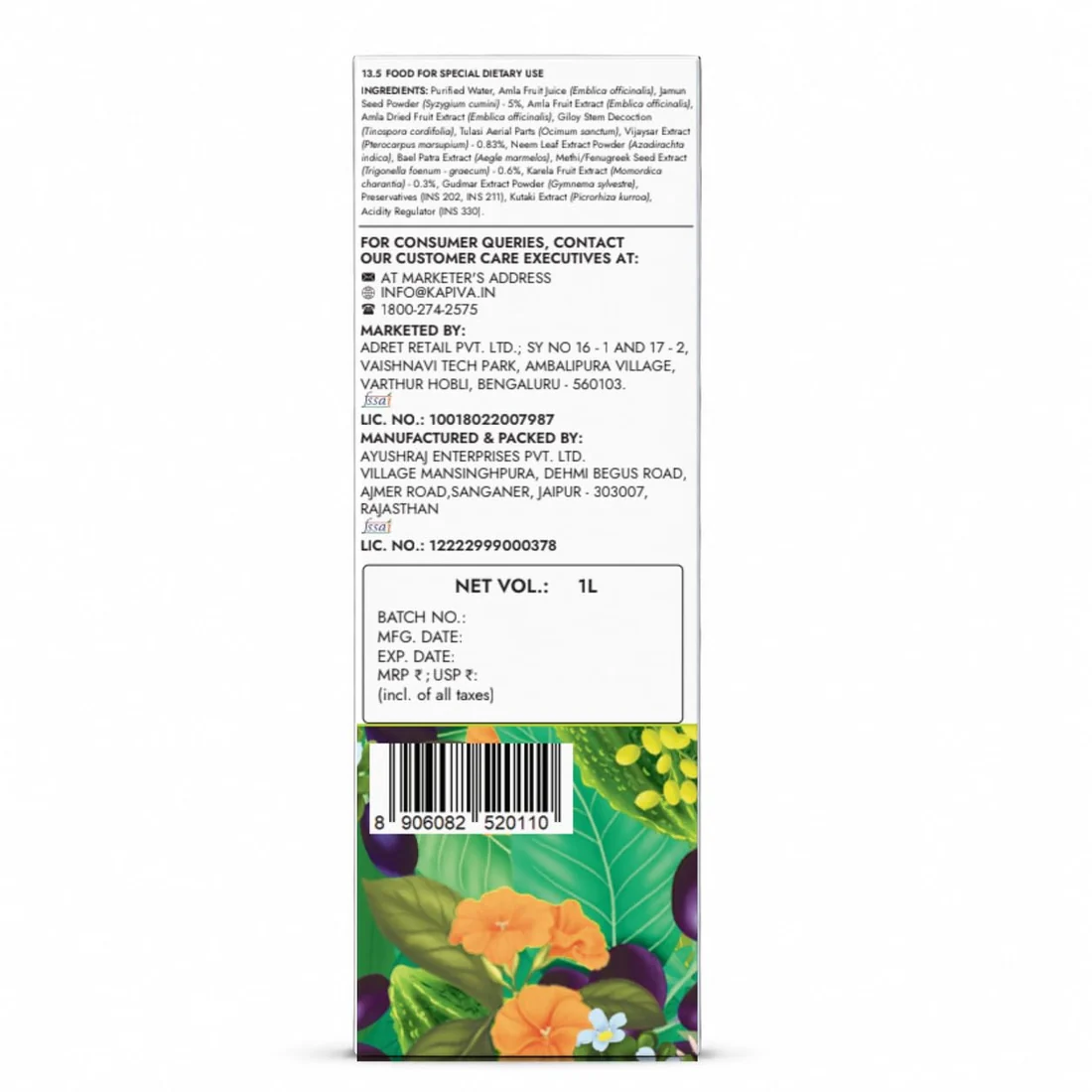
Purified water, amla fruit juice, jamun seed powder (5%), amla fruit extract, amla dried fruit extract, giloy stem decoction, tulsi aerial parts, vijaysar extract (0.83%), neem leaf extract powder, bael patra extract, methi/fenugreek seed extract (0.6%), karela fruit extract (0.3%), gudmar extract powder, preservatives (INS 202, INS 211), kutki extract, acidity regulator (INS 330).
Only the four bold items have amounts. Water and amla juice come first, so most of the bottle is diluted fruit juice. The serving is 30 ml, taken twice a day (60 ml). Assuming 1 ml weighs about 1g, here is what that works out to:
| Ingredient | On label | Per 30 ml | Per day (60 ml) | Studied elsewhere |
|---|---|---|---|---|
| Jamun seed powder | 5% | 1.5 g | 3 g | Only ingredient at a gram-level amount. We found no strong trials to benchmark it. |
| Vijaysar extract | 0.83% | 0.25 g | 0.5 g | An ICMR open trial used 2g of extract a day in most patients, up to 4g [3]. |
| Methi (fenugreek) extract | 0.6% | 0.18 g | 0.36 g | Meta-analysis found effects at 5g a day or more of seed powder [2]. Extract equivalence is not stated. |
| Karela extract | 0.3% | 0.09 g | 0.18 g | No standard dose. Cochrane found no consistent effect [1]. |
| Gudmar extract | Not stated | Under 0.09 g | Under 0.18 g | One small 1990 trial used 400 mg a day of a standardised extract. |
| Amla, giloy, tulsi, neem, bael, kutki | Not stated | Unknown | Unknown | Cannot be assessed. |
Gudmar is listed after karela, and the label lists ingredients in descending order, so it should be present at less than 0.3%. The percentages do not say whether they are weight or volume, and the extracts are not described as standardised to any marker compound. That is a real gap: two bottles with the same percentage can hold very different amounts of the active chemistry.
Nutrition per 30 ml: 8.89 kcal, 1.95g carbohydrate, 0.36g sugars (naturally occurring, none added), 0.45g fibre, 19 mg sodium. At 60 ml a day that is about 18 kcal and under 4g of carbohydrate. The juice will not move your glucose by itself. The preservatives are potassium sorbate and sodium benzoate, with citric acid as the acidity regulator. No sweetener, colour or flavour is listed.
See the nutrition and claims panel
The study: what it found and why it cannot settle the question
The "clinically tested" badge points to CTRI/2022/041781. The results were published in 2023 in the Journal of Diabetes Metabolism and its Complications, an open-access journal run by Science Repository [3]. This is the design:
- People: 30 adults with type 2 diabetes, HbA1c 6.5% or higher, BMI 27 to 45, at one site.
- Everyone stayed on their medicines: metformin, sitagliptin, glimepiride, dapagliflozin, vildagliptin, pioglitazone, teneligliptin, glibenclamide, voglibose, alone or combined. People on insulin were excluded.
- Dose: 30 ml in 200 ml water, morning and evening, an hour before meals, for 90 days.
- Design: open-label, single arm. Everyone got the juice, everyone knew it. The authors call it "exploratory and proof of concept".
- Funding: Kapiva paid for the product and testing. Two authors are on Kapiva's R&D team.
| Measure | Start | Day 90 | Change |
|---|---|---|---|
| HbA1c (%) | 9.36 | 8.32 | −1.04 points (−11%) |
| Fasting glucose (mg/dl) | 211.3 | 147.8 | −63.5 (−30%) |
| Post-meal glucose (mg/dl) | 254.9 | 170.5 | −84.4 (−33%) |
| C-peptide (ng/ml) | 4.13 | 2.94 | −1.19 (−29%) |
| BMI (kg/m²) | 28.37 | 27.54 | −0.83 (about 2.2 kg) |
Those are real numbers from real patients. A one-point HbA1c drop is about what an extra glucose-lowering drug can do. That is exactly why the missing control group matters.
Six reasons the numbers do not prove the juice works
- No comparison group. Without people who got no juice, you cannot know what would have happened anyway.
- High starting point. The average HbA1c at entry was 9.4%. Very high readings tend to drift down once people are enrolled, monitored monthly and reminded to take their medicines. Statisticians call this regression to the mean.
- Medicines could change. The paper states that dose changes were allowed after the juice started, and does not say how many patients had their drugs adjusted. A dose increase alone could explain the drop.
- Diet and routine were not controlled. Patients knew they were being studied, and that changes behaviour.
- Small, short and sponsored. Thirty people, one site, three months, paid for by the seller.
- Over-reading. The authors read the C-peptide fall as less insulin resistance. C-peptide measures insulin made by the body, so that is an interpretation, not a direct measurement. They also write that the juice is "safe to consume at any given dose". Thirty people for 90 days cannot show that.
What the study does show: in 30 people on medicines, liver enzymes, kidney markers and blood counts stayed in the normal range over three months, and 11 patients reported mild events (fever, cough, loose motion, dizziness) that the investigators judged unrelated. That is a reasonable early safety signal. It is not proof of benefit.
A second registered study (ISRCTN16382675) is listed by Kapiva's academy, an observational look at physician-prescribed use in people with HbA1c of 5.5 to 7%. We found no published results for it. The study we reviewed covers the original Dia Free Juice. We found no separate published study for Kapiva's newer Dia Free 2X.
The ingredient evidence, briefly
- Karela (bitter melon): a Cochrane review of four trials with 479 people found no significant difference from placebo in blood sugar control, and concluded there is insufficient evidence [1]. Side effects were mostly diarrhoea and abdominal pain.
- Methi (fenugreek): a meta-analysis of 10 trials found lower fasting glucose and HbA1c, mainly at medium or high doses (about 5g a day or more of seed), and rated most trials low quality [2].
- Vijaysar: an ICMR open trial without a control group reported glucose control in 69% of newly diagnosed patients, most of them on 2g of extract a day [3]. This juice carries a quarter of that.
- Gudmar: one small 1990 trial of 22 patients used 400 mg of a standardised extract daily [3]. This bottle holds well under half of that.
- Jamun, amla, giloy, tulsi, neem, bael, kutki: long traditional use. We found no controlled trials strong enough to rely on at the amounts in this bottle.
The brand's answer is that the whole formula was tested, not each herb. Fair. But that returns us to a 30-person study with no control group.
Safety: the part the front of the pack skips
- Low blood sugar. Karela can lower glucose and add to the effect of diabetes drugs, so combining it with sulfonylureas such as glimepiride or glibenclamide, or with insulin, raises the risk of hypoglycaemia. That is why interaction guides tell you to monitor your sugar closely [4]. The brand's own website offers free doctor consultations to review your medicines, which contradicts a pack line that says no medical advice is needed.
- Pregnancy and breastfeeding. Karela taken by mouth is rated likely unsafe in pregnancy [4]. The trial excluded pregnant and breastfeeding women.
- Insulin users. They were excluded from the study. There are no data on combining the juice with insulin.
- Before surgery, or with kidney or liver disease. Tell your doctor you take it.
- Watch for: shakiness, sweating, sudden hunger, confusion or a fast heartbeat. Check your sugar and get help if your readings run low.
Do not reduce or stop any medicine because of this juice. If your readings fall, tell your doctor and let them change your doses.
Price and what a trial-length course costs
The MRP is ₹562 for 1 litre, and Amazon.in listed it at ₹561 when we checked (some pharmacy sites list it near ₹506). The pack counts 33 servings, but the labelled and studied dose is two servings a day, so a bottle lasts about 17 days.
| Course | Bottles | Cost at ₹562 MRP |
|---|---|---|
| 1 day (60 ml) | 0.06 | About ₹34 |
| 30 days | 1.8 | About ₹1,010 |
| 90 days (as in the study) | 5.4 | About ₹3,030 |
Price per millilitre is around the middle of Indian herbal juices, so value scores as average. The cost question that matters is different: ₹3,000 over three months is real money to spend on something unproven. Spend it first on what has proof: regular HbA1c tests, a glucometer and strips, and a session with a dietitian who knows Indian diets.
Should you buy it?
Only if your doctor is aware and agrees, you keep every prescribed medicine, and you treat it as an experiment you will judge by your own HbA1c after three months, not by the label.
Skip it if you are pregnant or breastfeeding, you use insulin, you plan to cut your medicines, or you want something with proof. We have not scored a better herbal option for blood sugar, so we are not pointing you to one. A blood sugar plan that works starts with your doctor and your food, not a bottle.
How we scored it
Amounts are disclosed for 4 of 11 herbs, and those shown (karela, methi, vijaysar, gudmar) sit well below the amounts used in single-herb trials. The finished formula was tested at the label dose in 30 people, which lifts it to the top of the 0 to 4 band.
Extracts and decoctions are an acceptable form, but none is described as standardised to a marker compound, so strength is unknowable. Mid-band.
FSSAI-licensed maker and marketer, but we found no published batch certificate of analysis for heavy metals, pesticides or microbiology. Herbal extracts are a known source of metal contamination, which is why this sits in the no-documentation band.
About ₹0.56 per ml, around the middle of Indian herbal juices. The price is fair for what it is. Whether it is worth paying for is a separate question the evidence cannot answer.
Ingredients, percentages and nutrition panel are clear, and no added sugar claim holds. But "can be consumed without medical advice" is unsafe messaging for people on diabetes drugs, and "clinically tested" invites more trust than a 30-person open-label study supports.
Score formula: (4.0 × 0.30) + (5.0 × 0.20) + (3.0 × 0.20) + (5.0 × 0.15) + (4.0 × 0.15) = 1.20 + 1.00 + 0.60 + 0.75 + 0.60 = 4.15 → 4.2 / 10
How we reviewed it
The Naked Compound Research Team wrote this review. We read the front, nutrition and ingredient panels of the 1L pack, the published trial and its funding and conflict statements, the CTRI registration details quoted in it, the Cochrane karela review, the fenugreek meta-analysis, and current Amazon.in, BigBasket and pharmacy listings (checked 4 November 2026). We did not buy or taste the juice and did not lab-test it. Scores follow the public scoring rubric.
Not medical advice. This page is general information about a product, not advice for your health. Speak to your doctor or diabetologist before starting any herbal product if you have diabetes or take regular medicines.
References
- Ooi CP, Yassin Z, Hamid T-A. Momordica charantia for type 2 diabetes mellitus. Cochrane Database Syst Rev. 2012;(8):CD007845. doi:10.1002/14651858.CD007845.pub3
- Neelakantan N, Narayanan M, de Souza RJ, van Dam RM. Effect of fenugreek (Trigonella foenum-graecum L.) intake on glycemia: a meta-analysis of clinical trials. Nutr J. 2014;13:7. doi:10.1186/1475-2891-13-7
- Soni K, Sharma RN, Rao A. Efficacy and quality of life assessment of 'Kapiva Dia Free Juice' treatment as an adjuvant for type 2 diabetes. J Diabetes Metab Complications. 2023. CTRI/2022/041781. doi:10.31487/j.JDMC.2023.01.01. The vijaysar (ICMR, Indian J Med Res 1998;108:24–29) and gudmar (Baskaran et al., J Ethnopharmacol 1990;30:295–305) trials are cited in this paper.
- Bitter melon: uses, safety and interactions. WebMD / Natural Medicines monograph, via RxList. rxlist.com/supplements/bitter_melon.htm
Frequently asked questions
Does Kapiva Dia Free Juice work for diabetes?
Maybe, but nobody can say from the evidence yet. The only published study is a 30-patient open-label trial with no control group, paid for by Kapiva, in people who stayed on their diabetes medicines. HbA1c fell from 9.36% to 8.32% over three months, but the study cannot separate the juice from medicine changes, closer monitoring or chance.
Is Kapiva Dia Free Juice clinically proven?
No. It is clinically tested in one small, unblinded, uncontrolled study (CTRI/2022/041781). That shows the juice was taken safely by 30 people for three months. It does not prove the juice lowered their blood sugar.
Can I take Kapiva Dia Free Juice with metformin, glimepiride or insulin?
Talk to your doctor first. The pack says it can be consumed without medical advice, but karela and other glucose-lowering herbs can add to the effect of diabetes drugs and cause low blood sugar. The trial excluded people on insulin and let doctors change medicine doses during the study.
Is Kapiva Dia Free Juice safe in pregnancy?
Avoid it unless your doctor says otherwise. The juice contains karela, which is considered likely unsafe by mouth during pregnancy, and the Kapiva trial excluded pregnant and breastfeeding women.
How much Kapiva Dia Free Juice should I take, and for how long?
The pack and the trial use 30 ml diluted in water, twice a day, an hour before meals (60 ml a day). Kapiva says to use it for at least three months. One 1L bottle lasts about 17 days at that dose.
Does Kapiva Dia Free Juice contain added sugar, colour or flavour?
No. The ingredient list shows no added sugar, sweetener, colour or flavour. It has 0.36g of naturally occurring sugar per 30 ml serving, plus the preservatives potassium sorbate and sodium benzoate and citric acid as an acidity regulator.