The bottom line
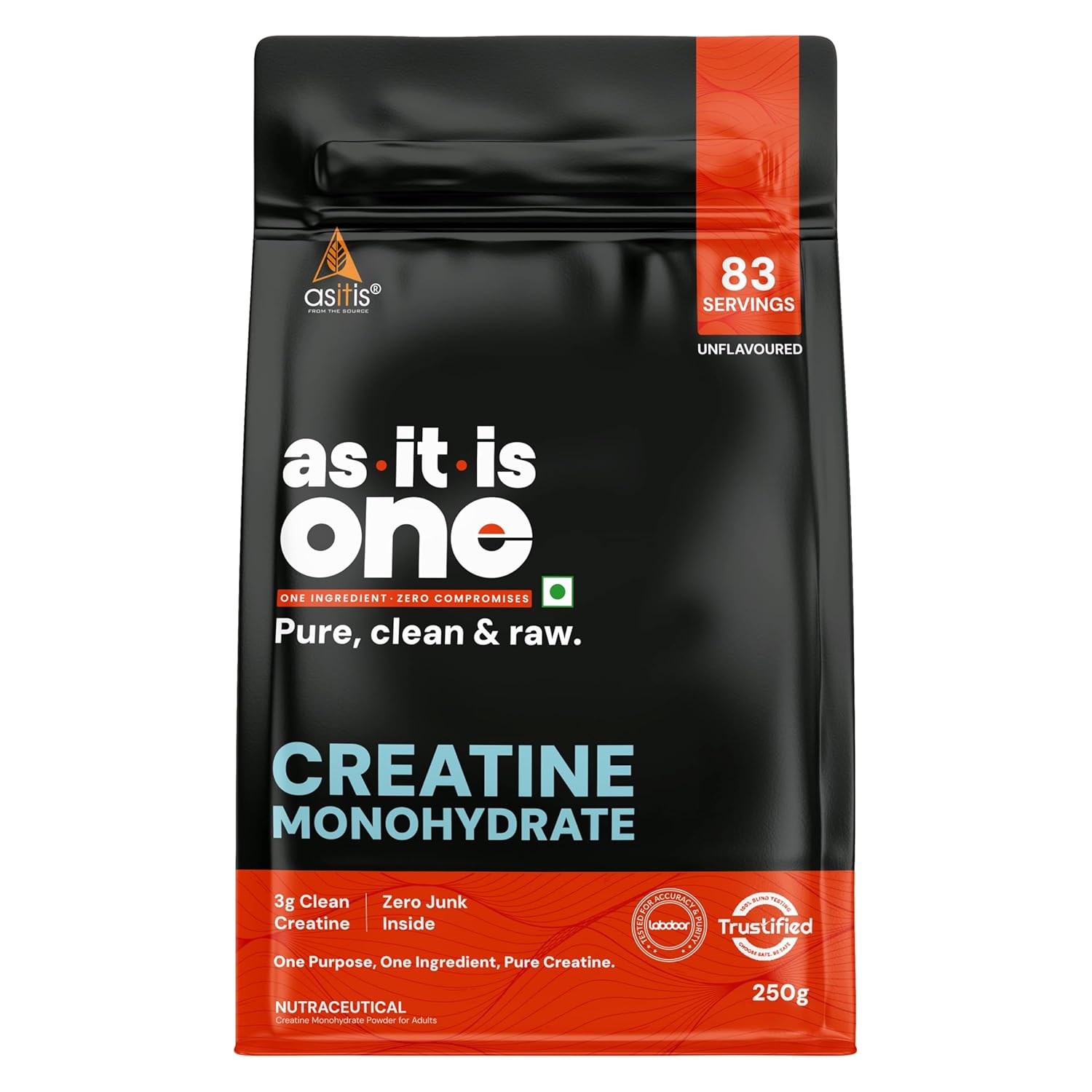
The one genuine caveat is the serving size. AS-IT-IS ONE scoops out at 3g per serve. The clinical evidence base for creatine — the 30 years of RCTs that established strength, power, and body composition effects — used 5g/day as the maintenance dose. At 3g, saturation happens, but more slowly. For buyers reading the label and following it as written, benefits will arrive — they will just take longer. The label should say this plainly. It does not. We will.
What AS-IT-IS ONE gets unambiguously right
Single ingredient: creatine monohydrate. Nothing else. Micronized particle size for improved dissolution. Unflavoured — stacks into anything. Labdoor certified for label accuracy and purity. Trustified QR code on every pouch — scannable at purchase to verify batch authenticity. GMP-certified manufacturing facility. Zero additives, fillers, artificial colours, or preservatives. FSSAI licensed. Vegan. Gluten-free. Soy-free. Dairy-free. At ₹549–649/250g the value score is the highest in its category — nothing certified at this level costs less per gram in India.
How creatine monohydrate works — the most replicated ergogenic in sports nutrition
Creatine is a naturally occurring compound synthesised from three amino acids: arginine, glycine, and methionine — primarily in the liver, kidneys, and pancreas, at approximately 1–2g per day endogenously. An additional 1–2g/day typically comes from dietary meat and fish. Muscle tissue stores creatine in two forms: approximately 65–70% as phosphocreatine (PCr), and 30–35% as free creatine. Total intramuscular creatine in an average adult sits at roughly 120g — and habitual omnivorous dietary intake + endogenous synthesis maintains saturation at approximately 60–80% of this maximum. Supplementation pushes stores toward 100% capacity — this ~20–30% augmentation is the entire physiological basis for creatine's ergogenic effects.
The phosphocreatine–ATP resynthesis system
Skeletal muscle relies on adenosine triphosphate (ATP) as its immediate energy currency. During high-intensity, short-duration efforts — a heavy squat, a sprint, a plyometric jump — the ATP pool depletes in 2–3 seconds. The phosphocreatine system is the fastest pathway for regenerating ATP: the phosphate group from phosphocreatine is transferred to ADP (by the enzyme creatine kinase) to regenerate ATP. This reaction happens faster than glycolysis and far faster than oxidative phosphorylation. It sustains maximal-intensity effort for approximately 8–12 seconds. Mechanistic
Creatine supplementation effect on intramuscular phosphocreatine stores — Hultman et al., 1996
Secondary mechanisms beyond ATP resynthesis
Phosphocreatine resynthesis is not creatine's only mechanism. Three secondary pathways are well-supported:
Cellular volumisation: Creatine is an osmolyte. As intramuscular creatine concentrations rise, water follows osmotically — muscle fibres swell slightly. This cell swelling activates anabolic signalling pathways including IGF-1-mediated mTORC1 activation and muscle protein synthesis. This is distinct from the phosphocreatine energy system. Mechanistic
Satellite cell activation: Creatine supplementation combined with resistance training has been shown to increase myonuclear addition via satellite cell proliferation and fusion, expanding the DNA capacity for muscle hypertrophy over time. RCT
Cognitive function: The brain is a metabolically demanding tissue. PCr serves as a brain energy buffer in exactly the same way as in muscle — particularly relevant for sleep-deprived individuals or those under mental fatigue. Several RCTs have found creatine supplementation improves cognitive performance under sleep deprivation and reduces the performance decrement from mental fatigue. RCT This is a growing and increasingly well-evidenced application of creatine beyond sport.
Why Indian vegetarians see larger benefits
Vegetarian and vegan diets contain virtually zero dietary creatine — the primary food sources are meat and fish. A strict lacto-vegetarian Indian diet provides essentially 0g dietary creatine daily. The body's endogenous synthesis covers approximately 1–2g/day — but this only partially saturates muscle stores. Studies comparing vegetarians vs. omnivores on creatine supplementation consistently find that vegetarians show larger absolute increases in intramuscular creatine, larger strength gains, and larger cognitive improvements — because they are starting from a lower baseline (approximately 60% PCr saturation vs. 80% in omnivores). RCT For a vegetarian Indian athlete or fitness enthusiast, creatine may be the single highest-return supplement they can take — higher even than protein, since food sources can be compensated for, but dietary creatine cannot be replaced without supplementation if no animal protein is consumed.
What's in the scoop — every ingredient, mapped to what the evidence requires
| Component | Per 1 scoop (label) | Clinical reference dose | Assessment |
|---|---|---|---|
| Creatine monohydrate (micronized) | 3 g | 3–5 g/day maintenance; 20 g/day for 5–7 days (loading) RCT | 3g sits at the lower boundary of the evidence-based range. Adequate for saturation over 28–30 days — but users wanting faster effects or following the standard ISSN protocol should take 1.5–2 scoops daily. |
| Creatine source / raw material | Not disclosed | Creapure (AlzChem, Germany) is the reference standard; Chinese-origin creatine is widely used and generally passes purity tests but may contain trace contaminants (creatinine, dicyandiamide) at slightly higher levels | Labdoor certification verifies the finished product — it does not verify the raw material manufacturer or origin. AS-IT-IS does not claim Creapure. This is not a disqualifying gap — it is a transparency gap. |
| Additives / fillers | None | No additives needed in a pure creatine monohydrate powder | Zero additives. This is the correct formulation for creatine — any additive other than creatine monohydrate is unnecessary cost and complexity. |
| Flavour | Unflavoured | Unflavoured is preferred — allows stacking into any drink, food, or pre-workout without flavour conflict | Correct. Creatine monohydrate is tasteless and odourless in water — no flavouring agent is needed or desirable. |
| Micronization | Yes — micronized | Smaller particle size (200 mesh or finer) improves dissolution speed and reduces grit in solution | Correct. Micronized creatine mixes more completely into liquid than standard-ground creatine — relevant for the mild solubility limitations of creatine monohydrate (approximately 14g/L in cold water). |
| Calories | 0 kcal | N/A | As expected. Pure creatine monohydrate is neither a fat, carbohydrate, nor protein — it contributes zero calories per serving. |
The 3g serving size — the only meaningful issue with this product
The International Society of Sports Nutrition (ISSN) position stand on creatine recommends 3–5g/day for maintenance — with 3g at the lower boundary. Most foundational RCTs (Greenhaff 1993, Hultman 1996, Kreider 1998, and the meta-analyses building on them) used 5g/day as the standard maintenance dose after loading. At 3g/day without loading, full saturation takes approximately 30 days. At 5g/day without loading, saturation takes approximately 28 days. The practical difference between the two is marginal over 30 days. However, for the large subset of buyers who will use one scoop daily and expect the same timeline of effects as the 5g literature suggests — there is a difference. For vegetarians, where baseline PCr is approximately 60%, the gap narrows further because absolute store augmentation is larger regardless. Our recommendation: take 1.5–2 scoops (4.5–6g) for the first 28 days, then reduce to 1 scoop (3g) for maintenance.
Creapure vs. non-Creapure — what the raw material source actually means for safety and purity
What Creapure is and why it matters
Creapure is the brand name for creatine monohydrate manufactured by AlzChem Trostberg GmbH in Bavaria, Germany. It is synthesised via a patented process using sarcosine and cyanamide under tightly controlled conditions. Creapure consistently tests at ≥99.9% pure creatine monohydrate, with extremely low levels of the two primary process contaminants — creatinine (the metabolic breakdown product) and dicyandiamide (DCD, a synthesis byproduct). The Creapure quality seal is backed by AlzChem's trademark licence contract, which actively pursues counterfeit claims.
Non-Creapure creatine — what we know
The vast majority of creatine monohydrate globally is manufactured in China, primarily in Hebei and Shandong provinces. This creatine is chemically identical when pure — creatine monohydrate is creatine monohydrate regardless of origin. The quality differences are not categorical: Chinese-origin creatine that passes Labdoor testing at finished-product level is safe and effective. The relevant distinction is in quality control consistency and traceability. Chinese creatine manufacturers vary significantly in their production standards — some match Creapure quality, others have higher impurity levels. Labdoor testing at the finished product level does verify purity within acceptable limits, but it tests one or a few batches, not every batch.
What Labdoor's certification actually covers for AS-IT-IS ONE
Labdoor tests for: creatine content accuracy (measured vs. label claim), creatinine levels (should be <1% of total creatine content), dicyandiamide (DCD — should be below 50ppm), heavy metals (Pb, Cd, Hg, As), and overall label accuracy. AS-IT-IS ONE passed Labdoor's testing standards. This is meaningful and the most independent verification available for a domestic Indian creatine brand at this price point. What it does not provide: per-batch testing (every batch), raw material country-of-origin certification, or the raw material traceability that Creapure's trademark licence provides. For everyday users, Labdoor certification is sufficient assurance. For competitive athletes requiring the highest possible supply chain documentation, Naturaltein Creapure or Thorne Creatine are the appropriate alternatives.
The Trustified QR code — India's strongest domestic batch authentication tool
AS-IT-IS ONE includes a Trustified QR code on every pouch. Scanning this code verifies the specific batch against Trustified's blockchain-backed authentication database — confirming that the product is genuine AS-IT-IS stock and not a counterfeit. Counterfeit protein and creatine in India is a documented problem in the unorganised retail channel. The QR verification is a practical tool that costs consumers nothing and provides a meaningful authenticity guarantee — particularly when buying from third-party Amazon sellers or local supplement shops. No other domestic creatine brand at this price point offers equivalent batch authentication infrastructure.
What 30 years of creatine research actually shows — endpoint by endpoint
Strength and power — the strongest evidence tier in sports nutrition
A 2025 systematic review and meta-analysis (Mazzuco et al., Nutrients, 17(17):2748; 53 RCTs) confirmed statistically significant improvements in upper-body and lower-body strength with creatine supplementation combined with resistance training across both younger and older adults, with effect sizes consistent with prior meta-analyses.
A 2024 meta-analysis (Wang et al., Nutrients, 23 RCTs, 509 participants) found a +4.4 kg improvement in upper-body 1RM strength and +11.35 kg in lower-body 1RM strength with creatine monohydrate + resistance training vs. resistance training alone (p < 0.001). These are large, clinically meaningful effect sizes — roughly equivalent to an additional 4–12 weeks of resistance training.
Muscle hypertrophy and lean mass
A systematic review and meta-analysis (Delpino et al., 2022, J Cachexia Sarcopenia Muscle; 22 RCTs, 721 participants) found an average lean mass increase of +1.37 kg (95% CI: 0.97–1.76 kg) with creatine combined with resistance training in adults over 50. In younger adults, a Burke et al. (2023, Nutrients, 10 RCTs by MRI/CT scan) found small but statistically significant increases in direct skeletal muscle hypertrophy measurements.
High-intensity performance beyond weightlifting
Creatine's phosphocreatine resynthesis benefit extends to any high-intensity, short-duration activity — not just resistance training. Vertical jump performance, repeated sprint ability (Wingate test), and cycling power output all show consistent improvements in meta-analyses. This makes creatine relevant for Indian athletes in cricket (fast bowling, batting power), kabaddi, athletics (sprints), and football — not only gym-based training.
Cognitive performance under fatigue
Rae et al. (2003, Proc R Soc B; n=45, double-blind RCT) found that 5g/day creatine supplementation for 6 weeks significantly improved measures of working memory and intelligence processing speed in vegetarians. RCT McMorris et al. (2007, Neuroscience) found significant improvements in cognitive performance under sleep deprivation with creatine supplementation. RCT The cognitive evidence is less consistent than the performance evidence in well-rested, omnivorous adults — but is more robust in vegetarians and sleep-deprived individuals.
Safety — the most robustly documented safety profile in sports supplements
The ISSN position stand on creatine (Kreider et al., 2017; updated guidance 2024) states that creatine monohydrate is the most scientifically supported ergogenic nutritional supplement available and is safe for long-term use in healthy adults. Over 500 peer-reviewed studies have not identified any clinically significant adverse effects at doses of 3–5g/day. The previously cited concerns about creatine and kidney function have been systematically investigated in multiple RCTs and meta-analyses — no evidence of harm has been found in individuals with healthy kidney function.
Creatine and kidney function — the context Indian buyers need
A common concern in Indian families is that creatine "damages the kidneys." This is based on a misunderstanding of creatinine — the breakdown product of creatine — which is elevated in serum during creatine supplementation and can superficially resemble markers used in kidney function testing. This elevation reflects increased creatine metabolism, not kidney damage. Long-term creatine supplementation studies (up to 5 years) in healthy adults show no markers of kidney dysfunction. The contraindication applies only to individuals with pre-existing kidney disease, in whom increased creatine metabolism may place additional load on already-impaired filtration. If you have a kidney condition — consult a physician. If you have healthy kidneys and no prior kidney history — the safety literature is unambiguous.
Labdoor certified + Trustified authenticated — the best documentation available from a domestic Indian creatine brand
| Test parameter | Standard | Status | Notes |
|---|---|---|---|
| Creatine content accuracy | ±5% of label claim | Labdoor verified — passes | Measured creatine content matches 3g label claim within acceptable tolerance |
| Creatinine level | <1% of total creatine (Labdoor standard) | Passes per Labdoor certification | Creatinine is the primary breakdown product — elevated levels indicate poor raw material quality or improper storage |
| Dicyandiamide (DCD) | <50 ppm (Creapure threshold); <100 ppm (general safety) | Passes per Labdoor certification | DCD is a synthesis byproduct. Labdoor screens for it — AS-IT-IS ONE passes. |
| Heavy metals (Pb, Cd, Hg, As) | Labdoor / California Prop 65 limits | Passes per Labdoor certification | No heavy metal concerns flagged in Labdoor testing history for AS-IT-IS creatine |
| Banned substance screen (WADA) | Informed Sport / NSF Sport | Not enrolled in Informed Sport or NSF | Labdoor does not screen against the WADA prohibited list. Competitive athletes in WADA-governed sports should use NSF Certified for Sport or Informed Sport creatine (e.g. Thorne, Klean Athlete) instead. |
| Batch-level QR authentication | Trustified blockchain-backed system | Yes — every pouch has a unique QR code | Scan the QR on receipt to verify batch authenticity — this is the most practical anti-counterfeiting tool available from any domestic Indian supplement brand. |
| Per-batch COA publicly available | Best practice (Transparent Labs, Nordic Naturals standard) | Not publicly posted | Trustified QR provides batch authentication — it is not equivalent to a full COA listing creatine assay, contaminant levels, and analytical lab name. A public COA would elevate confidence further. |
| GMP manufacturing | Good Manufacturing Practice | Yes — GMP-certified facility | Manufacturing facility has GMP certification. This is process-level quality assurance — not product-level testing. |
Competitor testing transparency comparison
| Brand / Product | Labdoor? | Creapure? | Public COA? | Informed Sport? | India price (5g dose) |
|---|---|---|---|---|---|
| AS-IT-IS ONE (this product) | Yes ✓ | No | Trustified QR only | No | ~₹13 / 5g dose (at ₹2.6/g) |
| Naturaltein Creapure | No | Yes ✓ | Quality seal on pack | No | ~₹37 / 5g dose (at ₹7.3/g) |
| GNC Pro Performance Creatine | Partial (older test) | Yes ✓ (Creapure) | No | No | ~₹11 / 5g dose (at ₹2.2/g) |
| Nakpro Micronized Creatine | No | No | Trustified QR | No | ~₹11 / 5g dose (at ₹2.2/g) |
| Thorne Creatine (import) | No | Not stated | Yes — lot searchable ✓ | NSF Certified for Sport ✓ | ~₹140 / 5g dose (at ₹28/g) |
Who actually needs creatine in India, what dietary sources provide, and the honest ₹ comparison
Dietary creatine context in India
Creatine occurs naturally in animal muscle tissue — the only meaningful dietary sources are meat and fish. Relevant Indian food sources: mutton (approximately 3.5g creatine/kg), chicken breast (approximately 3.4g/kg), beef (approximately 4.5g/kg), hilsa fish (approximately 3.5g/kg), tuna (approximately 4g/kg), sardine (approximately 4.5g/kg). A typical non-vegetarian meal containing 150g of chicken provides approximately 0.5g dietary creatine — approximately 10% of the daily supplementation dose. Even heavy omnivorous intake covers only 1–2g/day in the most optimistic scenario. Supplementation fills the gap to saturation.
For India's large vegetarian and vegan population — approximately 30–40% of adults, with state-level figures ranging from <5% (Meghalaya) to over 60% (Rajasthan, Gujarat, Haryana) — dietary creatine intake is functionally zero. This makes creatine one of the very few supplements where there is a genuine population-specific nutritional rationale for vegetarians in India, distinct from general performance supplementation.
₹ pricing table — India creatine market 2026
| Brand | Form | Price (India) | ₹ / gram creatine | ₹ / 5g clinical dose | Key certification |
|---|---|---|---|---|---|
| AS-IT-IS ONE Creatine (this) | Micronized monohydrate | ~₹649 / 250g | ₹2.6 | ₹13 | Labdoor · Trustified |
| Nakpro Micronized Creatine | Micronized monohydrate | ~₹860 / 400g | ₹2.2 | ₹11 | Trustified QR |
| GNC Pro Performance Creatine | Creapure monohydrate | ~₹549 / 250g | ₹2.2 | ₹11 | Creapure ✓ |
| Naturaltein Creapure | Creapure monohydrate | ~₹1,099 / 150g | ₹7.3 | ₹37 | Creapure ✓ |
| MuscleBlaze CreaPRO | Creapure monohydrate | ~₹899 / 300g | ₹3.0 | ₹15 | Creapure ✓ |
| Transparent Labs Creatine (import) | Micronized monohydrate | ~₹3,499 / 30 servings | ₹23 | ₹117 | NSF Certified for Sport ✓ |
AS-IT-IS ONE sits in the best value tier alongside Nakpro and GNC. At ₹13 per clinical 5g dose with Labdoor certification, it is the only product that combines both lowest cost and independent testing verification in the same SKU. The Creapure premium (Naturaltein at ₹37/dose, MuscleBlaze at ₹15/dose) buys raw material traceability. Whether that traceability is worth a 3–5× cost premium is a personal decision — the clinical outcome at matched dose will be identical.
AS-IT-IS ONE against four alternatives at different price points and certification levels


Full category: Best Creatine Monohydrate in India 2026 — all ranked → | Creatine Monohydrate — full ingredient entry with mechanism and dosing → | Should you load creatine? 27 trials reviewed →
Buy / consider alternatives
Buy if
- You want the most cost-efficient Labdoor-certified creatine in India — nothing verified at this level costs less per gram
- You are vegetarian or vegan — creatine monohydrate is synthesised from non-animal precursors and contains no animal products; AS-IT-IS ONE is explicitly vegan
- You train recreationally (2–4×/week) and want the ergogenic benefits of creatine at the lowest possible ongoing cost
- You want a zero-additive product that stacks cleanly into any pre-workout, protein shake, or morning routine without flavour conflict
- You want Trustified QR authenticity verification — particularly relevant when buying from Amazon third-party sellers or local supplement shops
- You are an older adult (50+) where creatine has strong evidence for muscle mass preservation and cognitive function alongside resistance training
Consider an alternative if
- You are a WADA-governed competitive athlete (Olympic sports, tested professional leagues) — Thorne Creatine (NSF Certified for Sport) or Klean Athlete Creatine are the appropriate products with banned substance screening
- You want Creapure raw material traceability with its unique quality seal and AlzChem licence assurance — GNC Pro Performance or Naturaltein Creapure at matched or lower cost per dose
- You want to take one standard 5g scoop without measuring — GNC or MuscleBlaze come with a 5g scoop; AS-IT-IS ONE's 3g scoop requires 1.5–2 scoops for the clinical maintenance dose
- You want a publicly posted per-batch COA with full analytical data — no domestic Indian creatine currently provides this; Transparent Labs (import) does at 10× the cost
How to use AS-IT-IS ONE Creatine — India-specific guidance
Dose: Use 1.5–2 scoops (4.5–6g) daily for the first 28 days, then 1 scoop (3g) for ongoing maintenance. You do not need a loading phase — though a loading phase (4 × 5g = 20g/day for 5–7 days) will saturate stores faster if you want quicker results. Timing: Irrelevant — take it at any consistent time daily. The evidence for post-workout as the "optimal" window is weak. Habit consistency matters more than timing precision. Mixing: Add to 200–300ml of water, a protein shake, or any beverage. Creatine monohydrate is mildly soluble in cold water — stir for 30 seconds or use warm water for faster dissolution. It will not fully dissolve in cold water and may appear slightly turbid — drink immediately. Hydration: Increase water intake modestly during the first week — creatine draws water into muscle cells and mild increase in total body water is expected. This is the mechanism, not a side effect. Drink an extra 400–500ml daily.
Three specific improvements that would push this product to a 9.0+
Add a 5g scoop — or clearly state "use 1.5–2 scoops for clinical maintenance dose" on the label
This is the most important improvement. Every credible creatine reference — the ISSN position stand, Kreider et al. 2017, the 2024 meta-analyses — recommends 3–5g/day with 5g as the standard. A 3g scoop is defensible as a minimum but it is not what most creatine research was built on. Users who read the label and take one scoop daily will saturate stores — eventually — but the effect sizes from the literature they will have read assume a 5g dose. Adding a 5g scoop, or printing "Take 1.5 scoops (4.5g) daily for best results" on the label, closes this gap at zero product development cost. It costs one line of copy. AS-IT-IS is a transparency-first brand — this specific omission is inconsistent with that identity.
Disclose the raw material manufacturer and country of origin
AS-IT-IS ONE discloses every operational quality credential — Labdoor, Trustified, GMP — but remains silent on where the creatine monohydrate raw material comes from. Creapure is not the only quality option — Chinese-origin creatine from reputable manufacturers (e.g. Skystone, Shandong Yasin Biological) consistently passes quality testing. But "we source from [Manufacturer], [Country]" is a disclosure that costs nothing and meaningfully increases trust. Competitors like Naturaltein specifically trade on "Made from Creapure — Made in Germany" as a differentiator. AS-IT-IS could counter this by naming their own vetted supplier. Transparency about raw material origin is the next logical step for a brand that has already committed to transparency in all other dimensions.
Publish a public per-batch COA with full analytical data
The Trustified QR code is a good start — it authenticates the batch as genuine AS-IT-IS product. What it does not provide is a full Certificate of Analysis: the creatine assay result, creatinine percentage, DCD level, heavy metal readings, and the name of the accredited laboratory that conducted the testing. Labdoor certification covers the product but does not publish granular per-batch analytical data publicly. A COA portal — similar to Transparent Labs' lot-number searchable system — where buyers can verify the full analytical profile of the specific 250g bag they received would be transformative for consumer trust. This is achievable: NABL-accredited labs in India (including those AS-IT-IS likely already uses for Labdoor testing) can generate this data. Publishing it publicly is an editorial and website decision, not a science or cost barrier.
References & citations
- Hultman E et al. (1996). Muscle creatine loading in men. J Appl Physiol, 81(1):232–237. RCT — loading kinetics and PCr saturation rates at different doses.
- Harris RC et al. (1992). Elevation of creatine in resting and exercised muscle of normal subjects by creatine supplementation. Clin Sci, 83:367–374. RCT — foundational PCr augmentation study.
- Burke DG et al. (2003). Effect of creatine and weight training on muscle creatine and performance in vegetarians. J Strength Cond Res, 17(1):38–43. RCT — vegetarian baseline PCr and differential response.
- Kreider RB et al. (2017). International Society of Sports Nutrition position stand: safety and efficacy of creatine supplementation. J Int Soc Sports Nutr, 14:18.
- Mazzuco A et al. (2025). The effects of creatine supplementation on upper- and lower-body strength and power: a systematic review and meta-analysis. Nutrients, 17(17):2748.
- Wang L et al. (2024). Meta-analysis: creatine + resistance training in adults under 50. Nutrients, 23 RCTs, 509 participants. +4.43 kg upper-body, +11.35 kg lower-body 1RM.
- Delpino FM et al. (2022). Creatine supplementation and muscle strength in older adults: systematic review and meta-analysis. J Cachexia Sarcopenia Muscle; 22 RCTs, 721 participants.
- Burke R, Piñero A et al. (2023). Effects of creatine supplementation on hypertrophy measured by MRI/CT: systematic review and meta-analysis. Nutrients, 15(9):2116.
- Rae C et al. (2003). Oral creatine monohydrate supplementation improves brain performance: a double-blind, placebo-controlled, cross-over trial. Proc R Soc B, 270(1529):2147–2150. RCT — cognitive effects in vegetarians.
- McMorris T et al. (2007). Creatine supplementation and cognitive performance under sleep deprivation. Neuroscience, 149(3):537–549. RCT
Not medical advice. Creatine monohydrate is safe for healthy adults at 3–5g/day based on extensive long-term research. Individuals with pre-existing kidney or liver disease, those taking nephrotoxic medications, or pregnant and breastfeeding women should consult a physician before starting creatine supplementation. The kidney safety concern in the general population is not supported by the evidence — but individual medical contexts vary.